Adhyatma: Spirituality — What it Truly Means
16 Mar 2026

The First Question
Long before I encountered any text or teacher, long before I knew what “Spirituality” as a word meant, there was simply a question.
I must have been eight years old, too young to understand vocabulary like “Adhyatma” or “Atman”( which we now loosely call as soul), but old enough for a question to make a strange, silent turn in my mind.
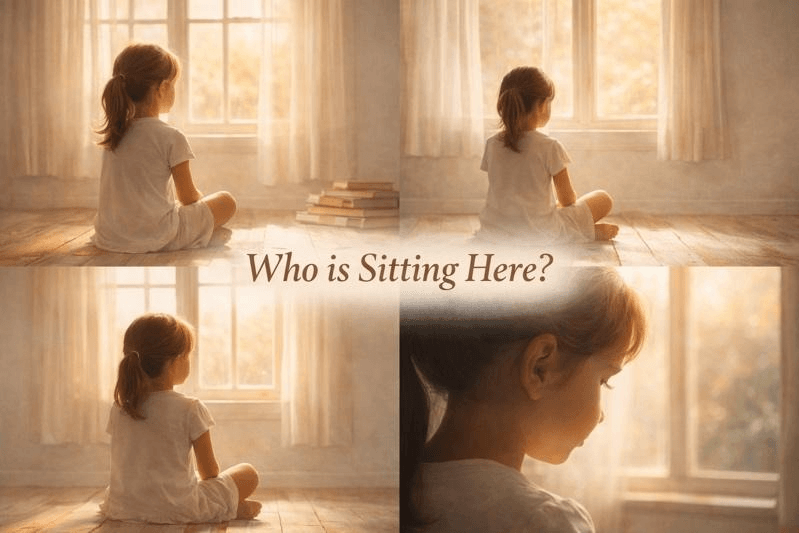
I sat in the quiet corner of my room, a space ordinary by all external standards, a bed, a window, a few books scattered about and suddenly I noticed “something noticing”.
It wasn’t a feeling of calm or curiosity or fear. It was nothing less than the simple recognition and a shock to my system for the first time – I was aware of ‘me’ sitting .
And that awareness turned, unbidden, inward and asked: “Who is sitting here?”
There was no immediate answer; and yet the question opened something vast.
Not excitement.
Not a doctrine.
Not an idea.
Just the undeniable presence of something that was aware before I even understood what awareness was.
It wasn’t curiosity about toys or trees or school.
It was a question without a known object, a question that didn’t point outward to the world but inward to the very centre of experience.
What Spirituality is Not
In English I had no vocabulary for it. “Spirituality” was a word adults sometimes used to refer to kindness, prayer, thinking positive or good feelings.
‘Styay’
In the Indic tradition, this form of inquiry has a name:
In sanskirt we called Spirituality - Adhyatma (अध्यात्म)
It doesn’t mean “spiritual” in a watered-down sense of mood or momentary bliss.
It is not comforting.
It is not soothing.
It is not immediately uplifting.
It is unsettling. Electric. Precise.
It is freedom and All knowing.
It means truth-seeking at the deepest level of being and knowing yourself and the universe within to understand the functioning of the multiverses outside.
It is an unflinching investigation into the nature of reality and the nature of self - an inquiry that refuses to be satisfied with appearances, stories, or explanations borrowed from others.
Western languages, and even much of contemporary discourse often use the word spirituality to signify wellbeing, comfort, mindfulness, or transcendental experience.
There is nothing inherently wrong with these uses, but they are not the territory into which my question pointed.
My experience - there was no invited calm; there was only a sudden exposure to presence itself.
I had not yet learned the Indian terms Atman or Adhyatma, but my inner sense intuitively grasped what the tradition later named.
Adhyatma: Spirituality, The Study of the Self
In the Indic tradition, this form of inquiry has a name: Adhyatma (अध्यात्म).
Atman refers to the innermost Self.
Adhyayana means study or disciplined inquiry.
Adhyatma, then, is not “spirituality” in the diluted modern sense.
It is the study of the Self.
Not as belief.
Not as theology.
Not as philosophy alone.
But as direct investigation.
It is truth-seeking at the deepest level of being.
An uncompromising inquiry into the nature of self and reality, refusing borrowed explanations or inherited assumptions.
It is not about constructing identity.
It is about dismantling it.
Question Stayed:
After that first question, life did not immediately become peaceful in an Instagram-worthy way. But the question stayed.
It resonated through school days, examinations, confusion, joy, disappointment, love, loneliness, and every inner landscape of adolescence and early adulthood.
It was never a problem to be solved. It was a constant resonance, like a subtle chord that would be heard more clearly as I learned silence began not when noise ended, but when identification ceased.
When Language Met Experience
When I finally engaged with Indian philosophical texts later in life, I encountered words like Adhyatma, Atman, Aparoksa Jnana, Viveka and Nyaya.
These were not foreign metaphors or poetic abstractions, they were verbal maps that pointed to the same terrain I had begun traversing in silence long ago.
But learning those words didn’t make the journey easier. They didn’t give me answers or quick illumination.
What they did was help me recognise what was already happening within me - the direction of my own attention, the ground on which my first question stood.
How Do We Actually Do This Inner Inquiry?
To make sense of how this enquiry actually unfolds, it helps to break it down with clarity, away from technicality but without losing depth.
1. Atma -The Witness of the experience:
The word ātman refers to what Indian thought calls the Self — not the ego, not personality, not memory, not thought, but the one who is aware of all these.
The never changing, the essence that can’t be changed or destroyed. “I” you refer to in everyday life is not the “I” that simply notices the world. The core of your being is awareness itself ,the knower of all experiences. This is not an abstract theory, but something that becomes directly evident in moments of quiet attention.
In my own life, this shift didn’t happen through effort or willpower.
It happened when I began to notice that thoughts, sensations, and emotions appear and disappear, but there is always a constant, witnessing presence underlying them, the silent observer of experience.
2. Viveka – The Power of Discernment :
Once that recognition begins to stir, the next task is to learn to discern to distinguish between what is fleeting and what is constant, between the stories our minds tell and the background of awareness where those stories appear.
The Sanskrit term for this clear discrimination is “Viveka”.
It means not just thinking about things, but learning to see the difference between the mind’s noise and the silent clarity that underlies it.
3. Aparokṣa Jyana - Direct Knowledge, Not Conceptual
The tradition makes an important distinction:
- Conceptual knowledge is indirect.
- Direct knowledge is immediate.
Aparokṣa Jnana means knowledge that is not second-hand.
In my own life, this shifted everything: it wasn’t enough to read about Self or to agree with a philosophical claim.
What has mattered and what Indian insight points to is direct recognition in experience.
This kind of knowledge doesn’t come from memorizing arguments or collecting comforting ideas, it comes from Inquiry and courage to stay in that inquiry.
4, Nyaya — Reasoned Inquiry as a Support
Indian philosophy never dismissed reason.
Many classical Indian systems of thought, especially Nyaya, emphasise reason and logic as tools for investigation not to build barriers between thought and reality, but to clear away confusion.
Nyaya examines how we know what we think we know, through perception, inference, and careful distinction not to arrive at belief, but to refine the clarity with which we see what is true.
It is to prevent self-deception.
To ask:
What do I actually know?
And how do I know it?
Reason becomes a support — not an obstacle — to clarity.
So how does all this actually happen in life?
Not in grand revelations or dramatic experiences, but in subtle shifts that take place when attention begins to turn away from the world of objects toward the source of all knowing.
In my early years, it didn’t happen because I repeated formulas. It happened because — again and again — that original question came back:
“Who is aware right now?”
And instead of looking outward for an answer, I held the question in awareness itself.
When the mind tries to answer with a story, you trace that story back to the one who knows the story.
This process; repeatedly returning attention to the source rather than the content - is what Indian thought calls self-inquiry (in Sanskrit, atma-vichara).
Closing reflection
The words — Adhyatma, Atman, Viveka, Aparoksa Jnana are only signposts. They matter, but only because they point.
The real work happens in silence.
Not the silence of absence, but the silence in which awareness recognises itself.
The question that began in childhood still echoes, not demanding an answer but inviting attention.
Who is aware?
The Indic tradition does not ask us to become something else.
It asks us to look carefully at what we already are.
Adhyatma is not an escape from the world, nor is it a performance of depth. It is the steady, sometimes uncomfortable, often humbling act of turning attention toward the one who is aware, again and again until the layers of assumption thin out.
Share

Aanshul Bafnaa 'ModMonk'
Business psychologist, spiritual coach, healer, hypnotherapist, teacher
Aanshul Bafnaa, also known as ModMonk or “Modern Monk”, is a business psychologist, spiritual coach, healer, hypnotherapist, teacher, and mystic with over 17 years of experience in bridging the gap between modern corporate life and spirituality. Aanshul is certified in hypnotherapy, yoga, Vedic sciences, and business psychology, offering 1:1 coaching, corporate training, and group workshops that blend Vedic literature, Upanishads, and scriptures with modern psychology and management. Having worked in both corporate boardrooms and spiritual environments, she helps individuals, corporates, and educational institutes navigate modern life challenges using the Indian Knowledge System (IKS).
Aanshul is the founder and CEO of The ModMonk Consultancy, through which she conducts corporate training on mythology, leadership, workspace spirituality, meditation, emotional intelligence, work-life balance, communication, self-awareness, and Indic knowledge for modern management. She is the visiting faculty member at multiple institutions, including The Flame University and Symbiosis Centre for Corporate Education, where she trains MBA students and corporate professionals in areas such as business communication, business etiquette, leadership, and diversity. She is also a mentor at MICA (The School of Ideas), where she offers guidance and coaching to students and professionals.