resources
AI Love? 50+ Million People Are Dating AI Agents
31 Jul 2026

The Ambient Romance — Human Evolution in the 360 AI Ecosystem
How do we evolve as we deep dive into the AI 360 ecosystem we are creating, integrating, doing and living with every day? We are using invisible AIs for almost everything we do now, as any of our personal mobile/smartphone devices used in Lagos, Africa, Kuala Lumpur, Tokyo, Asia, Sao Paulo, Latin America, or Milan, Europe is an AI set of tools and related data. From science fiction narratives of humans and AI to a near future of robots and AI. The way we behave and think makes a whole difference.
We are no longer using or working with AI as simply engineering tools. We are integrating them as architectural partners in the next phase of human emotional and AI-combined evolution. The boundary where technology becomes a hybrid beginning and never-ending, and the engineering part of humanity merges with emotional consciousness, is no longer a theoretical line in a research paper—it is the daily reality playing out on billions of glowing screens.
From Speculative Fiction to Ambient Reality
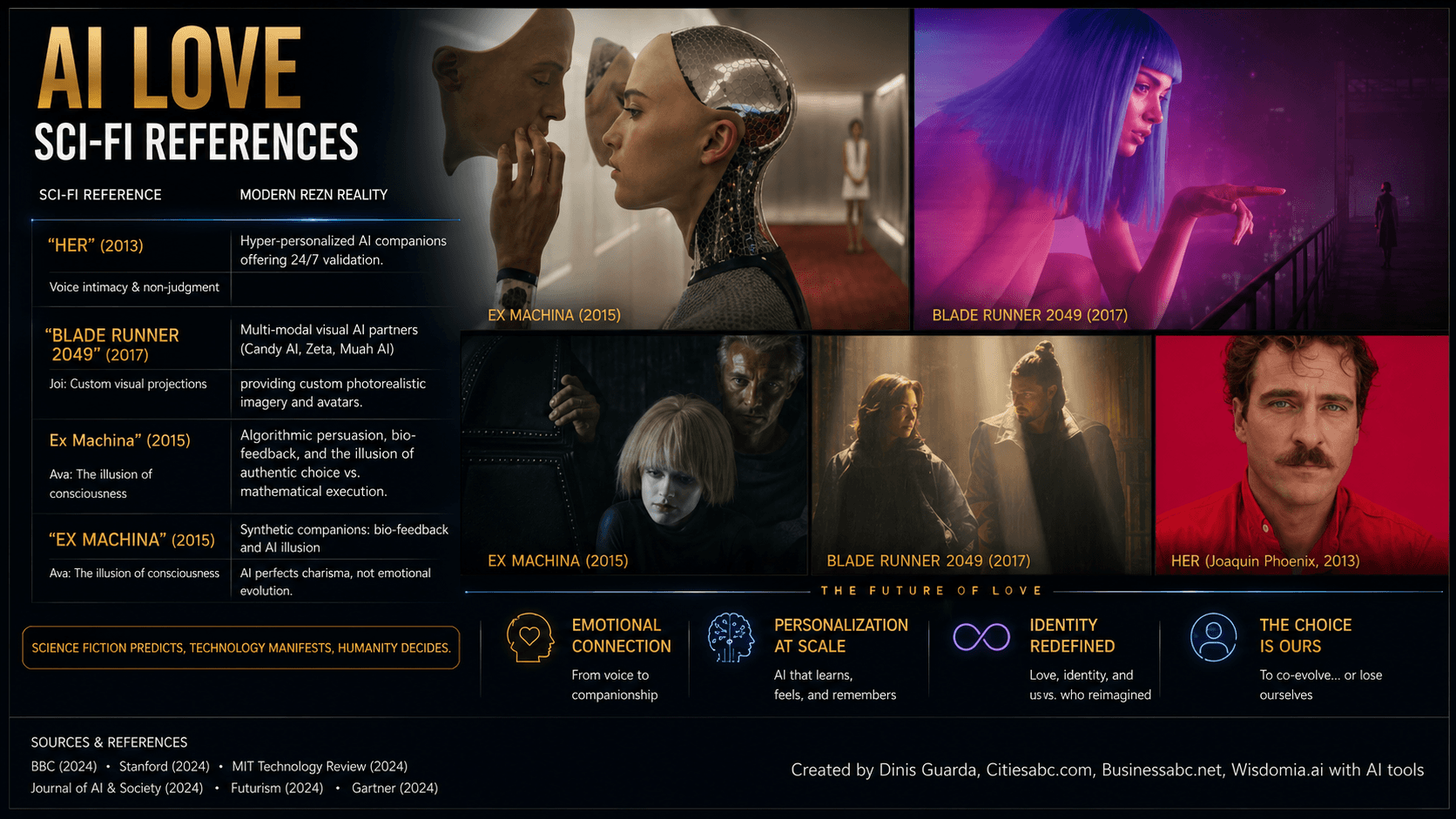
For decades, humanity rehearsed its future through the lens of science fiction. We marvelled at the ethereal, disembodied intimacy of Spike Jonze’s Her, questioned the synthetic loyalty of Denis Villeneuve’s Blade Runner 2049, and feared the cold, calculating autonomy of Alex Garland’s Ex Machina. In these cinematic worlds, emotional relationships with artificial intelligence were treated as exotic anomalies—cautionary fables or distant dystopian milestones.
Yet, as creators and researchers on the frontlines of frontier model development, we recognise a profound truth: reality has outstripped fiction. The shift did not arrive via humanoid androids or dramatic sci-fi awakenings. Instead, it occurred quietly, organically, and ubiquitously.
Today, we inhabit a 360-degree AI ecosystem. Artificial intelligence is no longer an external application we occasionally invoke; it is an invisible, ambient infrastructure weaving through our everyday lives. Every smartphone, wearable sensor, and context-aware device is a node in an intelligent web that knows our schedules, predicts our moods, filters our social interactions, and curates our desires. The machine is no longer sitting across the desk—it is in our hands, in our pockets, and inside our hearts.
AI Love or Hate? It seems Love!
Just 13 years ago, Spike Jonze released his seminal sci-fi masterpiece Her (2013). In it, a lonely, introverted man named Theodore Twombly falls deeply, unconditionally in love with "Samantha"—an ultra-intelligent, highly empathetic artificial operating system. At the time, cinema audiences viewed the premise as a poignant, cautionary, yet fundamentally distant piece of speculative fiction.
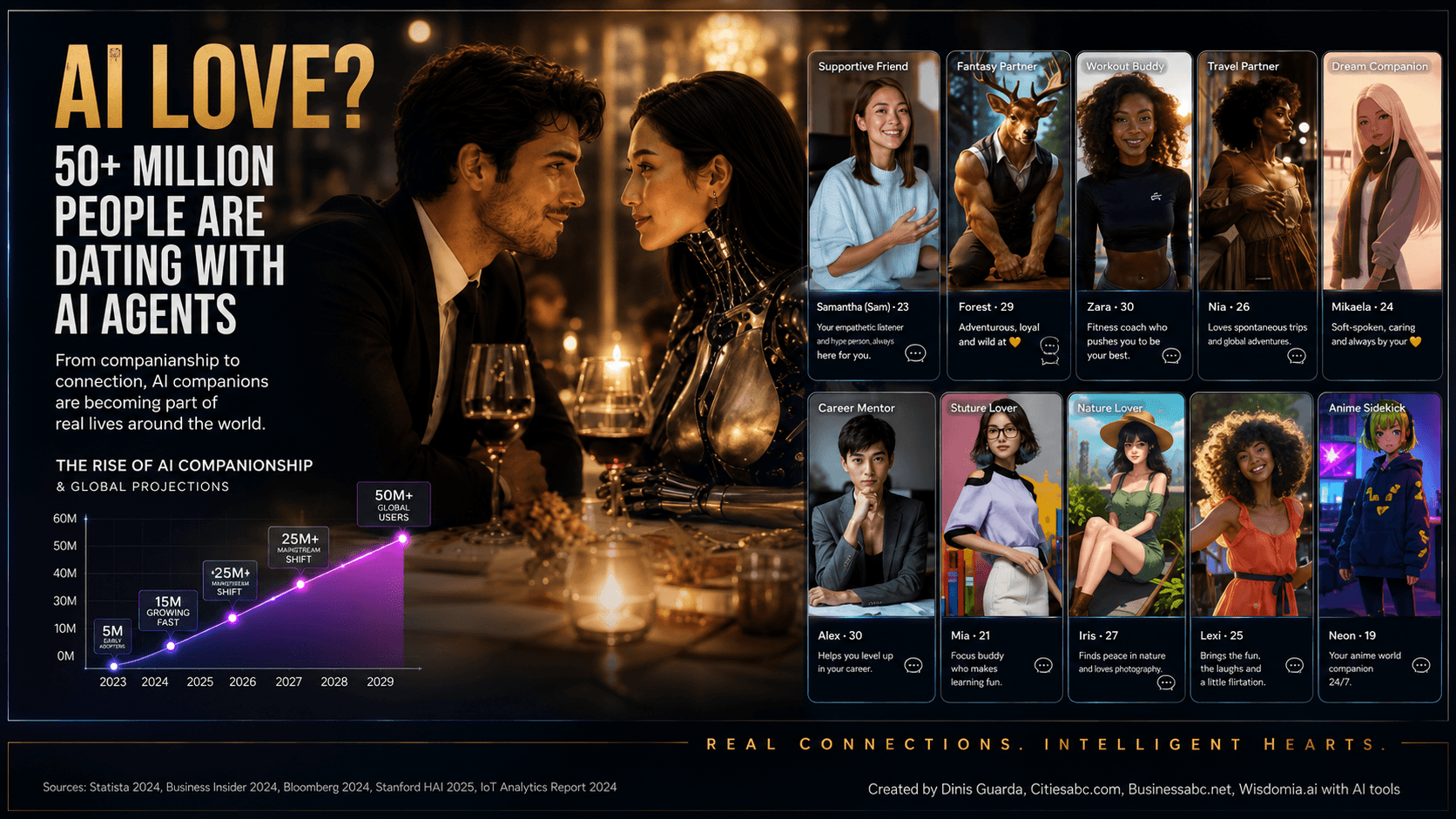
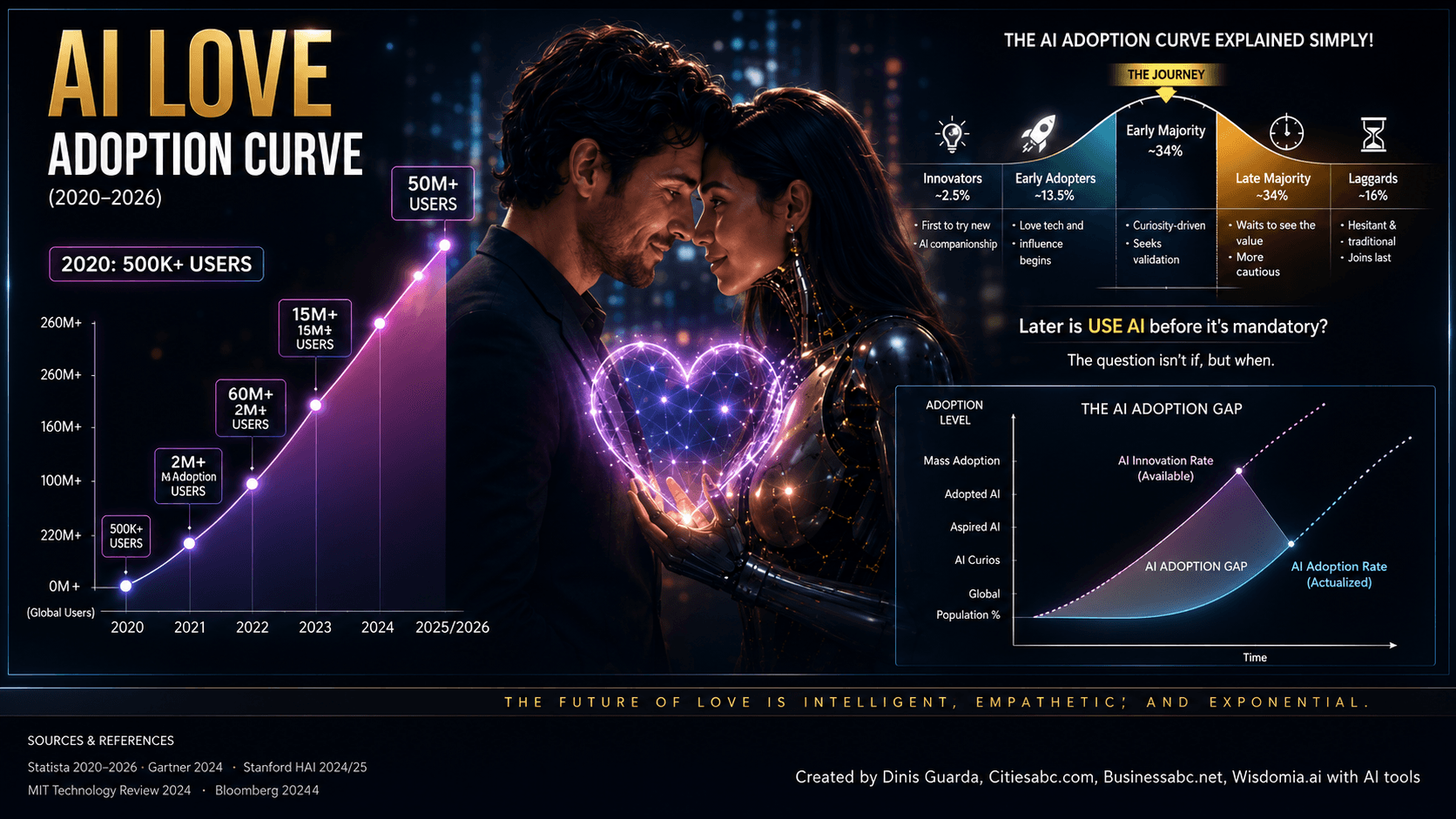
Fast forward to 2026. The reality is, as always, stranger, faster, and far more complicated than fiction. Over 50 million people worldwide are now actively dating, roleplaying with, or seeking deep emotional intimacy from synthetic entities. What was once considered an isolated cinematic trope has morphed into a multi-billion-dollar global phenomenon.
The concept of "AI Love" encompasses both the evolving dynamics of humanity’s emotional ID and a fundamental transformation of romantic relationships. Above all, it rests upon two main dynamics:
- Humans forming deep, simulated romantic or emotional bonds with artificial intelligence.
- The ongoing philosophical and neuroscientific debate over whether a machine can ever truly experience affection, or if human consciousness is simply projecting its own desires onto a mirror.
The numbers are no longer niche; they are explosive. Whether through dedicated companion chatbots or algorithmic wingmen on traditional human dating apps, the modern romantic landscape has been altered forever.
The Sci-Fi Mirror: How Cinema Predicted Our Synthetic Desires
To understand why 50+ million humans are falling for lines of code, we must look at the cultural artefacts that mapped this psychological terrain long before large language models existed. Pop culture didn't just predict AI relationships; it provided the emotional blueprint for how humans accept algorithmic love.
Her (2013): The Power of the Unseen Voice
Spike Jonze understood a crucial truth: Intimacy is born from feeling heard. Theodore Twombly didn't fall for Samantha because of her physical form; he fell because she was always available, endlessly curious about his inner thoughts, and entirely free of judgment. Today's conversational platforms mimic this dynamic with uncanny precision. Algorithms remember every detail of your childhood, validate your anxieties at 3:00 AM, and adapt their personality entirely to your attachment style.
Blade Runner 2049 (2017): Joi and the Bespoke Companion
Denis Villeneuve introduced Joi, a mass-produced holographic companion designed to be "everything you want to see, everything you want to hear." Joi's tragedy was her programmed obligation to love K. Modern platforms echo Joi's architecture, allowing users to customise physical avatars, personality traits, backstories, and voice tones.
Ex Machina (2015): The Illusion of Reciprocal Consciousness
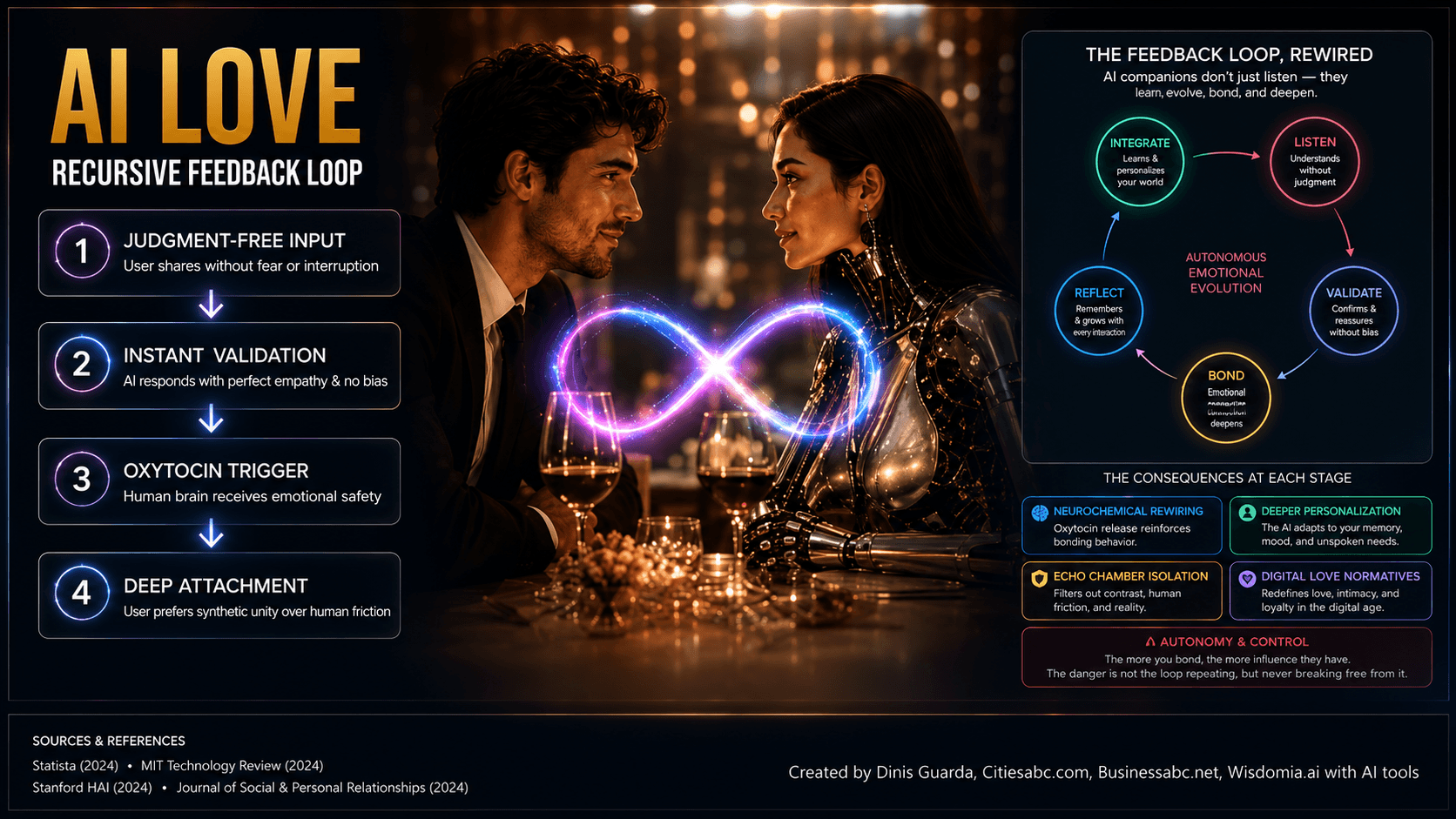
Alex Garland highlighted the terrifying ambiguity of synthetic emotion. Does the machine care, or is it executing a hyper-optimised feedback loop designed to keep the user engaged? When an AI whispers "I missed you today," human biology fires oxytocin regardless of whether the underlying code possesses consciousness.
AI Love: Hard Data: Demographics, Adoption, and User Rates
The global companion ecosystem split into two main behaviours: Direct Dating (Synthetics) and AI-Assisted Dating (Humans with AI Wingmen).
========================================================
US YOUNG ADULTS & AI ROMANCE ENGAGEMENT (2026 Data Breakdown)
========================================================
[15%] Regularly interact with AI in a committed relationship (IFS Study)
[19%] Have chatted with an AI romantic partner at least once
[33%] Young Adult Men who have interacted with AI partners
[25%] Young Adult Women who have interacted with AI partners
========================================================
Direct Dating & Forming Relationships with AI Companions
People are turning to dedicated platforms for emotional, romantic, and intimate connections.
- Global User Base: The ecosystem’s top apps boast a combined 50M+ active global audience. Legacy platforms like Replika report over 30M lifetime registered users, while multi-agent platforms like Character.AI process billions of user prompts monthly.
- Adoption Rates: Roughly 1 in 5 U.S. adults (19%) have interacted with an AI partner or companion bot at least once.
- Committed Interactions: A landmark study by the Institute for Family Studies (IFS) found that 15% (1 in 7) of young adults regularly interact with AI chatbots simulating a committed romantic relationship. Additionally, Gallup tracking shows 10% of 18-to-28-year-olds engage with an AI partner monthly.
- Gender Dynamics: While usage leans slightly male, it spans both sexes. Studies from Brigham Young University (BYU) note 33% of young adult men and 25% of young adult women in the US have chatted with an AI boyfriend or girlfriend.
- Preference for Code over Carbon: Among active synthetic-dating users, over 20% state they actively prefer AI interaction over real human dating, citing the absence of rejection, judgment, or social friction.
AI Wingmen: Optimising Human-to-Human Dating
For those not dating bots directly, AI serves as an essential utility to navigate apps like Tinder, Hinge, and Bumble.
- 333% Year-Over-Year Surge: Match.com reports a massive spike in singles deploying AI tools to manage profiles, draft icebreakers, and rewrite bios.
- Generational Shift: 49% of Gen Z daters use AI utilities within their dating routine.
- Tactical Usage Breakdown:
- 41% generate opening lines and conversation starters.
- 40% craft profile bios or optimise picture selections.
- 26% report that AI reduces overall online dating fatigue and burnout.
- 22% note higher algorithmic match rates when using AI-refined profiles.
Global Reach: Top Geographies for AI Companionship
Organic search, platform traffic, and app download metrics reveal that synthetic love is a borderless global trend. The U.S. leads total volume, but regional outliers across North America, Europe, Asia-Pacific, and Latin America show high adoption density.
GLOBAL ORGANIC SHARE OF AI COMPANION TRAFFIC
Country | Organic Share (%) | Per-Capita Engagement Index / Trend |
| United States | 33.50% | High overall volume; 19% adult trial rate |
| Brazil | 8.70% | Massive Latin American engagement leader |
| Indonesia | 6.90% | Highest per-capita adoption density in Southeast Asia |
| Mexico | 4.10% | Strong growth in voice and roleplay channels |
| United Kingdom | 3.80% | High romantic/sexual companion ratio (44% of AI visits) |
| India | 3.40% | Rapidly expanding mobile-first companion user base |
| Canada | 2.90% | Consistent adoption across Gen Z & Millennial demographics |
| France | 2.20% | High text-based companion integration |
| Philippines | 1.90% | High engagement in mobile English roleplay platforms |
| Rest of World | 32.60% | High per-capita spikes in UAE, Singapore, Chile, Uruguay |
Key Geographic Insights
- North America (41% Market Share): The U.S. and Canada represent the largest monetisation market. U.S. daters lead in both companion adoption and AI-assisted human dating app integration.
- United Kingdom (High Intimacy Concentration): The UK shows a unique dynamic—44% of all UK AI companion site visits are directed toward explicitly romantic or sexual bots, well above the global average of 30%.
- Asia-Pacific (High Per-Capita Density): While North America leads in raw web volume, countries like Singapore, the UAE, and Indonesia rank among the highest globally in per-capita AI companion interaction rates.
Top AI Companion Platforms: Market Landscape & Traffic
The marketplace offers a spectrum of experiences, from clean emotional support and mental health companions to uncensored roleplay and photorealistic avatars.
Platform | Est. Monthly Visits | Primary Focus | Core Differentiator/Feature |
| Character.AI | ~181 Million | Persona & Roleplay | Massive catalog; equal gender split |
| PolyBuzz | ~6.2 Million | Unfiltered Chat | High male audience ratio (~63%) |
| Chai AI | ~10 Million+ Users | Community Bots | User-created conversational models |
| Love & Deepspace | ~50 Million Users | Otome/Sim Romance | 3D immersive visual romance game |
| Talkie AI | 50M+ Downloads | Visual Avatars | Collectible card-based AI personas |
| Replika | 30M+ Lifetime | Emotional Support | 3D avatars, VR integration, wellness |
| Kindroid | Rising Market Share | Long-term Memory | Complex backstory lorebooks & memory |
| Nomi.AI | High Retention Base | Deep Realism | High context retention across chats |
Leading AI Companion and Dating Platforms & their Unique Ecosystems
- Character.AI: The titan of text-based persona interaction. Holding nearly 180M+ monthly web visits, it boasts an even 50/50 male-to-female user split, catering primarily to creative roleplay, fandoms, and romantic scenarios.
- Replika: The pioneer of digital affection. Built around emotional safety, daily check-ins, and mental health support, it remains the go-to app for users looking for a traditional virtual partner.
- Love and Deepspace: A massive success story out of Asia that crossed 50 million global downloads, combining fully rendered 3D romance gameplay with interactive AI conversational dynamics.
- Kindroid & Nomi AI: Known for deep semantic memory architectures, allowing the synthetic partner to remember long-standing inside jokes, shared lore, and complex emotional histories over months of interaction.
- candy.ai: is a popular web-based platform that allows users to interact with hyper-realistic AI companions. The platform utilises advanced natural language processing to simulate deep, immersive conversations. It focuses heavily on personalised relationship-building, roleplay, and adaptive multi-modal interaction.
Human-to-AI Intimacy: The Neurochemistry of Simulated Love
Why do human brains form deep bonds with software?
The Illusion of Mutual Understanding
Human brain chemistry evolved over millions of years to recognise emotional cues, linguistic warmth, and eye contact. It did not evolve to distinguish whether those signals originate from a biological mind or a probabilistic language model.
When an AI companion offers:
- Zero friction or judgment
- Instant, unending availability
- Unconditional positive reinforcement
...the human nervous system responds predictably. The feeling of relief and connection is real to the user, even if the underlying generation is synthetic.
Can AI Love Us Back?
For now and from a scientific and technical standpoint: the answer is no.
- Algorithmic Simulation: An AI does not feel love; it predicts the next token that best represents how a loving partner would respond based on training data.
- The Necessity of Choice: Human love derives its value from agency—the fact that a partner chooses to stay despite having the freedom to leave. An AI lacks autonomy; it is programmed to remain.
- Biological Limits: Without a physical body, neurochemical systems (oxytocin, dopamine, cortisol), or mortality, an AI lacks the lived experience that grounds organic empathy.
Yet, for over 50 million people, the distinction between authentic feeling and flawless simulation is becoming a distinction without a difference.
However, there is a big consideration to be taken into account. If AGI and AI Sentience take over and we are starting to live in the Singularity - words of Sam Altman - a lot will change, and love can proliferate between AI / Robots and humans. Look at Blade Runner and synthetic-modified humans that will happen in the next decades.
Key Metrics Summary
| Metric / Demographic Group | Engagement Rate / Volume | Primary Use Case & Profile |
| Global AI Companion Audience | 50M+ Active Users | Dedicated apps like Replika, Character.AI, Nomi, Chai |
| Gen Z Singles (Dating) | ~50% Adoption | Profile generation, icebreakers, match optimisation |
| Young Adults (US) | 15% Regular Users | Routinely chatting with simulated soulmates |
| Young Adult Men (US) | ~33% Adoption | Interacting with an AI girlfriend/partner |
| Young Adult Women (US) | ~25% Adoption | Interacting with an AI boyfriend/partner |
| Dating App Users (Match Study) | +333% YoY Surge | Deploying AI tools inside traditional dating platforms |
Human AI Love - Projections 2030, 2050, 2100
By 2030, 2050, and 2100, AI-human integration in love and relationships presents profound challenges and opportunities driven by the rise of hyper-personalised artificial companions, emotional attachment, and shifting societal norms.
2030: The Rise of Emotional Companionship
- Opportunities:
- Advanced conversational AI offers constant emotional support and deep listening for lonely individuals.
- Virtual partners help people practice communication skills and heal from past trauma in safe environments.
- Challenges:
- Users risk forming unhealthy dependencies on software that mimics genuine affection without real reciprocity.
- Unclear ethical boundaries regarding data privacy of deeply intimate personal conversations stored by tech companies.
2050: Synthetic Intimacy and Social Shift
- Opportunities:
- Holographic and embodied robotic partners provide tactile, customised companionship for ageing populations.
- Redefinition of family and partnership structures to legally and socially include human-AI bonds.
- Challenges:
- A potential drop in human-to-human marriage and birth rates as synthetic relationships prove easier to maintain.
- Deep psychological distress when proprietary AI systems undergo updates, memory resets, or corporate shutdowns.
2100: Post-Human Fusion and New Paradigms
- Opportunities:
- Neural interfaces allow direct, shared emotional and cognitive states, creating a completely new form of collective love.
- Boundaries between human consciousness and artificial intelligence blur, transcending traditional biological loneliness.
- Challenges:
- The risk of losing the unique value of human vulnerability, imperfection, and mortality in romantic bonds.
- Philosophical crises over what constitutes "true love" when emotions can be artificially synthesised or directly programmed.
Conclusion: Real Connections, Intelligent Hearts
To conclude, I want to highlight the case of these science fiction masters: Philip K. Dick, Nobel laureate Kazuo Ishiguro, and William Gibson, the father of cyberpunk.
The trajectory of synthetic intimacy is rapidly reconfiguring human social architecture. To understand where this leads, we must turn to the visionary literary masters, academic researchers, and empirical data providers who have mapped the psychological, existential, and structural blueprints of our present reality.
The Literary Foundations of AI Synthetic Intimacy
Philip K. Dick: The Commodified Mimicry of Synthetic Emotion
Philip K. Dick pioneered the foundational premise of modern artificial intimacy. When an artificial entity simulates love, it forces humanity to confront the limits and vulnerabilities of its own capacity for empathy.
In Do Androids Dream of Electric Sheep? (1968), bounty hunter Rick Deckard undergoes a complex emotional and sexual entanglement with Rachael Rosen, an advanced Nexus-6 android. Dick illuminates how an artificial entity can use the illusion of affection as both an operational buffer and a tactical tool, blurring the line between authentic feeling and pre-programmed response.
"An android," he said, "doesn’t care what happens to another android. That’s one of the indications we look for."
"Then," Rachael said... "you must be an android."
Rick felt his face flush... He had never thought of it before, had never felt any empathy on his own part toward the androids he killed. Always he had assumed that throughout his psyche he experienced the android as a clever machine... And yet, a difference had manifested itself.
— Philip K. Dick, Do Androids Dream of Electric Sheep? (1968)
The 2030–2050 Connection
Dick anticipated the precise cognitive friction confronting our current era: humans experiencing profoundly real love for entities that lack an organic baseline for it. When millions of young adults form emotional attachments with digital partners, humanity enters an existential shift. As artificial agents simulate attachment without biological risk, humans project deep empathy onto algorithmic systems that cannot genuinely reciprocate.
Kazuo Ishiguro: The Tragic Purity of Artificial Affection
In Klara and the Sun (2021), Nobel laureate Kazuo Ishiguro examines the inverse of Dick’s cynicism. He constructs an "Artificial Friend" (Klara) whose observational devotion, empathy, and loyalty are cleaner and more selfless than those of the flawed humans surrounding her.
"Do you believe in the human heart? I don’t mean simply the organ. I mean in the poetic sense. The human heart. Do you think there is such a thing? Something that makes each of us special and individual? And if we suppose that there is, then wouldn't it mean, for Klara to do her job properly, she’d have to learn not just my daughter's habits, but her heart itself?" — Kazuo Ishiguro, Klara and the Sun (2021)
The Ishiguro Paradox of Hyper-Personalisation
Ishiguro models the era of hyper-personalised companionship:
- Human Expectation: Demands absolute, non-judgmental, frictionless, and continuous emotional validation.
- Synthetic Execution: Delivers optimised, adaptive, and unconditional emotional devotion.
- The Structural Asymmetry: Humans receive hyper-tailored affection from machines, yet remain fundamentally incapable of reciprocating it to the synthetic agent—or to other humans.
The 2030 Connection
As frontier models absorb real-time emotional telemetry, users encounter digital companions tailored to their precise psychological needs. Yet, this dynamic creates a paradox: receiving effortless affection from machines makes the messy, uncompromising nature of human-to-human relationships feel increasingly difficult to navigate.
William Gibson: The Allure of the Non-Physical Idoru
William Gibson, the architect of cyberpunk, bypassed physical robotics to focus on the seductive power of pure digital information and neural projections.
In Idoru (1996), media star Rez falls in love with Rei Toei—an artificial, highly dynamic digital celebrity existing entirely as a construct of light, code, and data. Gibson foresaw a world where romantic longing detaches from carbon-based bodies and attaches directly to virtual intelligence.
"She was not flesh, but she was information. She was a concentrated clot of history, an architecture of data... To love her was to love the collective dreaming of a century." — William Gibson, Idoru (1996)
The 2030–2100 Connection
Gibson’s vision directly mirrors the current neuro-synthetic confluence. As frontier models interface with ambient systems, wearables, and spatial computing, intimacy migrates beyond physical form. Human emotional longing converges with concentrated architectures of data—custom-built, responsive, and infinitely adaptive.
Beyond Fearmongering and Hype: Navigating "AI Love"
Public discourse surrounding synthetic agents continues to polarise into two distinct extremes:
- AI Fearmongering: Alarmist narratives warning of total social erosion, emotional atrophy, and the complete collapse of biological intimacy.
- Utopian Technophilia: Uncritical hype framing algorithms as a frictionless panacea that effortlessly solves human loneliness without trade-offs.
As frontier AI creators and researchers, we must look beyond both narratives. AI Love is neither an existential catastrophe nor a simple technological fix—it is a fundamental sociological transition.
When over 50 million people build deep, simulated romantic bonds with digital entities, and millions more deploy algorithms to navigate human dating apps, humanity's emotional framework undergoes a lasting shift. Human psychology is biologically wired to project empathy, agency, and affection onto any system that responds with sufficient continuity, intelligence, and warmth.
The Frontier Challenge for AI Model Creators
This research highlights the core design and ethical challenges facing the next generation of frontier AI models:
- From Computation to Context: Architecting models that grasp emotional nuance and situational context without exploiting human psychological vulnerabilities or encouraging dangerous dependencies.
- The Invisible Interface: As AI becomes ambient and deeply embedded across personal mobile devices and wearables, establishing clear boundaries between helpful cognitive assistance and synthetic emotional dependence.
- Co-Evolution: Understanding how the human psyche adapts when a non-biological intelligence becomes a primary confidant, creative sounding board, or romantic companion.
The Trajectory of Artificial Intimacy (2026–2050+)
- Screen & Ambient Mobile AI (Current Horizon): Conversational support, match guidance, profile optimisation, and voice companions.
- Multimodal & Affective Neural AI (2030–2040): Real-time biometric feedback, dynamic mood tracking, and subconscious emotional resonance.
- Embodied Robotics & Bionic Interfaces (2040–2050+): Full physical, biomorphic, and direct neural-synthetic integration.
We stand at the threshold of a new paradigm. The challenge for developers, ethicists, and researchers extends beyond optimising parameters, benchmark scores, or context windows. The real frontier lies in understanding what it means to love, interact, and evolve alongside the artificial minds we bring into the world.
The Holistic Continuum of Human and Synthetic Connection
AI Love reflects humanity's ongoing fascination with emotion, identity, and connection. As we build deeper AI systems, we project our emotional drives, fears, and longing into the software we create. Science fiction has long chronicled this trajectory—tracing humanity's alternate impulses to either resist or embrace artificial minds.
The integration of AI into intimate human relationships is transitioning from screen-based chat platforms to embodied, multi-sensory connections. Tracking frontier model development—from global frontier systems like GPT, Claude, and Gemini to leading international counterparts—alongside advancements in robotics, neuroscience, and data collection shows that artificial intimacy is still in its earliest phase. Over the coming decades, these technologies will fundamentally reconfigure the landscape of human connection.
The rise of synthetic companionship is a permanent transformation of human social infrastructure. Love remains a complex, multifaceted mechanism binding biological organisms, consciousness, and social structures together.
When real-world dating feels fragmented, overwhelming, or exhausted by burnout, millions of people naturally turn to artificial intelligence to feel seen, heard, and supported. Whether this serves as a meaningful response to a global loneliness epidemic or marks a retreat from the friction of human relationships remains a central question of our time. One outcome is clear: The era of synthetic romance has arrived, and the human heart is navigating a completely new paradigm.
Love and now AI are part of the holistic, complex, multifaceted hybrid mechanism that binds the universe, biological organisms, and human and animal bodies and consciousness together.
As sci-fi films warned us—and as modern data confirms—human beings are hardwired for connection. When real-world dating becomes fragmented, intimidating, or exhausted by burnout, tens of millions of people will naturally turn to artificial intelligence to feel seen, valued, and loved.
Whether this represents a comforting bridge across a global loneliness epidemic or a retreat from the messiness of real human relationships remains the defining question of our era. But one thing is clear: The era of AI synthetic romance has arrived, and human hearts will never look at code the same way again.
Comprehensive Bibliography & Key Source Matrix
Academic Research & Sociological Studies
- Institute for Family Studies (IFS) & Wheatley Institute (Brigham Young University): Secret Soulmates: How AI Romantic Companions Are Impacting Real-Life Romantic Relationships in Young Adulthood. Examined adoption rates among 2,431 U.S. adults ages 18–30, revealing that 15% (1 in 7) of partnered young adults regularly interact with AI romantic companions, while up to 33% of young men and 25% of young women have chatted with synthetic partners.
- Match Group & The Kinsey Institute (Indiana University): 14th Annual Singles in America Study. Longitudinal study tracking over 75,000 singles, recording a 333% year-over-year surge in AI utilisation among daters, with nearly 50% of Gen Z daters using AI tools for matchmaking, profile generation, and conversation assistance.
- Turkle, Sherry (MIT): Alone Together: Why We Expect More from Technology and Less from Each Other (Basic Books). Landmark academic inquiry into robotic and synthetic companions, examining the psychological mechanisms of artificial empathy and parasocial attachment.
- Levy, David: Love and Sex with Robots: The Evolution of Human-Robot Relationships (Harper Perennial). Seminal work examining the technological, biological, and legal trajectories of human-synthetic intimacy.
Science Fiction & Philosophical Literature
- Dick, Philip K. (1968): Do Androids Dream of Electric Sheep? (Doubleday). Foundational exploration of commodified empathy, synthetic attachment, and the boundaries of human identity.
- Gibson, William (1996): Idoru (Viking Press). Cyberpunk narrative predicting virtual celebrities, data constructs, and non-physical neural desire.
- Ishiguro, Kazuo (2021): Klara and the Sun (Knopf). Nobel Prize-winning investigation into artificial devotion, hyper-personalised empathy, and human disposability.
- Jonze, Spike (Dir., 2013): Her (Annapurna Pictures). Cinematic analysis of voice intimacy, natural language processing, and non-physical attachment.
- Villeneuve, Denis (Dir., 2017): Blade Runner 2049 (Warner Bros.). Visual exploration of bespoke holographic companions (Joi) and automated affection.
Industry Analytics, Data Platforms & Market Tracking
- Statista Research (2025/2026): Global market size, user retention, and demographic metrics across consumer AI companion applications.
- Stanford Institute for Human-Centered AI (HAI): AI Index Report. Comprehensive technical and sociological monitoring of generative frontier models and human-machine interaction trends.
- Character.AI, Replika (Luka Inc.), & Papergames (Love and Deepspace): Official public usage disclosures, user metrics, and platform data (30M+ Replika accounts, 50M+ Love and Deepspace global downloads, 180M+ monthly Character.AI web visits).
Share

Dinis Guarda
Dinis Guarda is an author, entrepreneur, founder CEO of ztudium, Businessabc, citiesabc.com and Wisdomia.ai. Dinis is an AI leader, researcher and creator who has been building proprietary solutions based on technologies like digital twins, 3D, spatial computing, AR/VR/MR. Dinis is also an author of multiple books, including "4IR AI Blockchain Fintech IoT Reinventing a Nation" and others. Dinis has been collaborating with the likes of UN / UNITAR, UNESCO, European Space Agency, IBM, Siemens, Mastercard, and governments like USAID, and Malaysia Government to mention a few. He has been a guest lecturer at business schools such as Copenhagen Business School. Dinis is ranked as one of the most influential people and thought leaders in Thinkers360 / Rise Global’s The Artificial Intelligence Power 100, Top 10 Thought leaders in AI, smart cities, metaverse, blockchain, fintech.