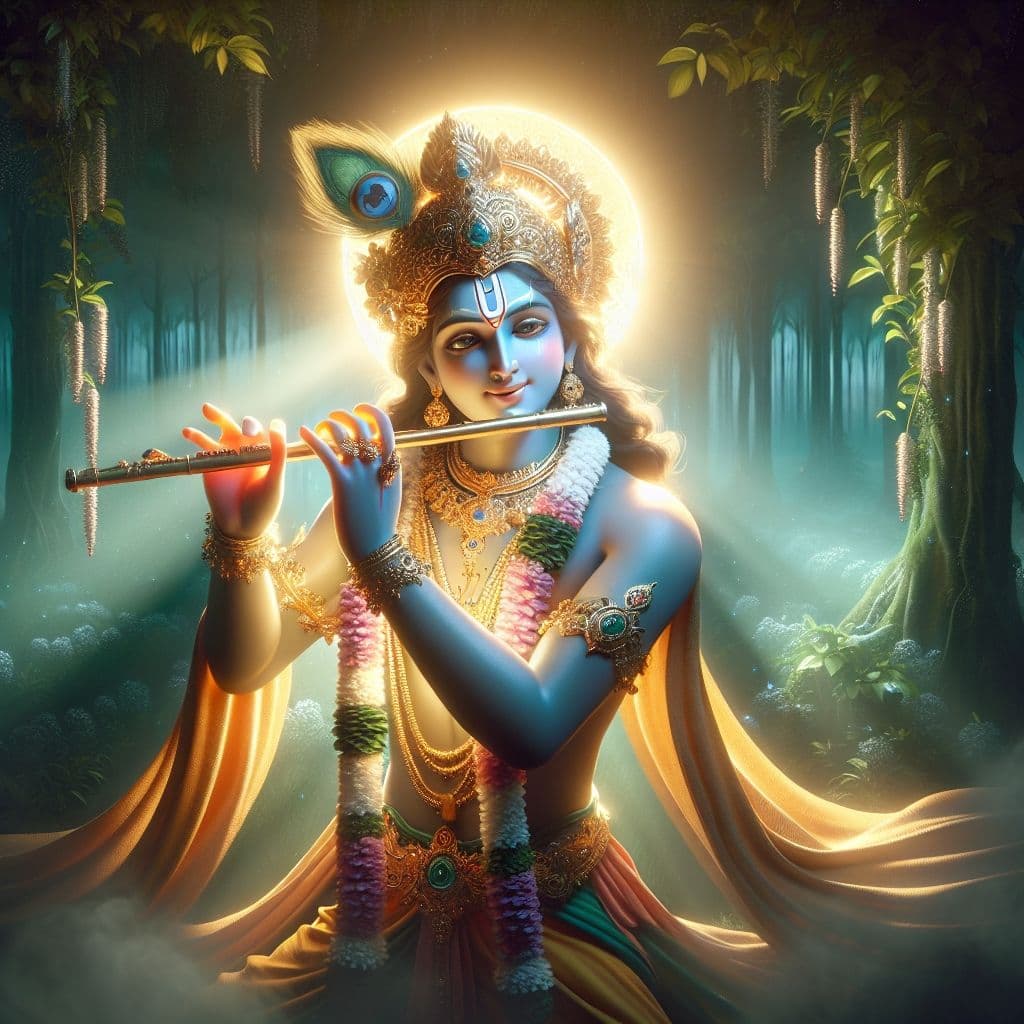

Krishna, the eighth incarnation of Vishnu, embodies immense diversity within Hinduism. He inspires countless souls as a divine lover, protector, and god of compassion, tenderness, and love. His teachings, especially those found in the Bhagavad Gita, have profoundly shaped philosophical and spiritual thought in India. Celebrated as a hero, philosopher, teacher, and friend, Krishna represents a rich tapestry of human and divine qualities. His stories and teachings are central to numerous Hindu traditions and scriptures, underscoring his vital role in India's cultural and spiritual life.
The name "Krishn" carries profound significance, rooted in the Sanskrit word "krs" which embodies various interpretations. It means "to attract" or "to draw in," symbolizing his divine power to captivate the hearts of his devotees. "Krishn" is also associated with the term "dark" or "black," reflecting his traditionally depicted skin complexion of dark blue or black. Additionally, it denotes being "attractive" or "all-attractive," highlighting his enchanting charm and magnetic influence over all beings. Some interpretations even link the name to concepts of "existence" or "consciousness," pointing to the essence of ultimate reality.
Other significant names and epithets associated with Krishna illuminate his various aspects in an inspiring manner:
Krishna is commonly portrayed as a young and attractive figure with blue or dark skin, often seen playing a flute. This youthful and divine image embodies ideal spiritual and physical beauty harmony. His hair, adorned with a peacock feather, symbolises grace and beauty, while his flute signifies a profound connection to music, love, and the divine call.
Krishna's iconography is a tapestry of rich and diverse elements, each reflecting a unique facet of his character and the stories that define his life. This diversity is a source of endless fascination and inspiration for those who seek to understand him.
Krishna's life is a tapestry of legendary tales and significant events that have profoundly shaped Hindu culture. Born in the Yadava dynasty to Vasudeva and Devaki in Mathura, he is a pivotal figure in the Mahabharata, serving as a charioteer and spiritual guide to Arjuna. Within this epic, Krishna shares the timeless teachings of the Bhagavad Gita, addressing the noble themes of duty, righteousness, and the quest for spiritual liberation.
Beyond his epic role, Krishna is celebrated for his enchanting childhood adventures, which are marked by mischievous acts of butter-stealing and heartfelt connections with the gopis (milkmaids) of Vrindavan. His divine protection of his community, courageously confronting and vanquishing numerous demons and malevolent forces, solidifies his identity as a divine protector. This aspect of Krishna's story is rich and multifaceted, continually inspiring through various scriptures, highlighting the key stages and roles that define his enduring legacy.
Krishna, a figure of reverence across India, is uniquely celebrated in each region, each with its distinct rituals and traditions. The festival of Janmashtami, marking his birth, is a vibrant display of this diversity, particularly in the sacred towns of Mathura and Vrindavan. While these diverse rituals and traditions inspire believers in unique and beautiful ways, the core of Krishna's worship remains universal, connecting us all to the broader Indian culture and fostering a sense of unity.
In South India, Vishnu is prominently worshipped, and Krishna is also revered in various forms. His devotion to Lord Vishnu and the teachings of the Bhagavad Gita, a philosophical text profoundly influential in Indian culture, inspire countless souls.
In Hindu cosmology, Krishna shines as an avatar of Vishnu , embodying countless forms and expansions. Revered as a complete (Purna) avatar, he exemplifies divine presence on Earth, descending to restore cosmic order and combat evil. Various schools and scriptures celebrate additional manifestations and related deities. Chaitanya Mahaprabhu, a 15th-century saint, is viewed by some as a harmonious incarnation of Radha and Krishna, providing a unique perspective on Krishna's incarnations. Krishna's profound contributions to the Mahabharat and the Bhagavad Gita and his enchanting childhood exploits in Vrindavan beautifully illuminate the essence of his divine nature and incarnations.
Krishna is a shining beacon in the sacred teachings of countless revered Hindu scriptures.
Encyclopaedia Britannica – Krishna Encyclopedia Britannica
British Library – Hindu Deities in Manuscripts (Gitagovinda & other Krishna material) British Library Blogs
National Museum, New Delhi – (Museums of India repository) museumsofindia.gov.in
Indian Culture Portal – Krishna artefacts & essays indianculture.gov.in
Vedabase – Bhagavad Gita - VedaBase
Vedabase – VedaBase
Internet Sacred Text Archive – Mahabharata Sacred Texts
Internet Sacred Text Archive – Hinduism Collection Sacred Texts
Indian Culture and Heritage Portal – essays & multimedia on Krishna indianculture.gov.in
Sahapedia – Scholarly articles Sahapedia
Incredible India – Incredible India
ISKCON (International Society for Krishna Consciousness)
Sahapedia – “Janmashtami: Prominent Places Where Krishna’s Birth is Celebrated”