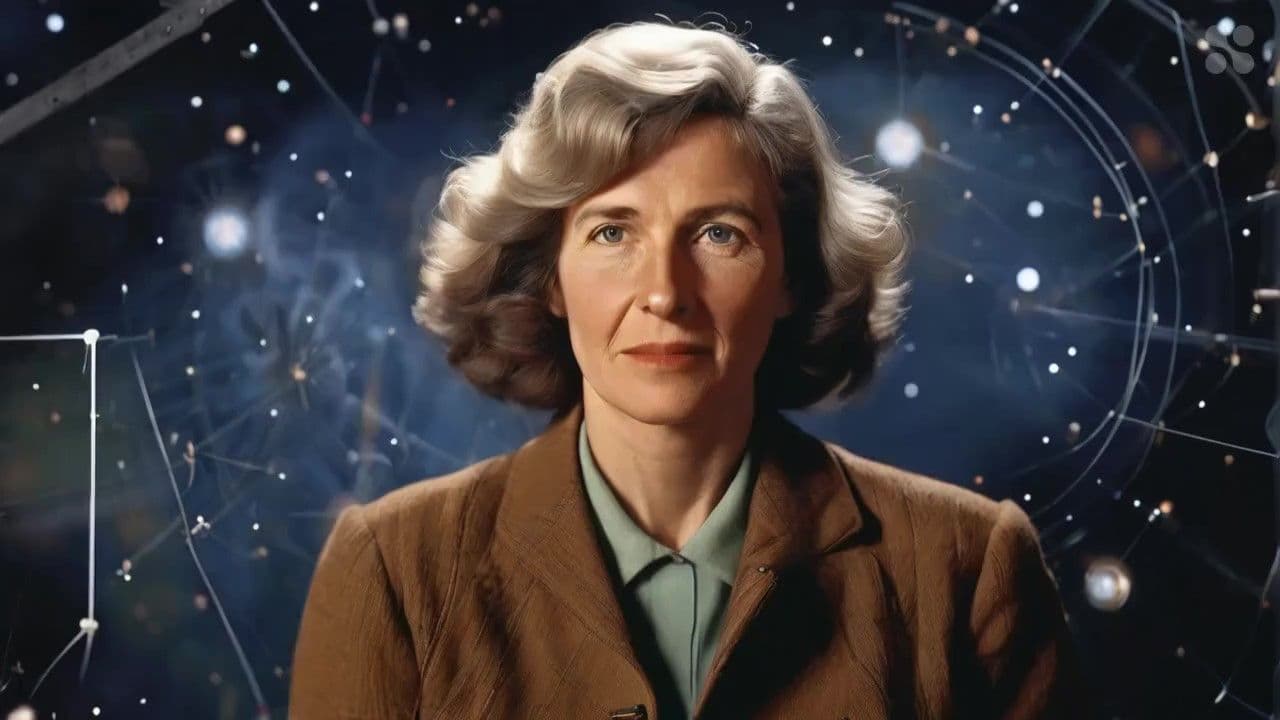

Dorothy Crowfoot Hodgkin envisioned a world where scientific knowledge, particularly in the field of biochemistry, could be used to solve complex human problems. She believed in the power of X-ray crystallography to reveal the mysteries of biological structures and their functions. Her vision was to make significant contributions to the global understanding of biochemistry and its potential applications in medicine.
Dorothy Crowfoot Hodgkin was born on May 12, 1910, in Cairo, Egypt, where her father served as an education officer. Despite the limited opportunities for women in science during her time, her passion for chemistry was evident from an early age. Her parents encouraged her interests, and at the age of 18, she started her studies at Somerville College, Oxford, where she studied chemistry and became fascinated with the study of crystals. After graduating from Oxford, she attended the University of Cambridge to study X-ray crystallography, a field that would become her lifelong passion. During her time at Cambridge, she worked under the supervision of J.D. Bernal, with whom she made her first scientific discovery: the structure of sterols. She returned to Oxford in 1934, and in 1945, she was appointed as a University lecturer and fellow of Somerville College, where she spent the majority of her academic career. Hodgkin's research focused on the structure of complex organic compounds using X-ray crystallography. She is most famous for her work in determining the structure of penicillin, vitamin B12, and insulin. Her determination of the structure of penicillin was completed in 1945, and her work on vitamin B12 was completed in 1955. Her work on insulin, a project she started in 1934, lasted for over 34 years and was finally completed in 1969. Dorothy Crowfoot Hodgkin retired from her University lectureship in 1977 but continued her research on insulin. She died on July 29, 1994, in Shipston-on-Stour, England.
Dorothy Crowfoot Hodgkin's remarkable work in the field of biochemistry earned her numerous awards and recognitions. Her most outstanding achievement was being awarded the Nobel Prize in Chemistry in 1964 for her determinations by X-ray techniques of the structures of important biochemical substances. She is the third woman to receive the Nobel Prize in Chemistry and remains the only British woman to have received a Nobel Prize in any of the three science categories. She was also awarded the Order of Merit in 1965, becoming the second woman after Florence Nightingale to receive this honor. In 1976, she was admitted to the Order of the Companions of Honour. She was also awarded honorary degrees from several universities, including Cambridge, Bristol, and York. In 2010, the Royal Society established the Dorothy Hodgkin Fellowship in her honor to support early-career researchers.
More Contents: