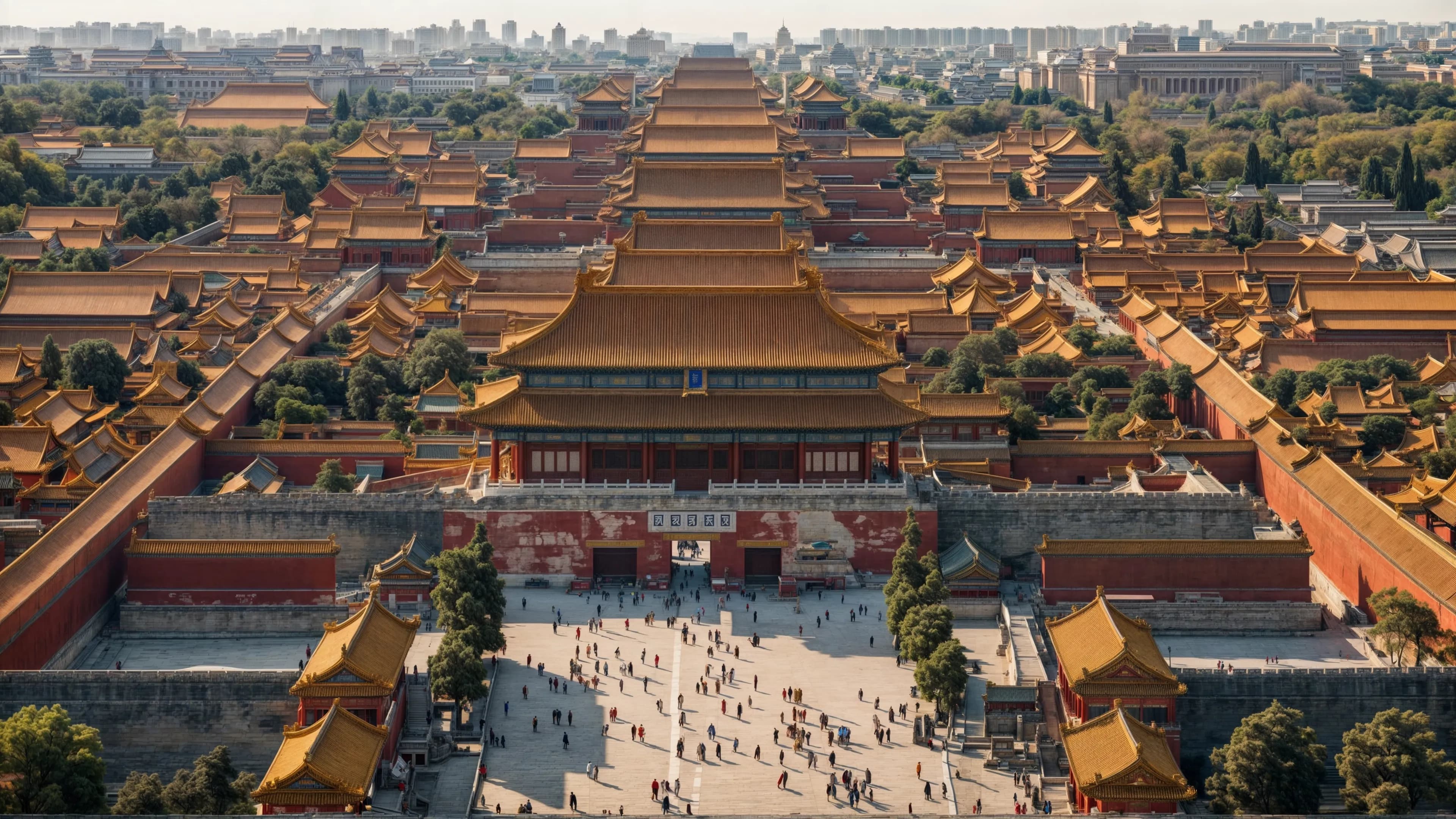

The Forbidden City, located in the center of Beijing, China, is a palatial complex that served as the residence of the Chinese emperor and his court for over 500 years, from the Ming Dynasty (1368-1644) to the end of the Qing Dynasty (1644-1912). Constructed between 1406 and 1420 during the reign of Emperor Yongle, the Forbidden City is a symbol of imperial power, representing the centralization and consolidation of political authority in China.
Read More:
The Forbidden City, spanning 180 acres, is the world's largest palace complex. It is a grand demonstration of traditional Chinese palatial architecture characterized by its hierarchical structures, vibrant colors, and intricate designs. With 980 surviving buildings and over 8,000 rooms, the City is encased within a 26-foot-high wall and surrounded by a moat. The complex is divided into two primary sections - the Outer Court, used for ceremonial purposes, and the Inner Court, which was the residence of the emperor and his family. The buildings and their layout strictly adhere to the principles of Feng Shui and Chinese cosmology.
The Forbidden City, also known as the Palace Museum, has immense cultural and religious significance. It was the ceremonial and political center of Chinese government for centuries and is a representation of traditional Chinese culture and history. The City houses an extensive collection of artwork and artifacts, reflecting the rich legacy of the Ming and Qing dynasties. As a religious symbol, it embodies the Chinese philosophy of the 'Mandate of Heaven', where the emperor was seen as the Son of Heaven and his residence a reflection of the celestial palace.
The Forbidden City continues to be a symbol of Chinese imperial power and architectural grandeur. It stands as a reminder of China's rich history, and its significance extends beyond the country's borders. Today, the Palace Museum attracts millions of visitors each year, making it one of the most visited cultural sites worldwide.
Despite its name, the Forbidden City is no longer forbidden. The name 'Forbidden City' is derived from the idea that no one could enter or leave the complex without the emperor's permission. Today, it houses the Palace Museum and is open to the public. It is said that there are 9,999.5 rooms in the Forbidden City because the number 9 is associated with the emperor and is considered lucky in Chinese culture.