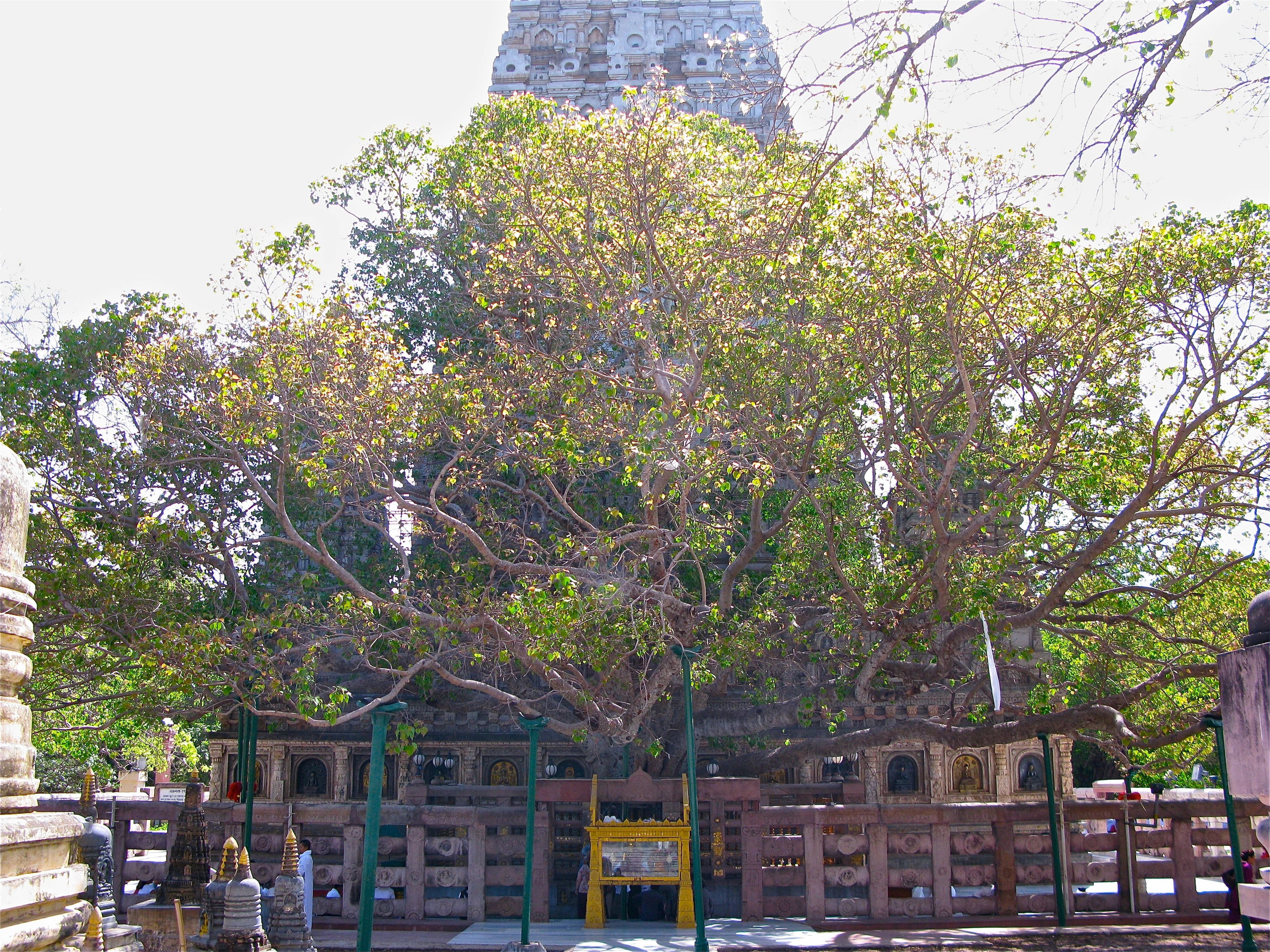

The Bodhi tree, also known as Bo (from the Sinhalese Bo), is a large and very old sacred fig tree (Ficus religiosa), located in Bodh Gaya, about 100 kms from Patna in the Indian state of Bihar. This tree is highly revered in various religious cultures, primarily because it is believed to be the tree under which Gautama Buddha, the founder of Buddhism, achieved enlightenment, or Bodhi. The term Bodhi tree is also widely used to refer to the descendants of the original tree and other trees that hold similar religious significance.
The Bodhi tree at the Mahabodhi Temple is called the Sri Maha Bodhi. According to Buddhist texts, Buddha, after his Enlightenment, spent a whole week in front of the tree, standing with unblinking eyes, gazing at it with gratitude. A shrine, called Animisalocana Cetiya, was later erected on the spot where he stood.
The tree is a central icon in Buddhism. It is worshipped and protected as the very symbol of Buddhist faith and history. It is often seen in Buddhist art and is a common subject of Buddhist literature. It is also a major pilgrimage destination for Buddhists from all over the world, who come to pay their respects and meditate under its shade.
The Bodhi tree is of the Ficus religiosa species. It is a large tree that can grow up to 30 meters tall and spread out up to 40 meters. It has heart-shaped leaves and is known for its long lifespan. The tree is deciduous, meaning it sheds its leaves annually. It is also known for its immense strength and resilience, as it can survive harsh weather conditions and diseases.
In many Buddhist cultures, the Bodhi tree is seen as a symbol of enlightenment. It is often depicted with a seat or throne beneath it, representing the place where Buddha meditated and achieved enlightenment. The heart-shaped leaves of the Bodhi tree are considered symbolic of the all-encompassing compassion of Buddha.
Over the centuries, many Bodhi trees have been planted around Buddhist temples and monasteries in various parts of the world. They are typically planted in a prominent place, often in the center of a courtyard, where they can provide shade and a place for meditation. They are well cared for and protected, as they are seen as living symbols of the Buddhist tradition.
There are various legends associated with the Bodhi tree. According to one popular story, the original tree was destroyed several times by storms and human actions, but it always managed to grow back from a surviving branch or seedling. This resilience of the Bodhi tree has come to symbolize the enduring nature of Buddhist teachings, which continue to thrive despite various challenges.
The Bodhi tree holds a special place in Sri Lankan history as well. It is believed that a sapling from the original Bodhi tree in India was brought to Sri Lanka by the Buddhist nun Sanghamitta, the daughter of Emperor Ashoka, in the 3rd century BC. This sapling was planted in Anuradhapura and is known as the Jaya Sri Maha Bodhi tree. It is considered the oldest living tree in the world with a known planting date.
In conclusion, the Bodhi tree is not just a tree, but a powerful symbol and an integral part of the spiritual and cultural heritage of Buddhism. It stands as a living testament to the life and teachings of Buddha and continues to inspire millions of people around the world. Despite its age and the many challenges it has faced, the Bodhi tree continues to thrive, much like the Buddhist faith itself.
The Bodhi Tree, also known as Bo (from the Sinhalese Bo) and Peepul (Ficus religiosa), is a large and ancient sacred fig tree under which Siddhartha Gautama, the spiritual teacher who became known as the Buddha, is said to have attained enlightenment, or Bodhi. The tree is revered and considered holy in many cultures, particularly in India, Nepal, and Sri Lanka.
The Bodhi tree is not just important for its spiritual significance but also for its practical uses. Its wood is used for making furniture and other wooden products. The tree’s leaves, bark, and seeds have medicinal properties and are used in traditional medicine. In addition, the tree provides shade and shelter to people and animals, and its roots help prevent soil erosion.
Human interaction with the Bodhi tree is primarily of two types: religious and practical. On the religious front, the tree is a prominent symbol in Buddhism and Hinduism. It is often found in the vicinity of Buddhist and Hindu temples. In Buddhism, the tree is considered the Tree of Enlightenment, and it is believed that meditating under the tree can lead to spiritual awakening. In Hinduism, the tree is associated with Vishnu and is considered auspicious. The tree’s leaves are often used in worship and rituals. In addition to religious significance, the tree also has cultural significance in many societies. It is often the center of village life, providing a meeting place for the community.
On a practical level, the Bodhi tree is used for various purposes. Its wood, being strong and durable, is used in making furniture, doors, and other wooden items. Its leaves, known for their heart shape, are used for decorative purposes. They are also used in traditional medicine for treating various ailments. The tree’s bark and seeds are also used in traditional medicine. The bark is used for treating skin diseases, while the seeds are used for treating digestive disorders. The tree is also a source of latex, which is used in making rubber.
The Bodhi tree also plays an important role in environmental preservation. The tree has a large canopy that provides shade and helps lower the temperature. This is particularly beneficial in hot climates, where the tree provides a cool resting place for people and animals. The tree’s extensive root system helps prevent soil erosion, particularly on riverbanks and slopes. Moreover, the tree is a host to many birds and insects, contributing to biodiversity.
Despite its many uses, the Bodhi tree is also associated with some challenges. The tree’s extensive root system can damage structures and roads if the tree is planted too close to them. The tree is also susceptible to certain diseases and pests, which can affect its health and longevity. Moreover, the tree requires ample space to grow, which can be a challenge in urban environments.
There have been initiatives to promote the planting of Bodhi trees. These initiatives not only aim to preserve the tree for its religious and cultural significance but also for its environmental benefits. These initiatives have been particularly prominent in countries with Buddhist populations, such as India, Nepal, and Sri Lanka. However, these efforts also face challenges, including lack of awareness about the tree’s benefits, lack of space for planting, and resistance from people who associate the tree with Buddhism and therefore oppose its planting for religious reasons.
In conclusion, the Bodhi tree is a significant tree that is revered for its spiritual significance and valued for its practical uses. It is a symbol of enlightenment in Buddhism and is associated with good fortune in Hinduism. The tree provides wood for making furniture, leaves for decoration and medicine, bark and seeds for medicine, and latex for making rubber. It also has environmental benefits, providing shade, preventing soil erosion, and contributing to biodiversity. Despite the challenges associated with its preservation, efforts are being made to promote the planting of Bodhi trees for the benefit of future generations.
The Bodhi Tree, also known as the Bo tree, holds a significant place in many cultures and religions, primarily in Buddhism and Hinduism. The tree, a large and old sacred fig tree (Ficus religiosa), is considered a symbol of enlightenment, peace, and wisdom.
In Buddhism, the Bodhi Tree is revered as the place where Siddhartha Gautama, who later became known as Buddha, attained enlightenment. It is believed that after years of searching for truth and meaning in life, Siddhartha sat under a fig tree in Bodh Gaya, India, and vowed not to rise until he had found enlightenment. After meditating for 49 days, he reached a state of profound understanding, or Bodhi, thus becoming the Buddha, the Enlightened One.
The Bodhi Tree, therefore, represents the path to enlightenment in Buddhist symbolism. It is a reminder of the Buddha's journey and the potential within each individual to attain the same state of enlightenment.
To commemorate this historic event, many Buddhist temples around the world have a Bodhi Tree planted within their compounds. It is not uncommon to see devotees offering prayers, lighting incense, or meditating under the tree, seeking spiritual guidance and peace.
In Hinduism, the Bodhi Tree is also revered. It is associated with Lord Vishnu, one of the principal deities in Hinduism, who is said to have been born under this tree. The tree is also associated with Brahma, the Hindu god of creation, making it a symbol of life and fertility.
Moreover, the Bodhi Tree is considered a wish-fulfilling tree in Hindu mythology. It is said that if one worships the tree with a pure heart, one's wishes may be granted. Because of this belief, Hindu temples also often have a Bodhi Tree, where devotees offer prayers and seek blessings.
Apart from Buddhism and Hinduism, the Bodhi Tree holds significance in Jainism as well. The 24th Tirthankara of Jainism, Mahavira, is said to have attained enlightenment under a Bodhi Tree. Thus, the tree holds a special place in Jain temples and rituals.
The Bodhi Tree is also of cultural importance. In many parts of India and Nepal, the tree is central to community life. Villagers often gather under the large, shady canopy of the Bodhi Tree for meetings, discussions, or to rest during the hot day. The tree, therefore, symbolizes community bonding and unity.
The Bodhi Tree also plays a significant role in environmental conservation. Its large size, extensive root system, and long lifespan make it an excellent choice for soil stabilization and urban greening. Moreover, the tree is a host to a variety of birds and insects, contributing to biodiversity.
Despite its religious and cultural significance, the Bodhi Tree is threatened by deforestation and urbanization. Efforts are being made by various organizations and individuals to conserve this sacred tree and its associated biodiversity. Planting a Bodhi Tree is seen not only as a religious act but also as a step towards environmental conservation.
Overall, the Bodhi Tree represents a blend of spiritual, cultural, and environmental significance. Whether it is seen as a symbol of enlightenment in Buddhism, a wish-fulfilling tree in Hinduism, a community gathering spot, or a beacon of environmental conservation, the Bodhi Tree continues to be cherished and preserved for its manifold values.
The Bodhi Tree, also known as the Tree of Awakening, holds an esteemed place in various cultures around the world, especially in the spiritual realm. With its deep symbolic and aesthetic significance, the tree resonates a sense of serenity and enlightenment. It signifies the journey towards spiritual attainment, the very essence of life, and the profound connection between nature and human consciousness.
Primarily known as the tree under which Siddhartha Gautama, the founder of Buddhism, achieved enlightenment, the Bodhi Tree is a central figure in Buddhist symbolism. The original Bodhi Tree was a large and ancient Sacred Fig tree located in Bodh Gaya, India. The aesthetic beauty of the tree, with its broad, heart-shaped leaves, is a sight to behold. The lush, vibrant green leaves represent life and vitality, while the strong, sturdy trunk symbolizes resilience and the ability to weather life's storms.
From an experiential perspective, being in the presence of a Bodhi Tree is often described as a profound and transformative experience. The tree emanates a powerful energy that is said to promote peace, calm, and clarity of mind. While sitting under a Bodhi Tree, one can feel a deep sense of connection with nature, a heightened awareness of one's surroundings, and an inward journey towards self-discovery and enlightenment. Many people describe the experience as a spiritual awakening, a feeling of being rooted in the present moment, and a newfound understanding of one's place in the universe.
From a purely aesthetic standpoint, the Bodhi Tree is a magnificent spectacle. It is a large tree with a massive trunk, and its wide, spreading branches create a natural canopy that provides shade and shelter. The leaves of the Bodhi Tree are large, heart-shaped, and have a glossy surface that reflects the sunlight, creating a mesmerizing play of light and shadow. The tree's bark is textured and rough, adding to its visual appeal. The Bodhi Tree is also known for its longevity, with some trees living for hundreds of years. This enduring quality further enhances its aesthetic appeal, as it represents the passage of time and the continuity of life.
Beyond its visual appeal, the Bodhi Tree has a unique, soothing aroma that adds to its experiential allure. The tree's scent, which is often described as earthy and grounding, can help to create a serene and peaceful environment. The rustling sound of its leaves in the wind can also have a calming effect, promoting a sense of tranquility and mindfulness.
The Bodhi Tree's aesthetic and experiential attributes are deeply intertwined with its spiritual significance. The tree's physical beauty and calming energy are said to facilitate meditation and introspection, helping individuals to connect with their inner selves and the universe. Its iconic status in Buddhism also adds to its allure, as it serves as a symbol of enlightenment and spiritual growth.
Beyond Buddhism, the Bodhi Tree holds value in other cultures as well. In Hinduism, it is considered sacred and is often associated with the gods Vishnu, Brahma, and Shiva. In these contexts, the tree's aesthetic and experiential attributes are used to facilitate religious rituals and ceremonies, further highlighting its cultural and spiritual importance.
In conclusion, the Bodhi Tree, with its aesthetic beauty and profound experiential qualities, plays a pivotal role in various cultural and spiritual contexts. Its symbolism transcends religious boundaries, embodying universal themes of life, transformation, and spiritual enlightenment. Whether it is the sight of its lush, green leaves, the feel of its rough bark, the sound of its rustling leaves, or the tranquility it emanates, the Bodhi Tree offers a unique, multi-sensory experience that inspires awe and contemplation.
The Bodhi Tree and Buddhism - Learn Religions
Bodhi Tree - Ancient History Encyclopedia
Beneath the Bodhi Tree - Tricycle: The Buddhist Review
BBC Radio 4 - In Our Time, The Bodhi Tree
Beneath The Bodhi Tree: A Story Of Enlightenment - HuffPost
Bodhi Tree - New World Encyclopedia
The Metropolitan Museum of Art - Buddha Shakyamuni Meditating Under the Bodhi Tree
The Bodhi Tree, the Buddha, and the Sri Lankan Monastic Order - JSTOR
Bodhi Tree (Ficus religiosa) - Science Source
Genome of the long-living sacred Bodhi tree (Ficus religiosa L.) - Nature
ResearchGate - Genome of the long-living sacred Bodhi tree (Ficus religiosa L.)