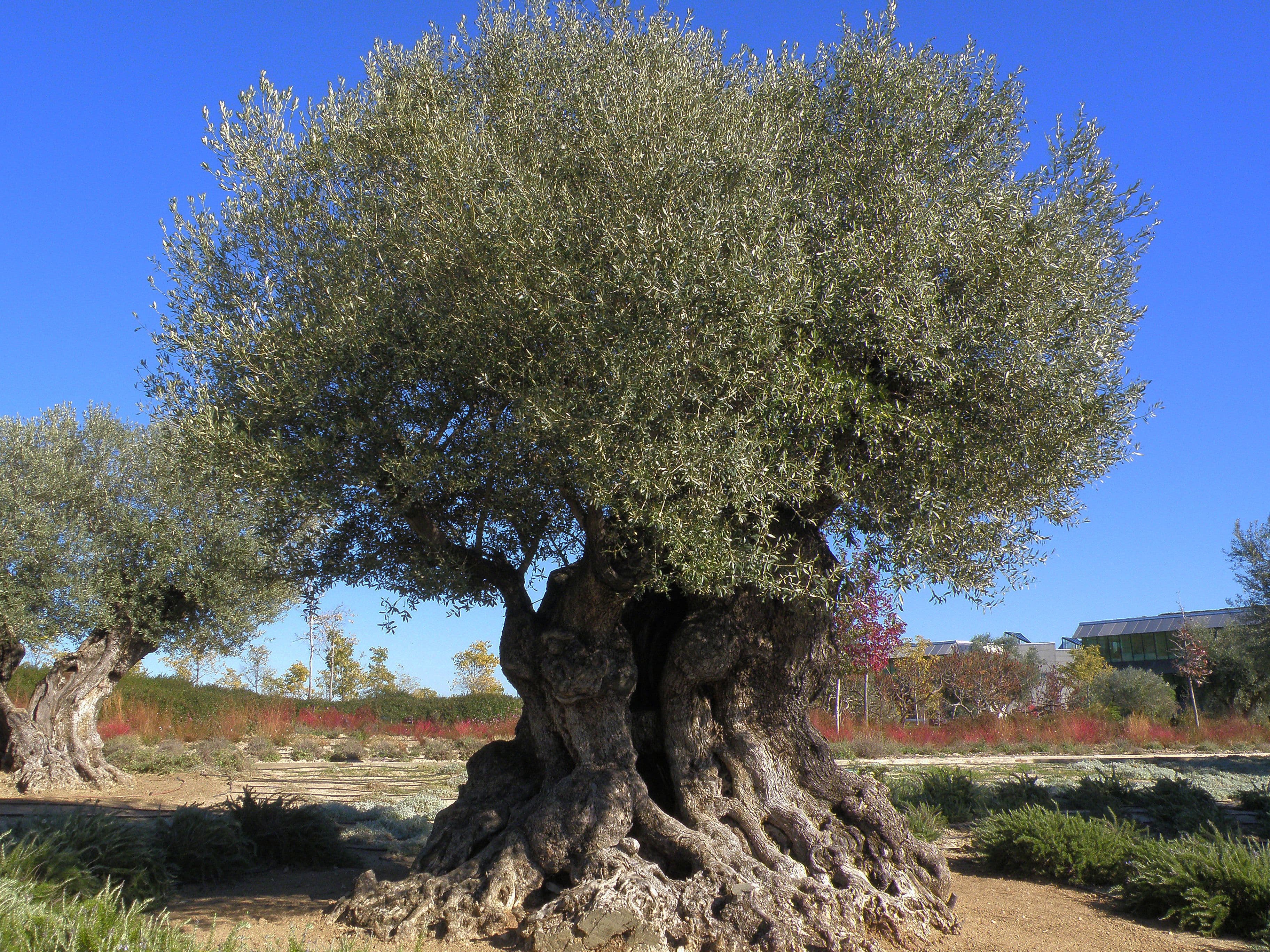

The olive tree, scientifically known as Olea europaea, is an evergreen tree or shrub native to the Mediterranean, Asia, and Africa. It is short and squat, and rarely exceeds 8–15 m (26–49 ft) in height. However, the Pisciottana, a unique variety comprising 40,000 trees found only in the area around Pisciotta in the Campania region of southern Italy, often exceeds 8–15 m with correspondingly large trunk diameters.
The silvery green leaves are oblong, measuring 4–10 cm (1.6–3.9 in) long and 1–3 cm (0.39–1.18 in) wide. The trunk is typically gnarled and twisted. The small, white, feathery flowers, with ten-cleft calyx and corolla, two stamens, and bifid stigma, are borne generally on the previous years wood, in racemes springing from the axils of the leaves.
The fruit is a small drupe 1–2.5 cm (0.39–0.98 in) long, thinner-fleshed and smaller in wild plants than in orchard cultivars. Olives are harvested in the green to purple stage. Canned black olives have often been artificially blackened and may contain the chemical ferrous gluconate to improve the appearance.
Olive trees in the groves around the Mediterranean Sea are centuries old, with some dated to 2000 years. The olive is one of the plants most often cited in literature. In Homer's Odyssey, Odysseus crawls beneath two shoots of olive that grow from a single stock, and in the Iliad, (XVII.57), is a metaphoric description of a lone olive tree in the mountains, by a spring; the Greeks observed that the olive rarely thrives at a distance from the sea, which in Greece invariably means up mountain slopes.
Olive oil, produced from olive trees, is a key component of the Mediterranean diet, and is widely regarded for its health benefits, including high levels of monounsaturated fats and antioxidative substances. Olive oil is used for cooking, cosmetic, medicinal, and soaps. It is also used as a fuel for traditional oil lamps and there are several biblical references to its use.
There are hundreds of cultivars of the Olea europaea olive tree. While some varieties are primarily used to produce olive oil, others are eaten as table olives. Among the most popular are Manzanilla, Picual, and Hojiblanca.
Olives are traditionally cured using a variety of methods, including lye curing, brine curing, and water curing. The process of curing removes the bitter phenolic compound known as oleuropein, making the olives palatable.
Olives and olive oil have been produced for thousands of years. The ancient Greeks used olive oil in their religious ceremonies and believed the olive tree was a gift from the goddess Athena. Today, the olive tree continues to be an important part of the agricultural economy in countries around the Mediterranean.
Olive trees are very hardy and resistant to disease, although they do suffer from a few diseases such as olive knot and verticillium wilt. They can also suffer from nutrient deficiencies, particularly a lack of iron and nitrogen.
Pruning is crucial for olive trees. Removing old wood and water shoots allows more light and air into the tree and encourages the growth of new shoots. It also helps to reduce the likelihood of disease. A well-pruned olive tree is a healthier olive tree.
Overall, the olive tree is a symbol of peace, wisdom, fertility, power, and purity. Its long history and many uses make it one of the most important trees in the world.
The olive tree, scientifically known as Olea europaea, is an evergreen tree or shrub native to the Mediterranean, Asia, and Africa. It is short and squat, and typically attains a height of between 26 to 49 feet. Olive trees are best known for their fruit, olives, which are a fundamental component of the Mediterranean diet and are widely cultivated for their oil and for table olives. However, the olive tree is not just a source of food. It has been a symbol of peace and victory, and has played a central role in many historical and religious texts.
Olive trees have been used by humans for thousands of years. In ancient Greece, olive oil was used as a body oil, in cooking, and in lamp fuel. It was also a central part of Greek religious rituals. Victors in the Olympic Games were crowned with a wreath of olive leaves, symbolizing the divine blessing of the Greek gods. In addition, the wood of the olive tree was used to carve statues and to build ships and houses.
The cultivation of olive trees is deeply rooted in the culture and economy of the Mediterranean region. Today, Spain, Italy, and Greece are the largest producers of olive oil, accounting for more than 75% of the world's total production. The olive tree has also been introduced in other parts of the world, such as California, Australia, and South America, where it is also grown for its oil and fruit.
However, the interaction of humans with the olive tree is not limited to its cultivation and use as a source of food and oil. Olive trees also have environmental benefits. They can help to prevent soil erosion, especially in hilly or mountainous regions. They also play a role in carbon sequestration, helping to mitigate the effects of climate change. Furthermore, olive groves can provide a habitat for a variety of wildlife, contributing to biodiversity.
The olive tree has also been used in traditional medicine. The leaves of the olive tree are known to have antiviral, antibacterial, anti-inflammatory, and antioxidant properties. They have been used in the treatment of a variety of conditions, including cardiovascular diseases, diabetes, cancer, and infections. Olive leaf extract is now available as a dietary supplement, and research is ongoing into its potential health benefits.
However, despite the many benefits of olive trees, they are also subject to a number of threats. These include pests and diseases, such as the olive fruit fly and olive knot disease, which can cause significant damage to olive crops. Climate change is also a growing threat, as it can lead to changes in rainfall patterns and increased temperatures, which can affect the growth and productivity of olive trees. There is thus a need for ongoing research and innovative strategies to ensure the sustainable management and protection of olive trees.
In conclusion, the olive tree is a remarkable species that has played a central role in human civilization. Its fruit and oil have been a source of nutrition for thousands of years, while its wood has been used in construction and craftsmanship. Olive trees have also had symbolic and religious significance, and have been used in traditional medicine. Despite the challenges they face, olive trees continue to be a vital part of our lives, contributing to our health, environment, and culture.
The olive tree has been part of the human story for thousands of years, and its importance cannot be overstated. Whether it is the oil that we drizzle on our salads, the wood that we use to build our homes, or the leaves that we use for their medicinal properties, the olive tree enhances our lives in many ways. As we continue to interact with this incredible tree, we must strive to protect and conserve it for future generations to enjoy.
The olive tree, scientifically known as Olea europaea, is a tree species native to the Mediterranean Basin, which spans parts of Europe, Asia, and Africa. It is renowned worldwide not only for its fruit and the oil produced from it but also for the profound cultural and symbolic significance it has held for thousands of years. Olive trees are often seen as symbols of peace, wisdom, fertility, prosperity, and immortality, among other things. This symbolism derives from the various roles the tree has played in the myths, traditions, and daily life of numerous civilizations.
In ancient Greece, the olive tree was considered sacred. It was associated with Athena, the goddess of wisdom, warfare, and handicrafts. According to Greek mythology, Athena and Poseidon, the god of the sea, competed for the patronage of the city of Athens. Each deity presented the city with a gift, Poseidon striking the ground with his trident to create a saltwater spring, and Athena planting the first olive tree. The Athenians deemed Athenas gift more valuable, and the city was named in her honor. The olive tree thus became an emblem of the goddess and the city, symbolizing wisdom, peace, and prosperity.
The Romans also held the olive tree in high regard. They considered it a symbol of peace and used olive branches as a gesture of reconciliation. In Roman mythology, the olive tree was linked to Minerva, the goddess of wisdom and strategic warfare, the Roman counterpart of Athena. Thus, the significance of the olive tree in Roman culture mirrored that in Greek culture.
In Christianity, the olive tree has numerous symbolic interpretations. It is often used to represent peace, as in the story of Noahs Ark, when a dove brought back an olive branch to signify the end of Gods wrath and the flooding. The olive tree and olive oil are also frequently mentioned in the Bible in association with healing and anointing, implying spiritual significance. In the New Testament, the Garden of Gethsemane, where Jesus prayed before his crucifixion, was filled with olive trees, further emphasizing their religious significance.
In Islamic tradition, the olive tree and olive oil are also viewed with great reverence. They are mentioned several times in the Quran, signifying light and guidance. In the Islamic Hadith literature, olive oil is recommended for medicinal and nutritional use, mirroring the trees practical importance in many Mediterranean societies.
The olive tree holds immense cultural significance in the Mediterranean region. It has been a vital part of the regions diet, economy, and landscape for millennia. Olive oil, in particular, has played a crucial role in the Mediterranean diet and cuisine, known for its health benefits. The tree is also central to the regions agricultural activities, with olive oil production being a major industry in countries such as Spain, Italy, and Greece.
The olive tree, with its gnarled trunk and silvery leaves, is also a symbol of the Mediterranean landscape. It has shaped the regions identity and has been a source of inspiration for artists, writers, and poets for thousands of years. The olive tree's resilience, able to thrive in harsh conditions and live for hundreds, sometimes thousands of years, further enhances its symbolic value, representing endurance and survival.
In Jewish tradition, the olive tree and olive oil have a special significance as well. The Menorah, a seven-branched candelabrum used in the ancient Temple in Jerusalem, was fueled by pure olive oil. The olive branch is also a symbol of peace in Jewish tradition, and the olive tree represents beauty and abundance.
In conclusion, the olive tree, with its rich history and diverse cultural and symbolic meanings, is truly a universal symbol. It transcends geographical and cultural boundaries, embodying values and ideals that are universal. From ancient myths and religious texts to everyday life and landscapes, the olive tree holds a unique place in human history and culture. Its enduring significance testifies to the profound relationship between humans and the natural world, a relationship marked by reverence, utility, and symbolic interpretation.
The Olive tree, scientifically known as Olea europaea, has been a symbol of peace, wisdom, glory, and purity throughout history. Its aesthetic appeal and experiential characteristics are profound, creating a unique connection between nature and human beings. The Olive tree is renowned for its hardiness and ability to survive in harsh conditions, often growing in landscapes that are otherwise barren, adding a touch of elegance and beauty to the surroundings.
From an aesthetic perspective, the Olive tree presents a captivating sight. It has a twisted and gnarled trunk that shows its age and resilience. This rugged appearance is contrasted by its delicate, silvery-green leaves that shimmer in the sunlight. The contrast between the rough, aged trunk and the youthful, vibrant leaves creates a visually appealing paradox.
The Olive tree blooms small, white flowers in spring, further enhancing its beauty. These flowers later give way to the tree's fruit - olives. Depending on the variety, olives can range in color from green to black, adding another layer of visual interest to the tree. The overall appearance of the Olive tree is rustic and natural, making it a popular choice for landscape artists and photographers.
But the aesthetic appeal of the Olive tree goes beyond its physical attributes. It also evokes a sense of history and culture. Olive trees have been cultivated for thousands of years, and they are deeply entwined with the history of the Mediterranean region. Walking through an olive grove can feel like stepping back in time, providing a tangible link to the past.
From an experiential perspective, the Olive tree is equally impressive. Its shade provides relief from the hot Mediterranean sun, creating a cool and peaceful resting spot. The rustling of the leaves in the wind creates a soothing soundscape. At harvest time, the picking of the olives is a communal event, bringing people together in a tradition that has been carried out for millennia. There's a certain rhythm and ritual to the harvest, adding to the overall experience of the Olive tree.
The Olive tree also provides sensory experiences. The smell of the leaves and the wood is earthy and calming. The texture of the bark, rough and gnarled, tells a story of survival and resilience. And, of course, there's the taste of the olives and the olive oil. The flavor can be robust and pungent or smooth and buttery, depending on the variety and how the olives are processed. This culinary experience is a crucial part of the Olive tree's charm.
Furthermore, the Olive tree has significant symbolic value. In many cultures, it's a symbol of peace and victory. In ancient Greece, winners of the Olympic Games were crowned with a wreath of olive leaves. The olive branch is a universal symbol of peace, and the dove carrying an olive branch is a widely recognized icon of hope and reconciliation.
In conclusion, the Olive tree offers a remarkable blend of aesthetic and experiential attributes. Its rugged beauty, historical significance, and sensory appeal make it a truly unique part of nature. Whether you're admiring its twisted trunk and shimmering leaves, resting in its shade, harvesting its fruit, or savoring the taste of its olives and oil, the Olive tree provides a rich and rewarding experience.
Gardening Know How - Olive Tree Care Information
National Center for Biotechnology Information - The Olive Tree Genome
Ancient History Encyclopedia - Olive in the Ancient Mediterranean
Olive Oil Times - Olive Tree Database
Agricultural Marketing Resource Center - Olives
National Center for Biotechnology Information - Olive Tree Genomics and Biotechnology
Ancient History Encyclopedia - Olive
National Center for Biotechnology Information - The Extra Virgin Olive Oil Handbook