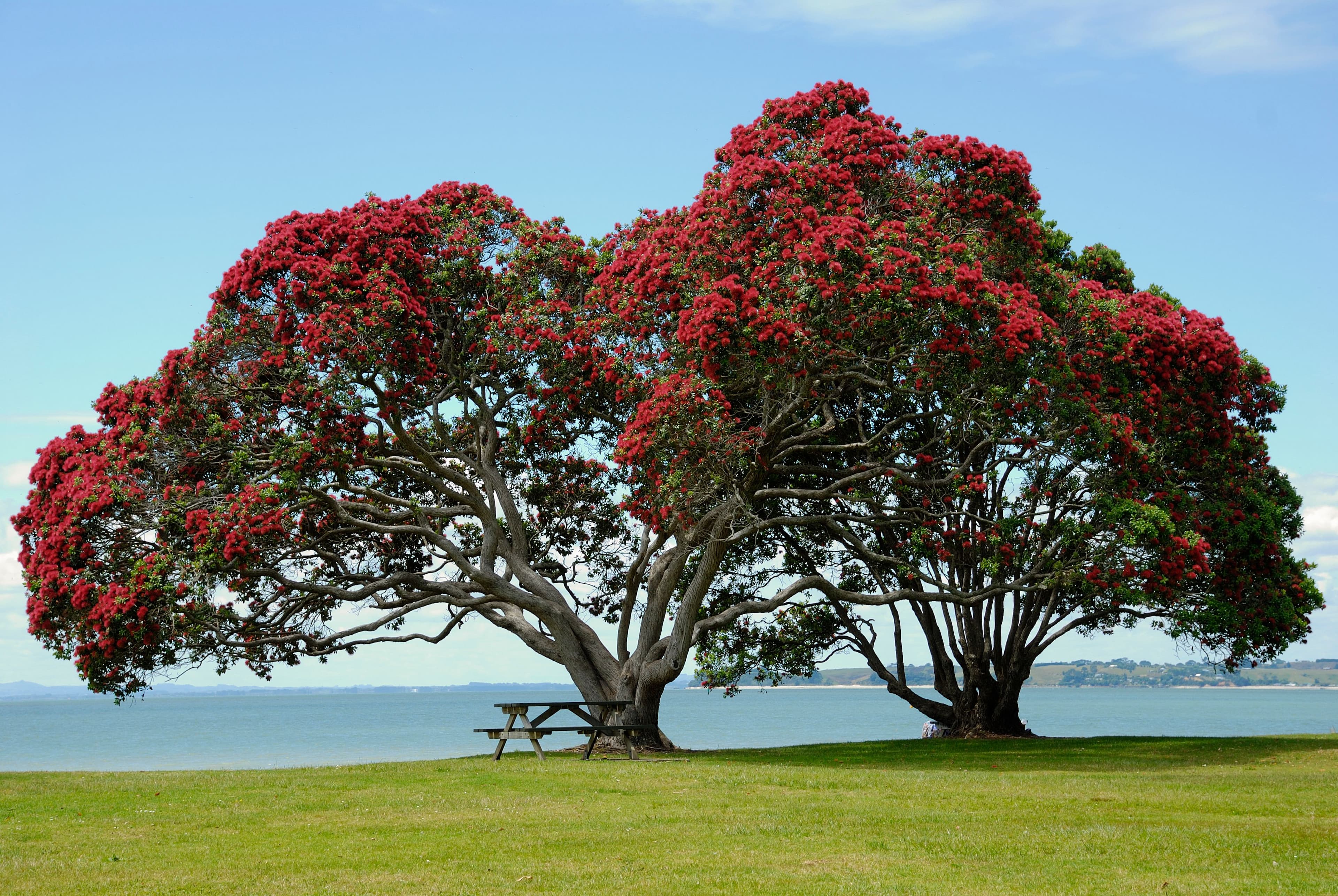

The P?hutukawa tree, scientifically known as Metrosideros excelsa, is a coastal evergreen tree endemic to New Zealand, particularly the North Island. Renowned for its vibrant crimson flowers that bloom around Christmas time, it has earned the moniker New Zealand Christmas tree. The tree is part of the myrtle family, Myrtaceae, and it is one of the 12 Metrosideros species endemic to New Zealand.
The P?hutukawa can grow up to 25 metres in height and can spread equally wide. Its gnarled roots often creep over cliffs and down towards the sea, creating a distinctive landscape. The bark is thick, corky, and flaky, providing protection from fires, which are common in its natural habitat. The leaves are oblong in shape, leathery, dark green, and covered with dense white hairs underneath.
The tree blossoms from November to January with a profusion of crimson flowers. Each flower consists of a multitude of stamens, which are the pollen-producing reproductive organ of the flower. The flowers are rich in nectar and attract various birds, particularly the native tui and bellbird. The flowering is followed by the production of capsules that contain numerous small seeds.
Pohutukawa has immense cultural significance for the Maori people, the indigenous Polynesian people of New Zealand. It is often found in Maori mythology and folklore. The trees are considered taonga, or treasures, and are protected by the community. Traditionally, the flowering of P?hutukawa has been linked to the timing of summer and the holiday season. Therefore, the P?hutukawa is a symbol of summertime, celebrations, and festive spirit.
The tree has also been introduced to other parts of the world with similar climates, such as the coastal areas of northern New South Wales and Queensland in Australia. However, it is not as prolific in these areas as it is in its native range.
The timber of the P?hutukawa is hard and durable, making it useful for various purposes. It has been used for boat building, house construction, tool handles, and carving. However, due to its slow growth and the effect of over-harvesting, it is not commercially exploited today. The tree also has several medicinal uses. The Maori people have used various parts of the tree, including the bark, leaves, and flowers, for treating different ailments.
Despite its beauty and cultural significance, the P?hutukawa is under threat from various factors. These include coastal development, which leads to habitat loss, and pests and diseases. The P?hutukawa is particularly susceptible to a fungal disease called myrtle rust, which has been devastating populations of myrtle species worldwide. To protect the P?hutukawa, various conservation efforts are underway. These include the propagation of disease-resistant varieties and the control of pests.
Moreover, the P?hutukawa is also threatened by the introduction of exotic species. The most significant of these is the brushtail possum, which was introduced from Australia and feeds on the leaves and flowers of the tree. Efforts to control the possum population have had some success, but the threat remains. The P?hutukawa also faces competition from exotic plant species, which can outcompete it for resources.
In conclusion, the P?hutukawa is a unique and iconic tree that symbolises the natural beauty and cultural heritage of New Zealand. Its vibrant flowers bring joy and colour to the holiday season, and its hardy nature reflects the resilience of the land where it grows. Despite the challenges it faces, efforts are being made to ensure the survival of this remarkable tree for future generations to enjoy.
With increased awareness and conservation efforts, the P?hutukawa will continue to thrive and bloom, gracing the coasts of New Zealand with its resplendent crimson flowers. It will continue to hold a special place in the hearts of the people, symbolising not just the festive season, but also the enduring spirit of the land and its people.
The P?hutukawa tree, known scientifically as Metrosideros excels, is a key part of both the natural landscape and cultural heritage in New Zealand. This iconic tree, often referred to as the New Zealand Christmas Tree due to its vibrant red blossoms peaking in the Christmas season, has been utilized by humans in many ways over the centuries.
The M?ori, the indigenous peoples of New Zealand, have a deep cultural and spiritual connection with the P?hutukawa. It is a taonga, or treasure, that plays a significant role in their mythology and traditions. The tree is believed to be the departure point for spirits, with the oldest known P?hutukawa at Te Rerenga Wairua, or Cape Reinga, being the mythical jumping off point of the spirits of the deceased on their journey to the afterlife. Many sacred rituals and ceremonies are performed under the P?hutukawa tree, the blossoms are used in adornments, and the nectar is often used in traditional medicine.
The P?hutukawa is not just a symbol, but also a resource. Its timber is hard and durable, making it an excellent material for tools and construction. M?ori made use of the wood to build canoes, fishing tools, weapons, and houses. The bark was used for making dyes and was also applied on wounds due to its antiseptic properties. The flowers and the nectar were used not only for decoration but also for medicinal purposes. The nectar was used to cure sore throats and dysentery, while a decoction of the bark was used to treat skin diseases.
European settlers in New Zealand also found uses for the P?hutukawa. Its timber was used for building ships, bridges, and houses. The tree's beautiful blossoms and its ability to grow in coastal areas made it a popular choice for ornamental landscaping. P?hutukawa honey, made by bees that feed on the tree's nectar, became a specialty food product. Today, the P?hutukawa remains a favorite for landscaping and the honey is still enjoyed.
However, human interaction with the P?hutukawa has not always been beneficial. Urban development and land clearance for agriculture have led to a significant loss of P?hutukawa forests. The introduction of pests and diseases, particularly the P?hutukawa moth and the fungal disease myrtle rust, have also threatened the tree's survival. Conservation efforts are now underway to protect and preserve the P?hutukawa. These include pest control, replanting schemes, and legal protection of the tree.
Despite these challenges, the P?hutukawa remains an integral part of New Zealand's identity. Its image can be found on postal stamps and it is incorporated into the design of the New Zealand Christmas stamp. The tree is also the subject of songs, poetry, and artwork. During the Christmas season, many New Zealanders gather under the P?hutukawa tree for celebrations, continuing the tradition of human interaction with this iconic tree.
As climate change becomes an increasing concern, the P?hutukawa is also gaining attention for its potential role in carbon sequestration. Like other trees, the P?hutukawa absorbs carbon dioxide, a greenhouse gas, from the atmosphere and stores it in its wood, leaves, and roots. By planting more P?hutukawa trees, we can help combat global warming while also preserving a significant part of New Zealand's natural and cultural heritage.
In conclusion, the P?hutukawa is more than just a tree. It is a symbol of New Zealand, a resource for its people, and a potential ally in the fight against climate change. The long history of human use and interaction with the P?hutukawa is a testament to the tree's versatility and resilience, and its importance to the people of New Zealand cannot be overstated.
The P?hutukawa, also known as Metrosideros excelsa, is a coastal evergreen tree native to New Zealand. It is a symbol of the festive season due to its vibrant red flowers which bloom during December. The P?hutukawa is of significant cultural and symbolic importance to the indigenous M?ori people and New Zealanders in general.
From a cultural perspective, the P?hutukawa has deep roots in M?ori mythology. It features prominently in local legends and carries a strong spiritual significance. In one popular M?ori myth, the P?hutukawa is connected with the journey of the soul after death. The spirits of the deceased travel to a P?hutukawa tree at the northernmost point of the country, the tree is said to be over 800 years old and is named Te Rerenga Wairua. From here, the spirits slide down a root into the sea below to journey to the afterlife. This has led to the P?hutukawa being symbolically known as the departure lounge for spirits, a gateway to the spiritual world, making it a sacred tree in M?ori culture.
Due to its association with death and the afterlife, some M?ori tribes view the P?hutukawa as tapu, or sacred. It is often considered inappropriate to cut down or damage a P?hutukawa tree, especially those considered ancient or significant to local tribes. This deep respect for the P?hutukawa reflects the larger M?ori worldview that emphasizes the interconnectedness of the natural world and the importance of maintaining balance and harmony within it.
On a symbolic level, the P?hutukawa has many meanings. Its vibrant red flowers, which usually bloom at around Christmas time, have led to it being known as the New Zealand Christmas tree. The bright red color of the flowers is often associated with joy and celebration, making it a fitting symbol for the festive season. However, the red flowers also represent strength and bravery in M?ori culture, as they are said to symbolize the blood of warriors.
Furthermore, the resilience of the P?hutukawa tree also holds symbolic value. It is known for its ability to survive in harsh conditions, growing in rocky, cliff-like conditions and even on the edge of volcanic activity. This has led to it being seen as a symbol of resilience and survival, mirroring the strength and determination of the people of New Zealand.
The P?hutukawa also holds a special place in New Zealand's national identity. It is frequently used as a symbol in art, literature, and media, representing the unique beauty and ruggedness of the New Zealand landscape. The image of a P?hutukawa tree against a beach or coastal backdrop is a common sight, evoking a sense of familiarity and pride among New Zealanders. It is also often used in logos and branding, symbolizing the country's natural heritage and sense of place.
In more recent years, the P?hutukawa has also become a symbol of environmental conservation. As urban development and the introduction of pests have threatened the survival of the P?hutukawa, efforts have been made to protect and preserve this iconic tree. Organizations like Project Crimson have been established to conserve P?hutukawa and other native trees, reflecting a growing awareness and commitment to environmental sustainability in New Zealand.
In conclusion, the P?hutukawa has a rich cultural and symbolic significance in New Zealand. As a sacred tree in M?ori culture, a symbol of the festive season, a signifier of resilience, and a symbol of environmental conservation, the P?hutukawa holds a unique and multi-faceted place in the hearts and minds of New Zealanders.
The P?hutukawa, a native of New Zealand, is a tree that encapsulates both aesthetic and experiential qualities. Its aesthetics are awe-inspiring, with its gnarled, twisted trunk that stretches upwards, reaching out with its branches in almost every direction. The beauty of the P?hutukawa is not just limited to its physical appearance but is also found in its cultural significance and the feelings it evokes.
The tree is crowned with a vibrant, fiery display of red flowers that bloom from November to January, earning it the affectionate title of New Zealand's Christmas tree. The brilliant red of the flowers juxtaposes beautifully with the deep green of the leaves, creating a stunning visual spectacle that is a joy to behold. The sight of a P?hutukawa in full bloom against the backdrop of a clear blue sky is an image that remains etched in the minds of those who have witnessed it.
However, the aesthetic appeal of the P?hutukawa goes beyond its physical attributes. The tree is steeped in Maori myth and legend, adding a layer of cultural and historical significance to its beauty. According to one Maori legend, the spirits of the deceased travel to Cape Reinga in the far north of New Zealand, where an ancient P?hutukawa tree stands at the entrance to the underworld. The spirits slide down the roots of the tree into the sea, making their final journey to the ancestral homeland of Hawaiki. In this way, the P?hutukawa is seen as a symbol of farewell and of journeys ended, adding an emotional depth to its aesthetic appeal.
The experiential aspect of the P?hutukawa is equally impressive. It provides a habitat for various species of birds, insects, and other wildlife, contributing to the biodiversity of the regions where it grows. The shade it provides, its resistance to salt spray, and its ability to stabilize cliffs make it a valuable part of coastal ecosystems. The tree's nectar is a source of food for bees, which in turn produce honey with a distinctive flavor. The sound of bees buzzing around a P?hutukawa in bloom, the sight of birds flitting among its branches, and the smell of its flowers contribute to a multisensory experience that is as enriching as it is enjoyable.
Moreover, the P?hutukawa has a role in human experiences as well. Its wood is used in traditional Maori carving, and its bark was used in ancient times for medicinal purposes. Today, the tree is a popular choice for public and private gardens and parks because of its beauty and hardiness. Its distinctive silhouette is a familiar sight in many New Zealand landscapes, and the sight of a P?hutukawa in bloom is a signal that the holiday season has arrived.
In conclusion, the P?hutukawa is a tree that combines aesthetic beauty with a rich cultural heritage and a wide range of experiences. Its vibrant colors, its historical and cultural significance, and the experiences it offers in terms of biodiversity and human interaction make it a truly unique and remarkable tree. Whether you are a nature lover, a culture enthusiast, or simply someone who appreciates beauty, the P?hutukawa has something to offer you.