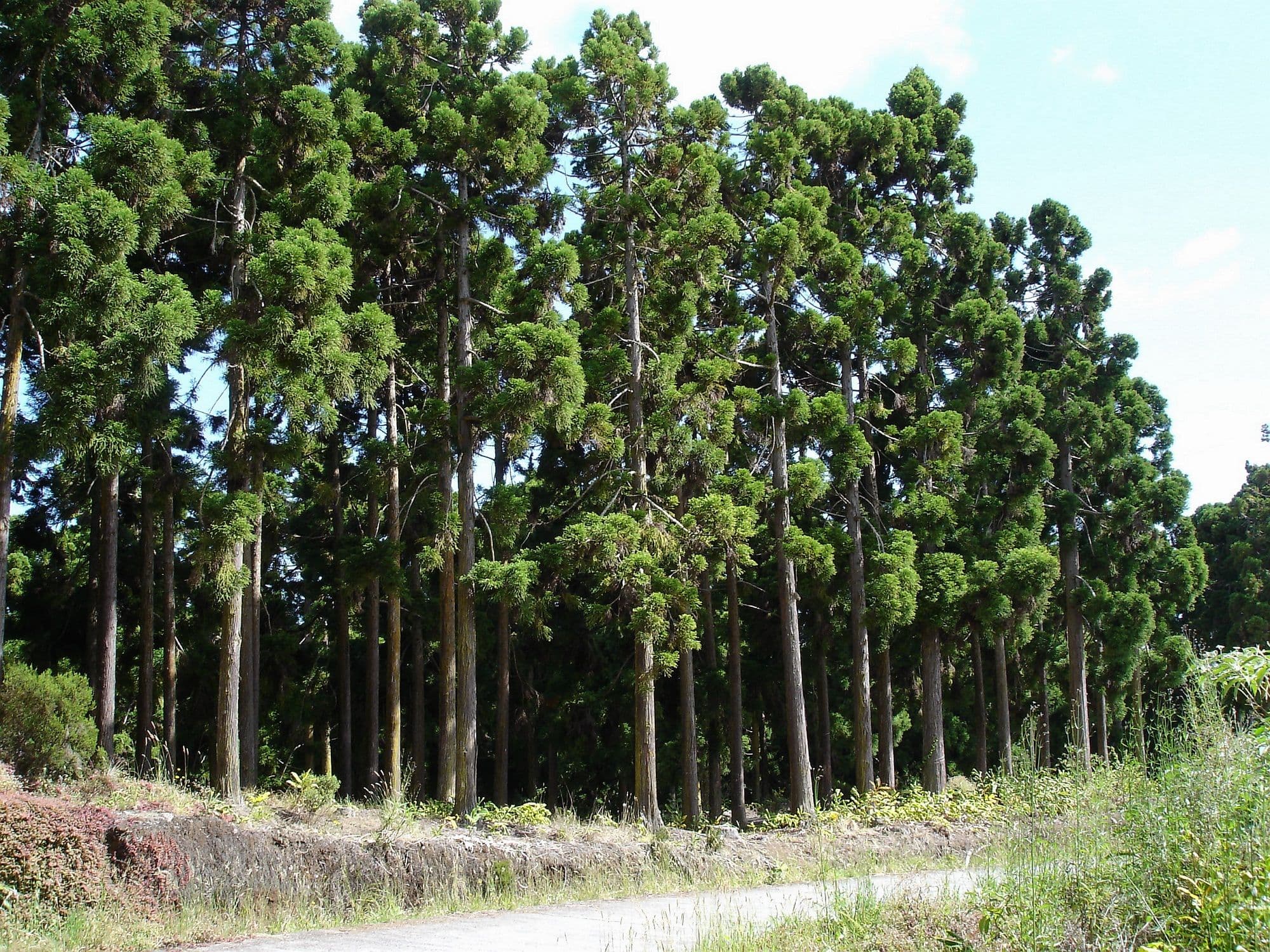

Sugi, also known as Cryptomeria, Japanese cypress, or Japanese cedar, is a large evergreen tree that originates from the forests of Japan. It is scientifically known as Cryptomeria japonica and belongs to the Cupressaceae family. Sugi is the national tree of Japan and is highly regarded for its cultural, economic, and environmental significance. It has a distinct, pyramid-like shape, with dense foliage and reddish-brown bark that peels off in vertical strips. Its size can range from 20 to 35 meters in height, but in optimal conditions, it can grow up to 70 meters tall.
Its needle-like leaves are arranged spirally and are dark green in color. They give off a pleasant, slightly lemony fragrance when crushed. The cones are spherical, about 1-2 cm in diameter, and contain numerous winged seeds. Sugi trees usually start to produce seeds at the age of 30 and continue to do so throughout their lifespan which can extend beyond 1000 years. The wood of the Sugi tree is lightweight, resistant to decay, and has a beautiful straight grain, making it highly valuable for construction, furniture, and paper production.
Sugi has been extensively cultivated in Japan for centuries. The planting of Sugi trees was particularly encouraged during the Edo period (1603-1868) to provide timber for construction. As a result, vast monoculture plantations of Sugi were established, which today cover about 44% of Japan's total forested area. However, the extensive planting of Sugi has also led to some environmental issues. Being a non-native species in many areas it was planted, Sugi has caused adverse effects on local biodiversity. Furthermore, many people in Japan suffer from hay fever caused by the pollen of Sugi trees.
Despite these issues, Sugi remains an important part of Japanese culture and economy. It is often planted in sacred groves surrounding Shinto shrines and Buddhist temples. Its wood is used in the construction of traditional Japanese buildings, such as shrines, temples, and teahouses. It is also used for making sake barrels, musical instruments, and various household items. In addition, Sugi is a popular ornamental tree in parks and gardens, admired for its majestic stature and beautiful foliage. With proper management, the Sugi plantations can also provide essential ecosystem services, such as carbon sequestration, soil erosion control, and water regulation.
For many centuries, Sugi has been used in traditional Japanese medicine. Its leaves, bark, and wood are used in various treatments, such as for skin diseases, respiratory problems, and rheumatism. The essential oil extracted from Sugi has antibacterial, antifungal, and insect-repellent properties. It is also used in aromatherapy for its soothing and calming effects.
In conclusion, Sugi is a remarkable tree species with a long history of use in Japan. Its versatility and resilience make it a valuable resource, while its cultural significance makes it a symbol of national pride. Despite the challenges posed by its extensive cultivation, with careful management and sustainable practices, Sugi can continue to play an important role in Japan's forests and society for many generations to come.
As climate change presents new challenges, research is being conducted to develop Sugi varieties that are more resistant to drought, disease, and pests. These efforts, along with sustainable forestry practices, will be crucial in ensuring the long-term survival and prosperity of this iconic tree species.
The Sugi, or Japanese Cedar, is a significant tree in Japanese culture, economy, and ecology. Officially known as Cryptomeria japonica, it is the national tree of Japan. The Sugi tree is unique because of its rapid growth and high commercial value. It is strongly associated with Japanese tradition and aesthetics, making it a prominent feature in many landscapes and architectural designs.
Historically, Sugi has been a crucial component of the Japanese timber industry. Its timber is of high quality, durable, and resistant to rot, making it ideal for construction. Sugi wood has been used extensively in building temples, shrines, and houses, as well as for making furniture and tools. The wood is also used in producing various products including paper, plywood, and fiberboard. The Sugi tree, due to its fast growth, has been extensively planted for reforestation and timber production. This has led to it being one of the most important commercial tree species in Japan.
Aside from its economic value, Sugi also holds cultural and spiritual significance for the Japanese people. It is often found in temple grounds and Shinto shrines, symbolizing sacred spaces and providing a connection to the divine. The tree is highly revered in Shintoism, the indigenous religion of Japan, where it is believed to house kami, or spirits. This spiritual significance is also evident in the practice of planting Sugi trees in cemeteries, a tradition aimed at guiding the spirits of the deceased.
In recent times, the interaction between humans and Sugi has taken a different turn. The tree has been identified as a major cause of hay fever, affecting millions of people in Japan each year. The pollen from Sugi trees, which are released in large quantities during the spring, triggers allergic reactions in many people. This has led to various measures being taken to reduce the impact of Sugi pollen, including the development of low-pollen varieties and initiatives to replace Sugi trees with other species in urban areas.
Despite its drawbacks, the Sugi tree remains an integral part of Japan. Its importance to the economy and the culture of the country cannot be overstated. From its role in the timber industry to its spiritual significance, the Sugi tree has been and continues to be a vital component of Japanese life. As such, it is crucial that sustainable practices are employed in the management of Sugi forests to ensure their continued existence and contribution to Japanese society.
Efforts are also underway to mitigate the negative effects of Sugi pollen on human health. These include the use of technology to forecast pollen levels and provide early warnings, as well as research into effective treatments for hay fever. Through these efforts, it is hoped that the relationship between humans and the Sugi tree can continue to flourish in a way that benefits both the environment and society.
Sugi is also used in the production of sake, a traditional Japanese rice wine. The clear water necessary for sake brewing is often filtered through charcoal made from Sugi wood. This is said to contribute to the unique flavor of the beverage. In addition, the barrels used to store and transport sake are often made from Sugi, as the wood is believed to improve the taste of the sake over time.
Overall, the Sugi tree serves as a symbol of Japanese identity, reflecting the country's deep connection to nature and its commitment to sustainable forestry. Despite the challenges posed by hay fever, the Sugi tree remains an important resource, providing valuable timber and playing a key role in cultural and spiritual practices. As such, the ongoing interaction between humans and the Sugi tree is a testament to the resilience and adaptability of both nature and human society.
The Sugi tree, also known as Japanese Cedar, is a tree of immense cultural and symbolic significance in Japan. Scientifically known as Cryptomeria japonica, this evergreen coniferous tree is native to Japan and is often found in the country's temperate rainforest zones. The tree is valued not only for its considerable height, which can reach up to 70 meters, but also for its straight trunk which makes it ideal for building purposes.
The Sugi tree plays an important role in Shinto, Japan's indigenous religion. Shinto places a heavy emphasis on the worship of natural elements, and the Sugi tree, with its towering height and majestic appearance, is considered sacred. Many Shinto shrines are traditionally built using Sugi wood, and the tree itself is often found growing within the precincts of these shrines. This is a manifestation of the deep respect and veneration that the Japanese people have for nature, and the Sugi tree is a potent symbol of this reverence.
In addition to its religious significance, the Sugi tree also has a prominent place in Japanese folklore and mythology. It is often associated with longevity and eternity, due to its evergreen nature and its ability to live for hundreds or even thousands of years. It is also considered a symbol of power and strength, thanks to its towering height and robust structure. A popular Japanese folklore tells the story of a giant Sugi tree that was so tall, it reached up to the heavens. The gods, impressed by the tree's strength and perseverance, made it a bridge between the earth and the heavens.
The Sugi tree has also been significant in Japan's history and economy. It was widely used in construction due to its durability and resistance to rot. The wood of the Sugi tree has been used to build temples, shrines, and castles throughout Japan's history. Today, it is still an essential resource in the construction industry, especially for traditional Japanese architecture. The Sugi tree's economic importance is further emphasized by the fact that it is one of the most commonly cultivated trees in Japan, being grown for timber production.
Aside from its economic and religious importance, the Sugi tree also holds a special place in the hearts of the Japanese people for its aesthetic appeal. The tree's distinct, slightly spiraled foliage and reddish-brown bark make it a favorite among horticulturists and garden enthusiasts. The sight of a grove of Sugi trees, especially when shrouded in mist, is a quintessential image of the Japanese landscape and is often depicted in traditional Japanese art and literature.
The Sugi tree is also a symbol of resilience. Despite being susceptible to certain diseases and pests, it can withstand harsh conditions and continue to grow. This characteristic is often paralleled to the Japanese spirit of perseverance and resilience in the face of adversity. It is no wonder that the Sugi tree was designated as Japan's national tree in 1947, a testament to its deep-rooted significance in the country's culture and history.
However, it is worth noting that the Sugi tree is also a cause of concern in Japan due to the increasing number of people suffering from hay fever caused by its pollen. Despite this issue, the Sugi tree continues to be an integral part of Japan's culture and identity. Efforts have been made to breed low-pollen varieties of the tree to help reduce the incidence of hay fever.
In conclusion, the Sugi tree, or the Japanese Cedar, is more than just a tree in Japan. It is a symbol of the country's culture, history, and spirit. Whether it is in its role in Shinto rituals, its representation in folklore and mythology, its contribution to the economy, or its aesthetic appeal, the Sugi tree embodies the values and traditions that are deeply ingrained in Japanese society. Its cultural and symbolic significance is a testament to the profound respect and veneration that the Japanese people have for nature.
The Japanese Cedar, known as Sugi in Japan, is a tree that holds a unique aesthetic and experiential significance in Japanese culture. Its towering presence and lush green foliage contribute significantly to the picturesque landscapes of Japan, creating a serene and tranquil environment that is deeply ingrained in the Japanese aesthetic.
Sugi trees, with their straight trunks and symmetrical structure, are considered symbols of endurance and longevity in Japan. The oldest living Sugi tree is estimated to be over 2000 years old, a testament to their robustness and resilience. The aesthetic appeal of these trees is heightened by their rich green color which changes subtly with the seasons, offering a visual treat to the onlooker.
The Japanese Cedar is not just a feast for the eyes, but it also plays a significant role in the sensory experiences of Japan. The scent of Sugi wood is distinctive and aromatic, often used in incense and aromatherapy for its calming and soothing properties. The sound of the wind rustling through the Sugi trees creates a harmonious and peaceful ambiance, contributing to the overall sensory experience of the Japanese landscape.
In terms of tactile experiences, the bark of the Sugi tree is rough and rugged, providing a contrast to the smooth and straight trunk. The texture of the Sugi wood is appreciated in Japanese homes where it is commonly used for flooring, furniture, and interior design. The wood grain of Sugi is straight and uniform, adding to its aesthetic appeal.
The Sugi tree also holds a significant place in Japanese spirituality and Shintoism. It is considered sacred and is often found in the vicinity of Shinto shrines, contributing to the spiritual ambiance. The Sugi tree is also associated with purification rituals in Shintoism, further enhancing its spiritual significance.
Another aspect that enhances the aesthetic value of the Sugi tree is its seasonal variations. During the spring, the new growth on the Sugi tree is a bright, fresh green which gradually darkens over the summer. In the autumn, the foliage turns a beautiful reddish-brown before falling off, leaving the tree bare and stark against the winter sky.
The cultural significance of the Sugi tree is also reflected in various art forms in Japan. From traditional ink paintings to modern photography, the Sugi tree is a common motif, representing the timeless beauty and resilience of nature. The aesthetic and experiential aspects of the Sugi tree are deeply intertwined with the cultural fabric of Japan, making it a symbol of Japanese aesthetics and sensibilities.
In conclusion, the aesthetic and experiential attributes of the Sugi tree extend beyond its physical characteristics. Its symbolic significance, cultural representation, and sensory experiences contribute to a deeper appreciation of this unique tree. The Sugi tree, with its beauty and resilience, embodies the essence of Japanese aesthetics, creating an experience that is profound and deeply moving.