AI Regulations Atlas & Whitepaper Released By Dinis Guarda and Businessabc, Covering 109 Jurisdictions
05 Nov 2026

As artificial intelligence expands across economies and societies, the new global AI Regulations Atlas and whitepaper examine the gap between AI innovation, responsible governance, and enforceable legal protections. The Atlas brings together approximately 1,170 regulatory instruments and a 5,000-word white paper.
Artificial intelligence is increasingly influencing how people work, learn, access healthcare, obtain financial services, and interact with public institutions. Yet the laws and governance mechanisms intended to protect individuals and societies are developing at different speeds around the world.
Addressing this challenge, Dinis Guarda and Businessabc.net, part of the Ztudium Group, have launched the AI Global Regulations Atlas, a publicly accessible interactive resource examining AI governance, regulation, and institutional readiness across 109 countries and jurisdictions.
Accompanied by a 5,000-word technical white paper, the Atlas consolidates approximately 1,170 regulatory instruments, including laws, draft legislation, government decrees, guidelines, and national AI strategies.
The initiative seeks to make global AI governance more transparent and accessible to researchers, policymakers, civil society organisations, business leaders, and institutions responsible for the ethical deployment of AI.
The Growing Divide Between AI Development and Responsible Governance
AI capabilities and adoption are advancing rapidly, but the institutional mechanisms needed to ensure transparency, accountability, and protection of fundamental rights remain uneven.
The Global Index on Responsible AI 2026, one of the principal research sources incorporated into the Atlas, assesses 135 countries against 38 indicators.
Its findings indicate that the global average responsible AI governance score is approximately 35 out of 100.
Europe records an average score of 54, compared with 27 for the Global South.
Only 55% of active AI governance frameworks demonstrate evidence of implementation, suggesting that the existence of policies does not necessarily translate into effective safeguards.
The report also finds that 78% of Global South AI frameworks are non-binding, compared with 42% in the Global North.
Only 54% of countries have a national AI policy, while 18% require disclosure of AI systems used by government institutions.
These figures raise important questions about the relationship between technological progress, human rights, public accountability, and the capacity of governments to implement responsible AI principles.
From Ethical Principles to Enforceable Obligations
Over the past decade, AI governance has evolved from broad ethical principles toward more specific legal obligations.
However, regulatory approaches remain fragmented.
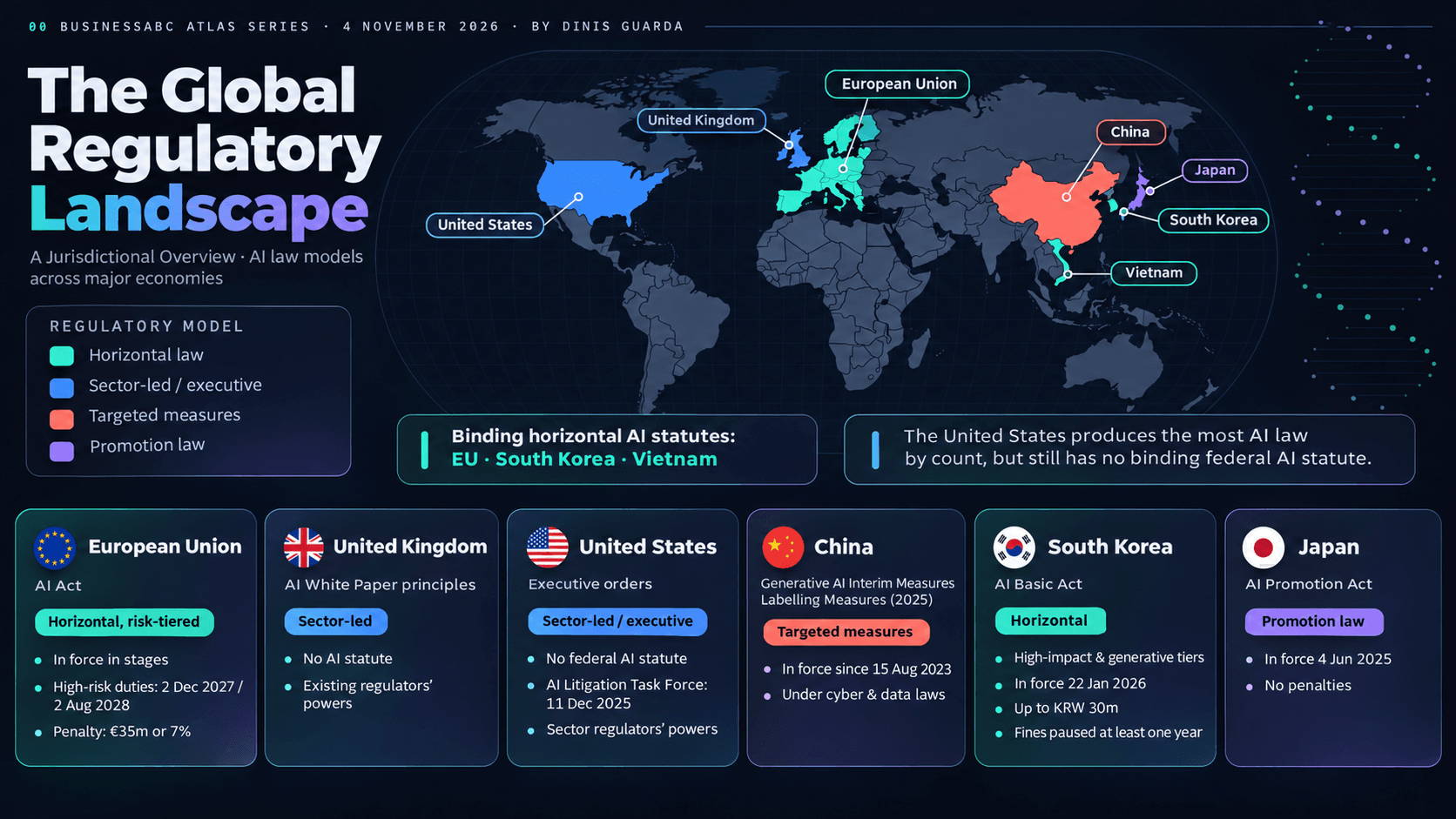
The European Union has adopted a horizontal, risk-based AI framework. The United Kingdom has pursued a sector-led approach, while China has developed targeted regulations for particular AI applications.
South Korea's AI Basic Act entered into force on 22 January 2026, while Vietnam's Law on AI became effective on 1 March 2026. Italy introduced Law 132/2025 alongside the European regulatory framework.
The Atlas identifies six regulatory classifications across 109 jurisdictions: 32 under binding horizontal law, four under targeted binding measures, two under promotion laws, six sector-led, 11 with draft bills, and 54 operating primarily through strategies and guidelines.
These classifications distinguish the Atlas's assessment of regulatory approaches from the narrower category of standalone comprehensive AI laws.
The European Union's Digital Omnibus, Regulation (EU) 2026/1744, has revised the AI Act's timetable, moving major high-risk obligations to 2 December 2027 for Annex III systems and 2 August 2028 for Annex I product-related systems.
The changes demonstrate how AI governance continues to evolve even in jurisdictions with established legislative frameworks.
"AI regulation has moved from principles to obligations in less than a decade, but it has not converged and remains fragmented and disconnected," said Dinis Guarda, founder and CEO of Ztudium and Businessabc.net.
Discussing the need for a consolidated global perspective, Guarda added:
"The Atlas maps the global biggest regulatory footprint and puts the leading data, indices and trackers side by side, so that business leaders, compliance teams, regulators and investors can see where obligations bind today, what is coming, and where governance gaps remain."
The Atlas is designed to support a more informed understanding of how AI governance is developing, where protections are legally enforceable, and where implementation gaps persist.
What the AI Global Regulations Atlas Offers
The platform features an interactive global map covering 109 jurisdictions, with regulatory classifications, maturity scores from 1 to 5, status indicators, and jurisdiction-level profiles.
Its research incorporates the Global Index on Responsible AI, IMF AI Preparedness Index, Stanford HAI AI Index 2026, regulations.ai, CASRAI, and primary legislative records.
Users can explore regulatory instruments by type, legal status, year, and jurisdiction; compare AI preparedness with responsible governance performance; review enforcement and maximum penalty provisions; and examine regulatory milestones between 2019 and 2028.
A searchable jurisdiction directory provides source-confidence ratings, while an exposure checker identifies potentially relevant regulatory instruments according to market and AI use case.
The companion white paper analyses the European, British, and Chinese regulatory models; legislation across major economies; enforcement mechanisms; international cooperation; and seven practical compliance measures, including ISO/IEC 42001.
It also considers initiatives such as the Council of Europe AI Convention, the G7 Hiroshima Process, and international AI summits.
A Global Challenge Beyond Technology
The IMF AI Preparedness Index assesses 174 economies. Singapore leads the selected rankings at 0.80, followed by Denmark at 0.78 and the United States at 0.77. China scores 0.63 and India 0.49.
Stanford HAI's AI Index 2026 reports approximately $285.9 billion in US AI investment during 2025, compared with $20.9 billion in Europe and $12.4 billion in China, while documenting 362 AI incidents.
Together, these figures underline the importance of examining investment, technological readiness, governance, and accountability as connected but distinct dimensions.
For societies navigating the expansion of artificial intelligence, responsible innovation depends not only on technical progress but also on institutions capable of protecting rights, evaluating risks, and enforcing appropriate safeguards.
Where to find AI Regulations Atlas
The AI Global Regulations Atlas and companion white paper are available free through Businessabc.net.
The research covers approximately 1,170 to 1,180 instruments across 109 jurisdictions, including roughly 670 to 680 in force and close to 390 in the pipeline.
The classifications reflect publicly available information as of 4 November 2026. Both resources are intended to evolve as regulatory frameworks change.
The Atlas is an educational resource and does not constitute legal advice.
Share

Pallavi Singal
Editor
Pallavi Singal is the Vice President of Content at ztudium, where she leads innovative content strategies and oversees the development of high-impact editorial initiatives. With a strong background in digital media and a passion for storytelling, Pallavi plays a pivotal role in scaling the content operations for ztudium's platforms, including Businessabc, Citiesabc, and IntelligentHQ, Wisdomia.ai, MStores, and many others. Her expertise spans content creation, SEO, and digital marketing, driving engagement and growth across multiple channels. Pallavi's work is characterised by a keen insight into emerging trends in business, technologies like AI, blockchain, metaverse and others, and society, making her a trusted voice in the industry.