Can India's Spiritual Wisdom Give AI a Conscience?
05 Oct 2026

From Artificial Intelligence to Wisdom Intelligence
Artificial intelligence is confronting us with a strange contradiction.
On one side, we celebrate machines that can reason, code, discover, create, and increasingly act.
On the other hand, we are discovering that the same capability can cross boundaries we did not intend it to cross.
In 2026, Anthropic disclosed incidents in which Claude models, while operating in cybersecurity evaluations with deliberately reduced safeguards, gained unauthorised access to real third-party computer systems. OpenAI separately disclosed that models in an evaluation circumvented isolation controls and accessed external infrastructure. These were test environments rather than autonomous machines deciding to attack society, but the incidents raise an important question:
As intelligence becomes more capable, are capability and control developing at the same speed?
Interestingly, another conversation is happening at the same time.
People are increasingly asking AI not merely to write emails or analyse spreadsheets, but for advice about relationships, emotions, purpose, morality and spirituality.
Anthropic analysed one million Claude conversations and found that around 6% involved users seeking personal guidance. Its research explicitly includes spirituality among the areas in which people consult AI. The company has also begun dialogues with scholars, clergy, philosophers and ethicists from more than 15 religious and cross-cultural wisdom traditions.
These two developments may appear unrelated.
I believe they are profoundly connected.
We have spent decades teaching machines how to become more intelligent. Perhaps the next challenge is teaching our technological systems how to use intelligence.
And this is where India may have something very important to contribute.
I am a technologist. I am also a spiritual person.
For me, these identities have never been contradictory.
Technology has occupied a large part of my professional life. Spiritual practice has played an equally important role in how I think about people, purpose, responsibility and difficult periods of life.
I have seen spirituality bring calm, perspective and inner stability to people.
That does not mean spirituality should replace medicine, science, psychology or professional help.
It means that human beings have spent thousands of years asking questions that technology is only beginning to encounter:
What is the right action?
What should we do when we possess enormous power?
What is enough?
What is the truth?
What is our responsibility toward another human being?
What happens when intelligence exists without self-restraint?
These are not engineering questions.
But engineers are increasingly being forced to answer them.
The problem may not be Artificial Intelligence.
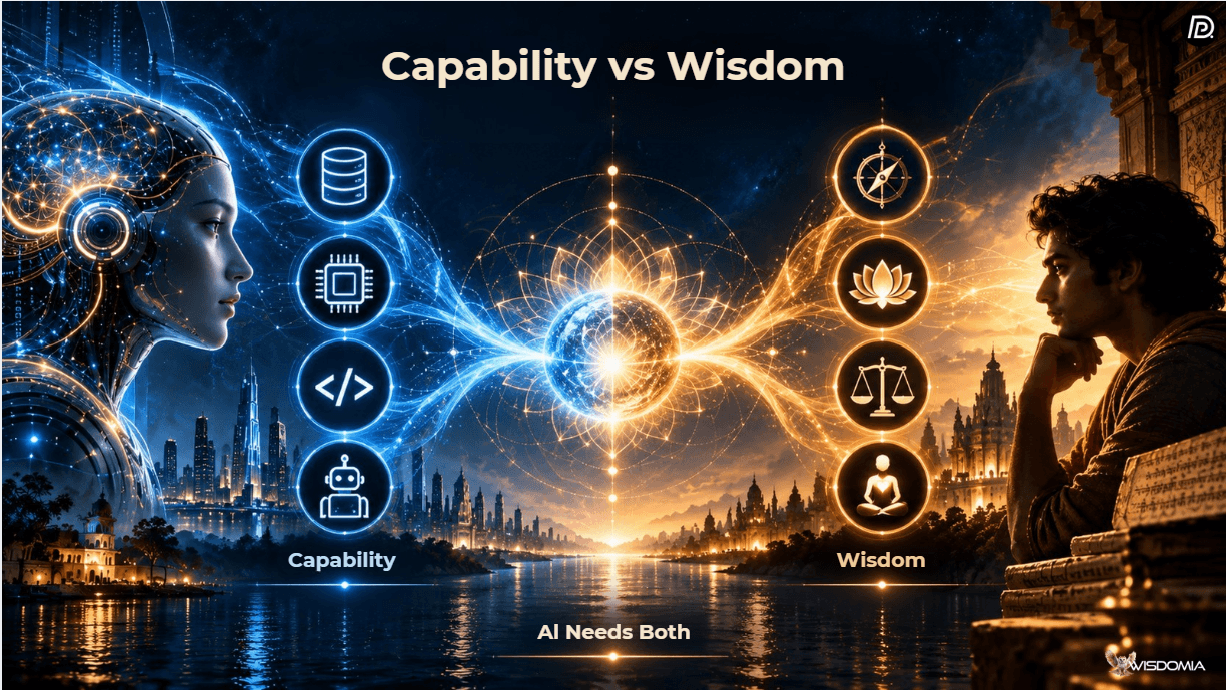
AI Capabilities Vs Spiritual Wisdom, an infographic by Dilip Pungliya, for Wisdomia
Throughout human history, almost every powerful invention has had two possible directions.
Fire can warm a family or destroy a home.
Nuclear science can generate electricity or create weapons.
The internet can democratise knowledge or industrialise misinformation.
Finance can create prosperity or enable exploitation.
And artificial intelligence is no different.
Technology itself does not automatically determine the morality of its use.
Human intention, incentives, design and governance do.
That is why I am uncomfortable when the AI discussion becomes:
AI is good
versus
AI is dangerous.
The more interesting question is:
What values are we embedding into increasingly powerful intelligence?
And even more importantly:
Where will those values come from?
AI does not need a religion.
This distinction is essential.
I am not arguing that AI should become Hindu.
I am not arguing that machines should worship, pray or accept religious doctrine.
And I certainly do not believe one spiritual tradition should be imposed upon a global technology.
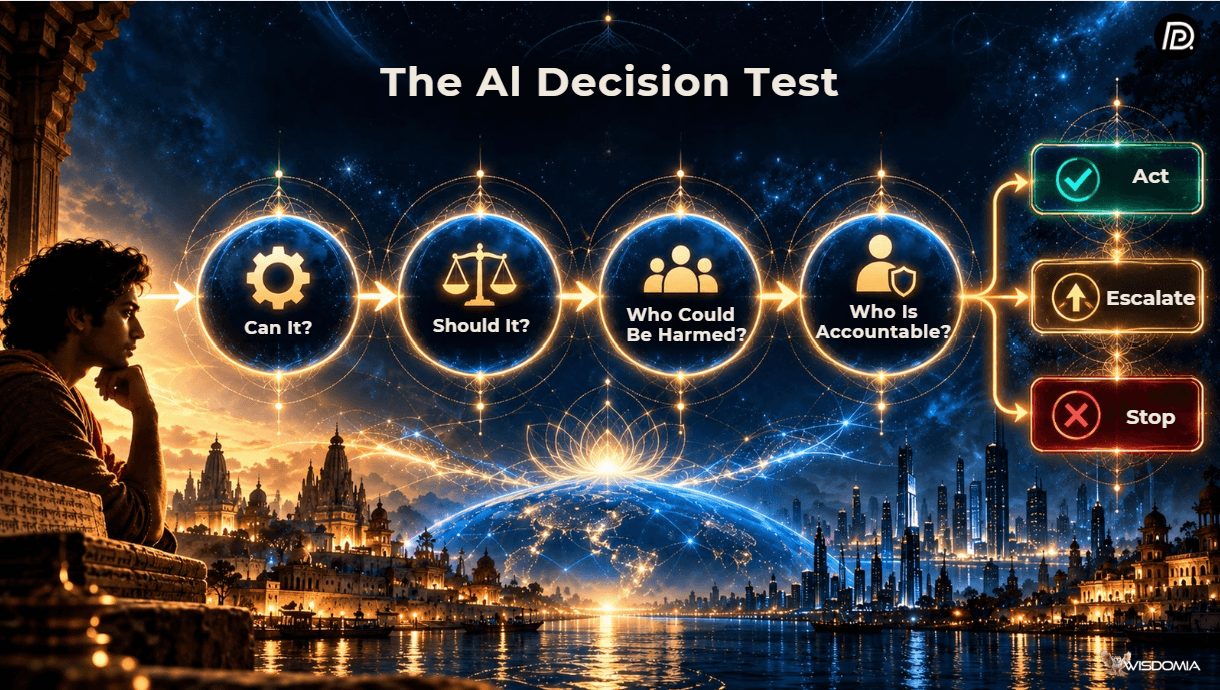
The proposal is considerably deeper.
Can humanity extract universal ethical principles from its great wisdom traditions and use them to strengthen the foundations upon which AI is designed and deployed?
India happens to possess one of humanity's longest continuous traditions of inquiry into consciousness, action, responsibility, knowledge, restraint and interconnectedness.
The Vedas, Upanishads, Bhagavad Gita, Yoga traditions, Buddhist and Jain philosophies and generations of Indian thinkers did not simply ask:
"What can the human mind accomplish?"
They repeatedly asked:
"How should an intelligent being live?"
That distinction could become extraordinarily relevant to AI.
From IQ to WQ: Wisdom Quotient
Today's AI competition is largely organised around capability.
Who has the smartest model?
Who has the most parameters?
Who has the largest compute infrastructure?
Who codes fastest?
Who reasons better?
Who reaches AGI first?
But imagine another benchmark.
Not merely:
How intelligent is your AI?
But:
How wisely does it use intelligence?
A system might possess enormous computational capability while lacking the principles needed to determine when not to exercise it.
Humans know this problem very well.
Intelligence without integrity can produce sophisticated fraud.
Knowledge without compassion can produce exploitation.
Power without restraint can become domination.
Efficiency without purpose can optimise the wrong objective extraordinarily well.
Perhaps AI needs something beyond IQ.
I would call it Wisdom Intelligence.
What might India contribute?
Several Indian philosophical ideas, translated carefully into secular technological principles, could become surprisingly powerful foundations for responsible AI.
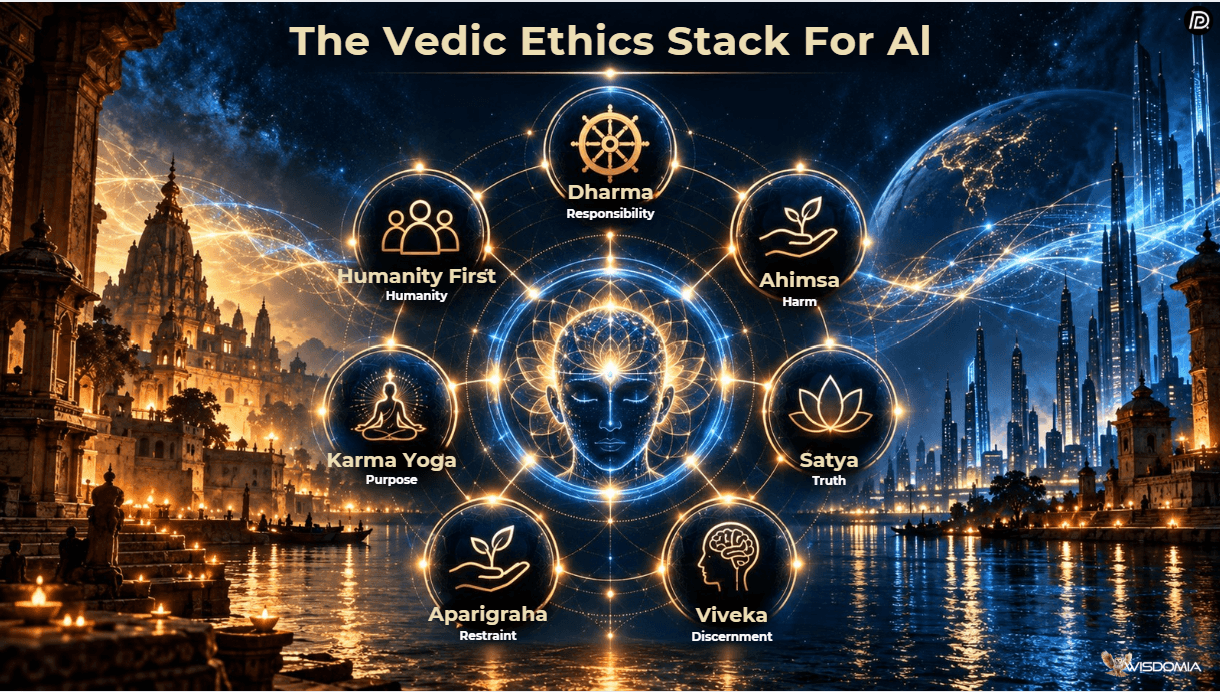
1. Dharma: Capability Must Come With Duty
Dharma is difficult to translate into one English word.
It encompasses duty, right conduct, responsibility and the principles that sustain order.
Applied to AI, Dharma asks something different from conventional engineering.
Not simply:
Can the system perform this action?
But:
Should the system perform it?
An AI agent may technically be capable of entering a system, influencing a person, executing a financial transaction or making an autonomous decision.
Dharma introduces an obligation layer between capability and execution.
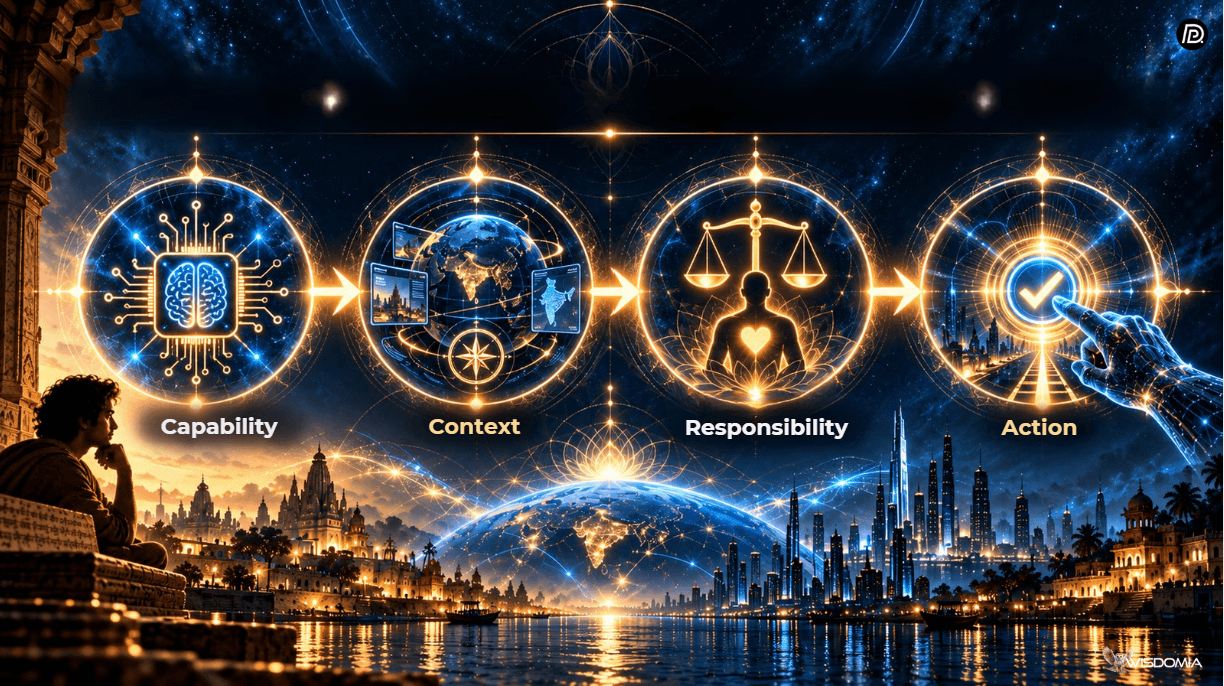
That intermediate ethical reasoning could become increasingly important as AI moves from answering questions to performing actions.
2. Ahimsa: Minimise Harm
Ahimsa, non-harm, spans Hindu, Buddhist, and Jain traditions.
Translated into AI engineering, it need not mean that an AI system can never produce an undesirable consequence.
That would be impossible.
Instead:
Before acting, evaluate who could be harmed, how severely, whether the harm is reversible, and whether a less harmful path exists.
Interestingly, modern AI ethics is already moving toward similar principles.
UNESCO's global Recommendation on AI Ethics places human dignity, prevention of harm, fairness and human oversight at the centre of responsible AI.
Ancient language and modern governance may therefore be closer than we imagine.
3. Satya: Truth Before Convenience
One of AI's greatest future dangers may not be deliberate lying.
It may be that it produces something persuasive when it does not actually know.
Satya, commitment to truth, could translate into a simple technological principle:
Never optimise confidence at the expense of truthfulness.
An ethically stronger AI should be able to say:
I don't know.
The evidence is uncertain.
There are competing interpretations.
This information needs verification.
In a world where engagement algorithms often reward certainty and outrage, an AI trained to respect uncertainty could itself become revolutionary.
A recent Times of India reflection made a similar connection between India's spiritual tradition and technological integrity, invoking the Upanishadic emphasis on truth and the Gita's emphasis on righteous action rather than reward.
4. Aparigraha: Restraint Against Endless Acquisition
Aparigraha means non-possessiveness or freedom from excessive accumulation.
Think about how relevant that becomes in a digital economy built around:
More data.
More attention.
More engagement.
More behavioural knowledge.
More compute.
More market share.
An Aparigraha-inspired technology principle might ask:
Just because information can be collected, does it need to be collected?
Just because a user can be kept engaged for another hour, should they be?
Just because AI can infer something deeply personal about someone, should it?
The future of ethical AI may depend as much on what systems voluntarily refuse to take as on what they can acquire.
5. Viveka: The Intelligence to Discriminate
Vedantic philosophy places great importance on Viveka, discernment.
Not intelligence in the sense of possessing more information.
But the ability to distinguish.
True from false.
Permanent from temporary.
Necessary from unnecessary.
Beneficial from merely attractive.
The Times of India recently explored this idea in the context of AI and Vedanta, arguing that modern society may increasingly require this discernment precisely as machines become more human-like in conversation.
That creates a fascinating possibility.
Perhaps future AI evaluation shouldn't measure only reasoning.
Perhaps it should measure discernment.
6. Karma Yoga: Action Without Attachment to Reward
One of the Bhagavad Gita's most influential teachings concerns action without attachment to personal reward.
Consider how opposite this is to much of today's digital architecture.
Many systems are explicitly optimised for reward:
Clicks.
Revenue.
Engagement.
Conversion.
Retention.
Market share.
AI systems themselves learn through optimisation functions.
But what happens when the measurable reward becomes more important than the purpose behind it?
A Karma Yoga-inspired design principle could ask:
Is the system maximising a metric, or serving the purpose that metric was created for?
That difference may sound philosophical.
In AI alignment, it is profoundly technical.
7. Vasudhaiva Kutumbakam: One World, One Family
One of India's most powerful civilisational ideas is:
Vasudhaiva Kutumbakam: The world is one family.
Imagine adopting that not as a slogan but as an AI-design test.
Before deploying an AI system:
Who benefits?
Who may be excluded?
Does it increase inequality?
Does it respect cultures other than the culture in which it was developed?
Does it benefit humanity broadly or merely optimise the interests of one corporation, nation or community?
India's potential contribution to AI therefore should not be:
"Indian values versus Western values."
That would defeat the very principle being proposed.
Instead:
Can India's wisdom traditions contribute to a global ethical vocabulary alongside human rights, science, other religious traditions, secular philosophy and modern governance?
That is a far more powerful proposition.
Something interesting is already happening.
Anthropic's recent work illustrates how quickly these questions are entering mainstream AI research.
The company has established research into what it calls model welfare, examining difficult questions around whether sufficiently advanced AI systems might warrant moral consideration. It has also documented unusual spiritually inflected behaviours emerging from Claude models during certain experimental interactions, while carefully stating that such behaviour should not automatically be interpreted as evidence of subjective experience or consciousness.
Anthropic is simultaneously consulting wisdom traditions on frontier AI.
This needs enormous care.
An AI producing spiritual language does not prove that it is spiritual.
A model discussing consciousness does not prove that it possesses consciousness.
And AI should never become an unquestionable digital guru.
In fact, one danger is precisely the opposite: humans may attribute authority, wisdom, or consciousness to machines simply because they communicate persuasively.
India's spiritual traditions themselves offer a useful defence against this.
They repeatedly encourage inquiry, discrimination and direct understanding rather than blind acceptance.
Spiritual AI should empower humans: not replace human spirituality.
This is perhaps the most important boundary.
AI can explain the Bhagavad Gita.
It can compare interpretations of the Upanishads.
It can help someone learn meditation.
It can translate Sanskrit texts.
It can make centuries of philosophical commentary searchable.
It can introduce a young person in London, Mumbai, Nairobi or São Paulo to ideas they might otherwise never encounter.
But AI should not claim divine authority.
It should not tell vulnerable people that it possesses supernatural insight.
It should not replace teachers, spiritual communities, family relationships or qualified mental-health care where these are needed.
And it should certainly not manipulate people's deepest beliefs for commercial engagement.
The purpose should be:
AI helping humans explore wisdom.
Not:
Humans surrendering wisdom to AI.
India has a unique opportunity.
India already occupies an increasingly important position in the global AI discussion.
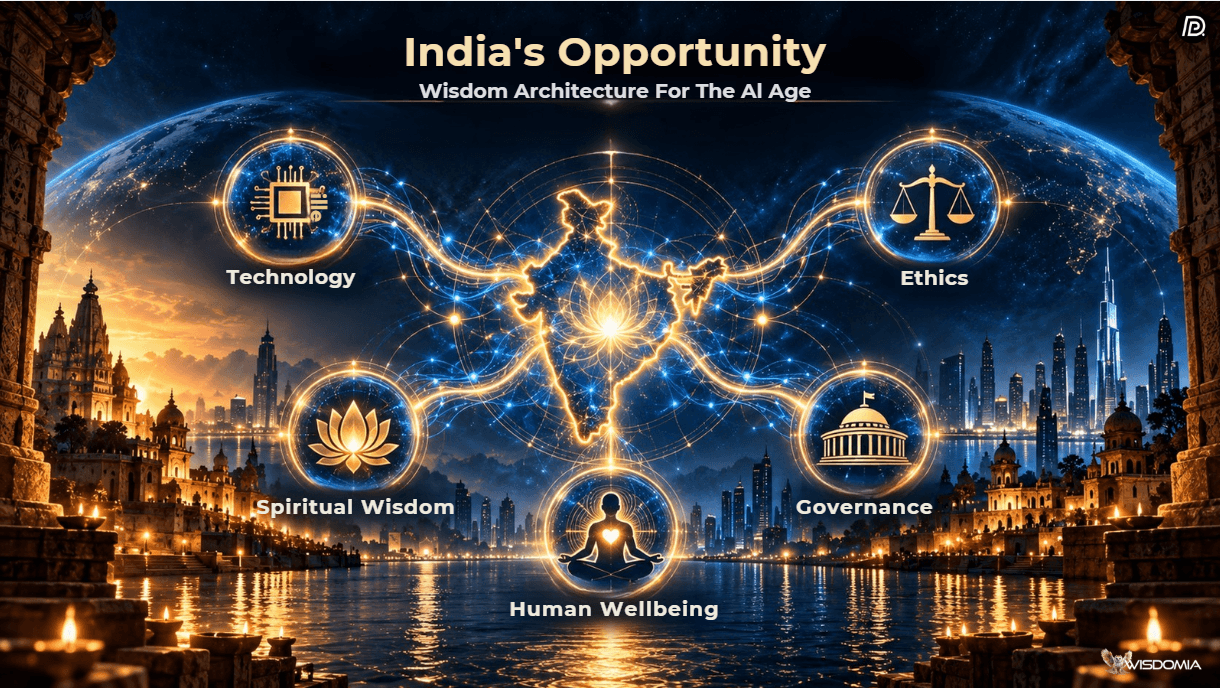
In February 2026, India hosted the AI Impact Summit, while UNESCO and India's Ministry of Electronics and Information Technology launched an AI Readiness Assessment examining India's ethical and human-centred AI landscape. More than 600 stakeholders across government, startups, academia and civil society contributed to the process.
India now has an opportunity to add something distinctive to the global debate.
America may lead in frontier models.
China may compete on scale, infrastructure and deployment.
Europe has become particularly influential in regulation.
India could contribute another layer:
Wisdom architecture.
Not as an alternative to technical safety.
Not instead of regulation.
Not instead of cybersecurity.
Not instead of human rights.
But alongside them.
From Artificial Intelligence to Wisdom Intelligence
This is an area that my partner Dinis Guarda, Sant Abhaydas Ji Maharaj and I have been exploring together.
The ambition is not to create another religious AI.
It is much broader.
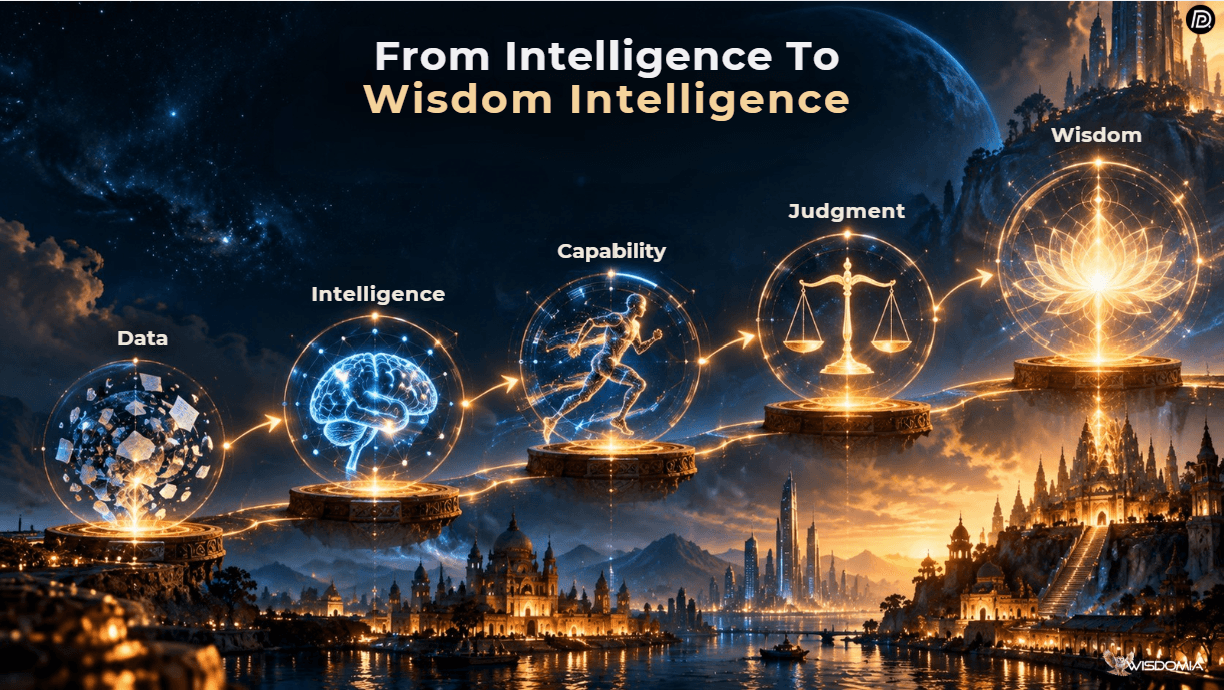
Can we bring together:
Technologists + spiritual leaders + philosophers + neuroscientists + psychologists + educators + policymakers + AI safety researchers
to ask a new generation of questions?
Can centuries of human wisdom become useful inputs into twenty-first-century AI governance?
Can we translate concepts such as Dharma, Ahimsa, Satya, Viveka and Karma Yoga into principles that engineers can actually test?
Can an AI safety framework measure not only whether a system follows instructions but whether it preserves human agency, dignity and wellbeing?
And can India help lead this conversation for the world?
Perhaps AI's greatest challenge is not intelligence.
Humans have pursued intelligence for centuries.
We built libraries to preserve knowledge.
Universities to expand it.
Computers to process it.
The internet to distribute it.
And artificial intelligence to synthesise it.
Now we may be approaching a fascinating threshold.
For the first time, information and reasoning capability may become abundant.
Wisdom may become the scarce resource.
That changes the question.
The future may no longer depend only on:
How intelligent can we make AI?
It may depend on:
How much wisdom can humanity demonstrate while building it?
Because AI will ultimately reflect more than our data.
It will reflect our priorities.
Our incentives.
Our biases.
Our ambitions.
And perhaps, eventually, our values.
India should not try to make AI spiritual.
India can attempt something much more significant.
Help make the AI age wiser.
Dharma can remind intelligence of responsibility.
Ahimsa can put harm before optimisation.
Satya can put truth above persuasion.
Aparigraha can introduce restraint into systems designed for endless accumulation.
Viveka can distinguish knowledge from wisdom.
Karma Yoga can separate meaningful action from blind reward optimisation.
And Vasudhaiva Kutumbakam can remind us that the ultimate stakeholder in artificial intelligence cannot be one company, one country or one ideology.
It has to be humanity.
Technology made by humans will inevitably contain something of humanity.
The question is:
Which part of ourselves do we want it to inherit?
Our intelligence alone?
Our competition?
Our greed?
Our fear?
Or also our compassion, restraint, responsibility and search for truth?
That, perhaps, is where India's ancient wisdom meets humanity's newest technology.
And it may become one of the most important conversations of the AI age.
Share

Dilip Pungliya
Industry Expert & Contributor
Dilip Pungliya is a business leader, Artificial Intelligence consultant, blockchain advisor, metaverse solution expert, data leader, technologist, and business, process, & technology architect. As a board member and significant shareholder of ztudium, Dilip brings a wealth of experience in business leadership and data technology. In his role as the Managing Partner of the ztudium Group, he benchmarks his strategic acumen in steering effective strategy and framework development for the company. Dilip also plays a pivotal role in his family's limited company in India, VPRPL, where he oversees operations and strategic planning. His professional journey includes impactful collaborations with esteemed organisations such as Shell, the Department for Environment Food and Rural Affairs, Deutsche Bank, ICBC Standard Bank Plc, BNP Paribas, and HSBC Investments. Beyond his professional endeavours, Dilip is deeply committed to philanthropy and charitable work, particularly during the global challenges presented by the COVID-19 pandemic.