Dinis Guarda Recognised by MSN Among 2026’s Inspiring Leaders Shaping AI, Knowledge and Human Innovation
06 Oct 2026

Dinis Guarda, founder and CEO of ztudium and creator of Wisdomia.ai, Businessabc and Citiesabc, has been featured by MSN among ten men recognised for their work across leadership, innovation, entrepreneurship, healthcare, communications and social impact in 2026. Compiled by digital PR and branding agency Presszila, the list also features Dr. Kanans Visvanats FRSC, Greg Aguirre, Dr. Keith L. Marshall, Tim Thomas, Mark Lee Hegarty, Dr. Craig Taylor, Maxim Behar, Dr. Ollie Evans and Anton Guinea. The recognition reflects Dinis’s broader work at the intersection of artificial intelligence, knowledge, education, human creativity and digital transformation.
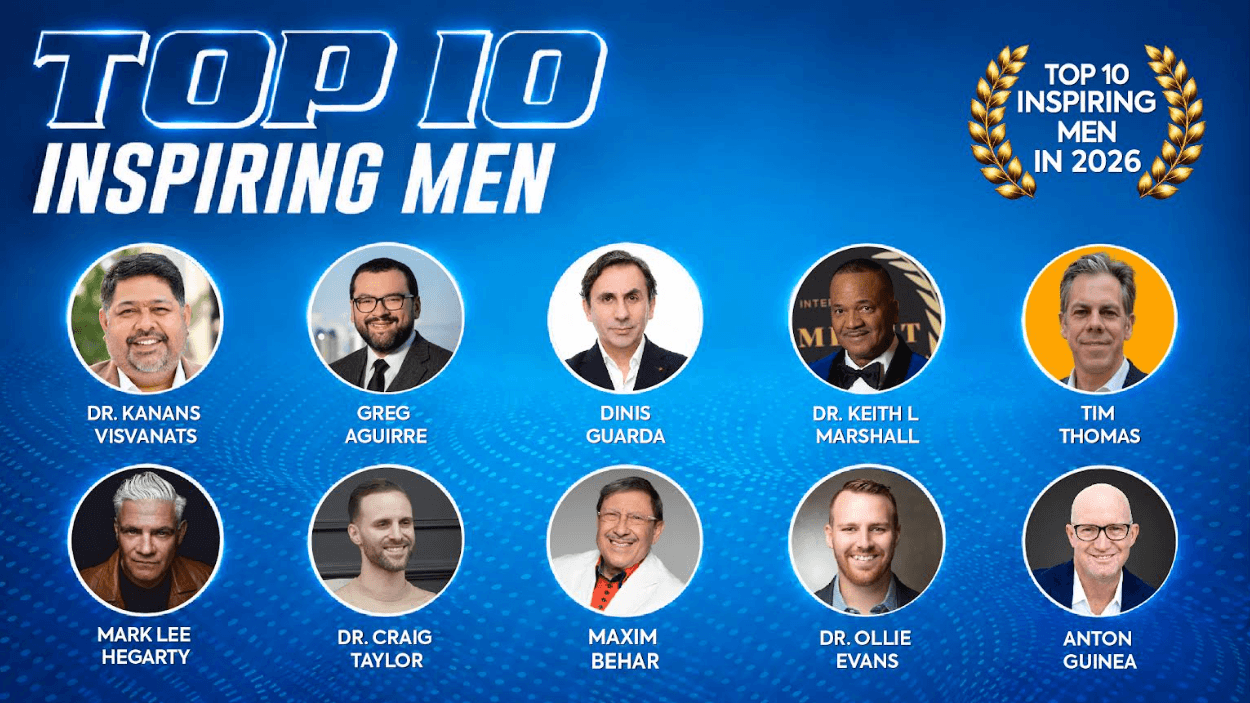
LONDON, October 2026 — Dinis Guarda, author, entrepreneur, global thought leader and founder and CEO of ztudium, has been named among the “Top 10 Inspiring Men You Should Know in 2026” in a feature published by MSN.
The list, compiled by digital PR and branding agency Presszila, brings together professionals working across technology, entrepreneurship, healthcare, communications, leadership and social impact.
Alongside Dinis, the feature includes Dr. Kanans Visvanats FRSC, Greg Aguirre, Dr. Keith L. Marshall, Tim Thomas, Mark Lee Hegarty, Dr. Craig Taylor, Maxim Behar, Dr. Ollie Evans and Anton Guinea.
Published through MSN, the feature reflects a broad view of contemporary leadership and brings together individuals whose work spans business, society, communications, health and technological transformation.
Dinis Guarda: AI, knowledge and human-centred intelligence
Dinis Guarda is an author, entrepreneur and global thought leader whose work spans artificial intelligence, digital transformation, smart cities, blockchain, fintech, digital identity, media and emerging technologies.
Through an ecosystem that includes Wisdomia.ai, Businessabc, Citiesabc, IntelligentHQ, Fashionabc, HedgeThink and TradersDNA, Dinis increasingly explores how artificial intelligence is changing the ways people learn, create, make decisions and engage with knowledge.
A recurring theme in his work is that intelligence should not be understood only as computation.
As AI systems become more capable, questions around knowledge, wisdom, creativity, ethics and human judgement are becoming more important. The challenge is therefore not simply how to build more powerful AI, but how to ensure that technology contributes to deeper understanding and meaningful human development.
This idea sits at the heart of Wisdomia.ai, a platform focused on the convergence of artificial intelligence, knowledge, education, culture and human intelligence.
From information to knowledge
The current AI era is defined by access to extraordinary amounts of information.
Generative AI can summarise texts, generate images, write code, analyse data and interact conversationally with users. Yet access to information does not automatically produce knowledge, and knowledge does not necessarily produce wisdom.
This distinction is increasingly important.
The next stage of AI development will require people and institutions to think more carefully about how knowledge is created, interpreted, validated and applied.
For Dinis, AI should therefore be understood not only as a productivity technology but also as a new layer within human knowledge systems.
Through initiatives including AI.DNA and Wisdomia.ai, Dinis explores AI agents, digital twins, immersive technologies and AI-powered learning environments, while maintaining a strong focus on human agency and critical thinking.
Leonardo da Vinci and interdisciplinary intelligence
Dinis is also the creator of Leonardo da Vinci: The Genius Mysteries, a 20-episode AI-powered documentary and edutainment project examining the life, ideas and interdisciplinary thinking of Leonardo da Vinci.
Leonardo represents a model of intelligence that is especially relevant to the age of AI.
His work moved across art, anatomy, engineering, mathematics, observation, philosophy and natural science. Rather than treating these areas as separate disciplines, he connected them through curiosity and experimentation.
That approach has renewed relevance in a technological environment increasingly shaped by artificial intelligence.
As machines become capable of operating across multiple domains, human value may increasingly depend on the ability to connect ideas, ask better questions, interpret complexity and combine knowledge from different fields.
The project therefore goes beyond biography. It uses one of history’s most interdisciplinary thinkers as a framework for exploring how curiosity, creativity and human judgement can remain central in the AI era.
AI and the future of education
Education is one of the areas most likely to be transformed by generative AI and intelligent agents.
AI systems can already provide personalised explanations, generate learning materials, translate content, support research and adapt educational experiences to individual users.
This creates significant opportunities for making knowledge more accessible, but it also changes what education may need to prioritise.
If AI can provide information almost instantly, the value of education increasingly extends beyond remembering facts toward developing critical thinking, judgement, creativity, interpretation and the ability to assess the quality of information.
The role of teachers and educators may consequently evolve from primarily delivering information toward helping learners make sense of increasingly complex knowledge environments.
Dinis’s work through Wisdomia reflects this transition from information delivery toward AI-assisted knowledge and education systems.
The wider objective is not simply to automate learning, but to use technology to strengthen human understanding.
Human intelligence in an age of artificial intelligence
The development of increasingly capable AI systems has renewed fundamental questions about the meaning of intelligence itself.
Human intelligence involves more than pattern recognition or calculation. It also encompasses context, lived experience, social understanding, imagination, judgement and the ability to create meaning.
AI may increasingly perform tasks traditionally associated with reasoning and knowledge work, but that does not remove the importance of distinctly human forms of intelligence.
Instead, the relationship between human and artificial intelligence may become one of the defining intellectual questions of this century.
Dinis’s work frequently focuses on this convergence: how people can use intelligent technologies while retaining agency, creativity and responsibility.
Rather than treating artificial and human intelligence simply as opposing forces, this approach explores how different forms of intelligence can interact and complement one another.
A career across knowledge, technology and innovation
Dinis has collaborated with organisations including UN/UNITAR, UNESCO, the European Space Agency, IBM and Siemens, and has lectured at institutions including Copenhagen Business School.
He has authored books including 4IR: AI, Blockchain, Fintech, IoT – Reinventing a Nation, exploring how emerging technologies are reshaping economies, institutions and society.
His work has also been recognised by Thinkers360 across areas including artificial intelligence, blockchain, fintech and smart cities.
Across his books, digital platforms, interviews, research and educational initiatives, Dinis has continued to explore how technology can be connected with knowledge, culture and human development.
What leadership means in the age of AI
The MSN recognition also points toward a broader question: what does leadership mean when technology is changing how people work, learn and communicate?
In the age of AI, leadership increasingly requires more than technical expertise.
It involves the ability to interpret complexity, connect different areas of knowledge, communicate ideas clearly and make decisions in environments shaped by rapid technological change.
It also requires judgement.
AI can generate and process information at extraordinary speed, but people and institutions still need to determine what matters, what is trustworthy, what is ethical and how information should ultimately be used.
This is where the distinction between information, knowledge and wisdom becomes particularly important.
Dinis’s inclusion in the MSN feature reflects his contribution to this wider conversation around artificial intelligence, education, interdisciplinary knowledge, creativity and human-centred technological development.
About Presszila
Presszila is a digital public relations and branding company founded in 2023 and led by CEO and Co-Founder Evelyn Foster.
The company works with businesses, entrepreneurs and brands seeking to strengthen their visibility through digital media and online publishing.
Its approach reflects the evolution of public relations in an environment where reputation and visibility are increasingly shaped by search engines, digital platforms, social media and AI-powered discovery systems.
As the ways people discover and engage with information continue to evolve, the relationship between media, knowledge and digital visibility is likely to become increasingly important.
Read the MSN feature:
https://www.msn.com/en-xl/news/other/top-10-inspiring-men-you-should-know-in-2026/ar-AA2dAk1Y
Share

Sara Srifi
Sara is a Software Engineering and Business student with a passion for astronomy, cultural studies, and human-centered storytelling. She explores the quiet intersections between science, identity, and imagination, reflecting on how space, art, and society shape the way we understand ourselves and the world around us. Her writing draws on curiosity and lived experience to bridge disciplines and spark dialogue across cultures.