
Durga, a revered and influential deity in Hinduism, is celebrated as a fierce warrior goddess who valiantly fights against evil and demonic forces. She embodies the principles of feminine strength, righteousness, and protection, symbolizing the triumph of good over evil. Her presence is especially honoured during the Navaratri festival, a significant event in India and Nepal, where she is widely worshipped.
Durga, also known as "the invincible" or "the inaccessible," is a principal Hindu figure associated with themes of strength, motherhood, destruction, and war. She is often depicted as a fierce warrior, defending peace and upholding dharma. Additionally, she is referred to as Mahashakti, representing the supreme power that encompasses the energies of all gods. Durga's distinct identity and story are intricately tied to Parvati, the consort of Shiva. Some traditions view her as an independent deity, while others see her as a remarkable manifestation of Parvati, reflecting the diverse beliefs within Hinduism.
The name Durga, rooted in Sanskrit, embodies the essence of 'the inaccessible' or 'the invincible.' 'dur' signifies difficulty, and 'ga' means to go. This influential figure is celebrated through many names and epithets, emphasising her incredible strength and victorious spirit. Durga's myriad names reflect specific meanings, showcasing her character's diverse and inspiring dimensions.
The various names attributed to her illuminate the many roles she embodies, showcasing the diverse ways her devotees connect with her. Each name reflects a unique and intriguing aspect of her power in maintaining cosmic balance and guiding spiritual liberation.
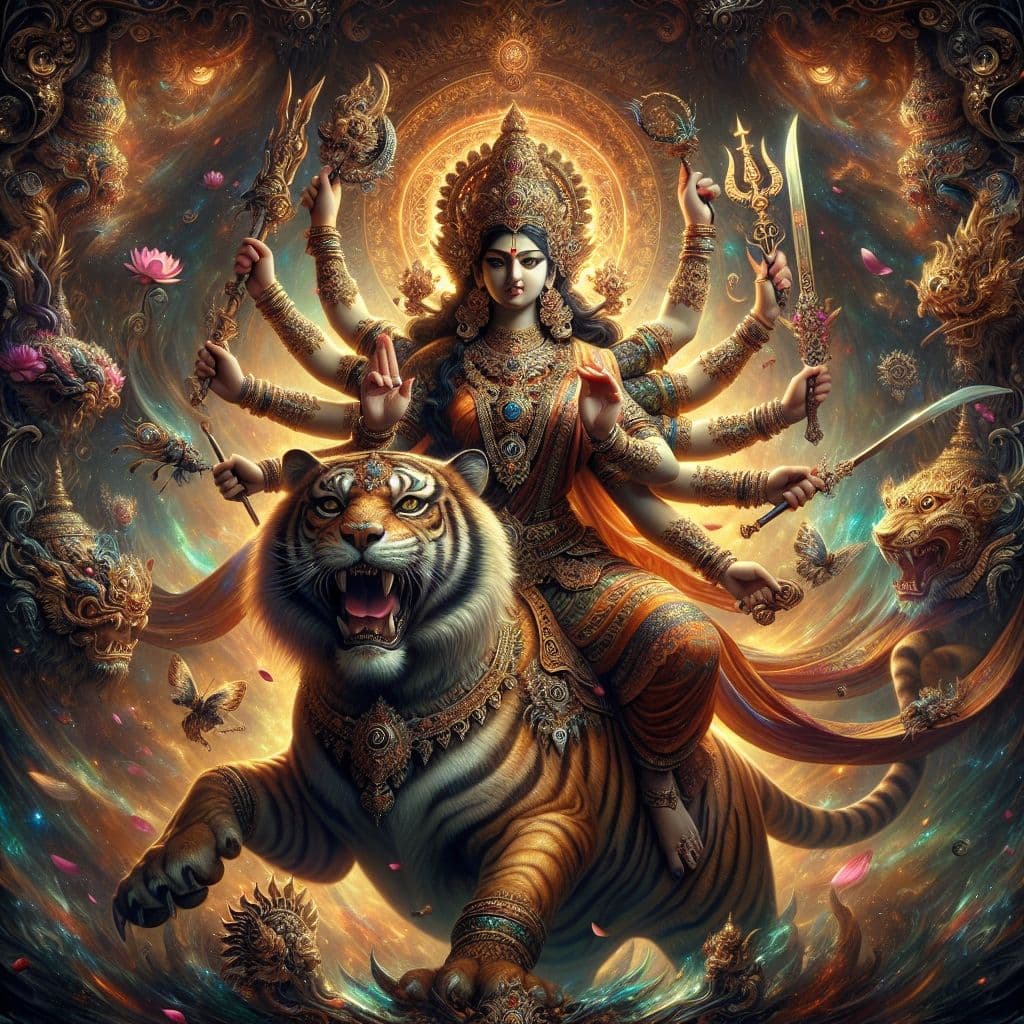
Durga embodies strength and resilience and is often depicted as a powerful and radiant woman. Her iconography is rich and deeply symbolic, typically showcasing her with multiple arms, ranging from eight to eighteen. Each arm wields a different weapon, symbolising her ability to confront evil from all directions. This multitude of arms signifies the unified power of various gods, who have empowered her with their weapons, illustrating the strength that comes from collaboration and support.
Her expression radiates fierce determination in the heat of battle, seamlessly transforming into serene compassion that showcases her dual nature. She embodies the essence of a fierce protector and a nurturing mother, fluidly navigating between these influential roles as the situation calls for it, demonstrating her adaptability and versatility.
The narratives surrounding Durga inspire us with her fierce determination and resilience in the face of overwhelming challenges. Her legendary battle against Mahishasura, the shape-shifting buffalo demon who struck fear into the hearts of gods and men, is a powerful reminder of the strength found in unity. The gods came together, channeling their energies to give birth to Durga, who emerged as a symbol of hope and courage. After an intense nine-day struggle, her victory earned her the revered title of Mahishasuramardini, central to the vibrant celebration of the Navaratri festival.
Durga's confrontations extend beyond Mahishasura; as the Devi Mahatmya recounts, she bravely faces other formidable foes, such as Shumbha and Nishumbha. Her fierce manifestations, including Kali and Chandika, rise to vanquish the asuras, reminding us of our lives unyielding fight for balance and harmony.
Yet, Durga embodies more than just a warrior; she represents many powers and attributes, showcasing her multifaceted nature among Hindu deities. Her most celebrated tale, found in the Devi Mahatmya, highlights her divine origin from the combined energies of Brahma, Vishnu, and Shiva to defeat Mahishasura, underscoring her immense strength and significance in mythology as a source of inspiration for all.
The worship of Durga showcases inspiring variations across India and Nepal, with each region illuminating unique aspects and traditions of her reverence. These diverse practices and forms of devotion beautifully reflect the rich cultural tapestry of the goddess's devoted followers.
These regional variations beautifully illustrate the diverse and meaningful ways Durga is revered and woven into local customs and beliefs.
Durga is a primary deity and the source of many goddesses across various traditions. She embodies strength and resilience. She is venerated in numerous forms, each representing unique battles and facets of her divine power. Among her remarkable incarnations is Navadurga, the nine forms celebrated during the festival of Navaratri, a nine-night festival that honours the sacred feminine. These forms reflect her diverse cosmic purposes and profound significance in Hindu devotion.
These incarnations illuminate Durga's diverse essence, showcasing her remarkable ability to take on different forms in response to our unique needs and challenges.
Durga's narratives and significance are deeply rooted in several pivotal Hindu scriptures, showcasing her extraordinary strength and revered presence.
The narratives surrounding Goddess Durga are the cornerstone of her rich mythology and the various practices associated with her worship. Her stories inspire millions, symbolizing the victory of good over evil and celebrating the strength of the divine feminine.
Wikipedia – Durga
Encyclopaedia Britannica – Durga | Hindu deity
Institutional & Museum Sources
National Museum, New Delhi – Exhibitions and depictions of Durga
Chhatrapati Shivaji Maharaj Vastu Sangrahalaya (CSMVS), Mumbai – Sculptures and iconography of Durga
British Library – Researching Hindu Deities in Manuscripts
British Library – Digitised Manuscripts – Search: "Durga"
Indira Gandhi National Centre for the Arts (IGNCA)
Sacred Texts & Scriptural Databases
Internet Sacred Text Archive – Hinduism Collection
Bharatavani – Digital Library of Indian Knowledge
Vedabase.io – References to Durga in scriptures and epics
Devi Mahatmya (Durga Saptashati) – Found within the Markandeya Purana
Puranas – Shiva Purana, Skanda Purana, Kalika Purana, Agni Purana
Devi Bhagavata Purana – Scriptural details about Durga's cosmic role
Tantric Texts – Various texts including Rudra Yamala, Kalika Purana
Indian Culture and Heritage Portal – Durga: Symbol of Shakti
Sahapedia – Detailed articles on Durga’s mythology and regional celebrations
Oxford Bibliographies – Hinduism – Entries on Durga and Shaktism
Center for Indic Studies – Essays and papers on Devi worship and festivals
Oxford Centre For Hindu Studies