Netflix's INKubator: How AI Is Rewriting the Rules of the Creator Economy
18 May 2026

INKubator, the AI animation studio for short-form content, was quietly established in March 2026 and now actively hiring producers, software engineers, technical directors, and CG artists.
Netflix has appointed Serrena Iyer, formerly of DreamWorks Animation, MRC Studios, and A24 Films, as COO of the new unit. The company also recently acquired InterPositive, an AI startup co-founded by Ben Affleck that specialises in AI-assisted post-production. INKubator significantly expands Netflix's ambitions from post-production automation into core animation development itself.
But here's the bigger picture: Netflix's INKubator isn't just a company story. It's a mirror held up to an entire economy that is transforming faster than most people realise.
What the Creator Economy Looks Like in 2026
The global creator economy is now valued at approximately $234 billion, growing at a compound annual rate of 22.5%, with Goldman Sachs projecting it could reach $480 billion by 2027. U.S. ad spend on sponsored content alone is projected to hit $43.9 billion in 2026, a 26% jump from 2025.
There are now over 207 million active content creators worldwide. Yet only 4% earn more than $100,000 per year. The system has always been winner-take-most. What AI is doing, right now, in real time, is disrupting that equation.
According to Adobe's 2025 Creators' Toolkit Report, 86% of creators actively use generative AI tools across their workflows. A separate 2026 survey found that number as high as 91%, as creators lean on AI to scale content production, speed up editing, and explore creative territory they couldn't access alone.
The result? A creator who once needed a full production agency can now do that work themselves.
AI as the Great Equaliser or the Great Displacer?
Netflix's official statement on INKubator is carefully worded:
The initiative will provide creators with an artist-focused environment to experiment in, where they can explore how new tools and workflows, alongside traditional animation creative practices, can be leveraged to enhance their storytelling capabilities.
They're framing AI as a collaborator, not a replacement. And for now, Netflix has confirmed that its main Animation Studios will continue using traditional animation techniques. INKubator is positioned as an experimental wing, a sandbox.
But the economic logic underneath this move is undeniable. AI-assisted content production can reduce costs by 30% to 50% while increasing output volume by over 500%. For a streaming platform competing at global scale, that math is impossible to ignore.
Here's where it gets nuanced. If INKubator exists to handle the "grunt work", the repetitive, mechanical parts of animation production, so that artists can focus on storytelling and creative direction, that could genuinely expand what gets made. More niche stories. More diverse voices. More animated content for markets that traditional studios wouldn't touch because the economics didn't work.
But if it becomes a machine for churning out volume without investing in the artists, the outcome looks much bleaker. The animation community has already raised alarms, protests by international animators at major festivals have made clear that the fear of generative AI replacing human artistry is real, not hypothetical.
No Film School put it plainly: "Are they looking for artists who use AI, or are they looking for prompt engineers to replace artists?" That question doesn't have a public answer yet.
The Bigger Shift: AI Is Restructuring Creative Power
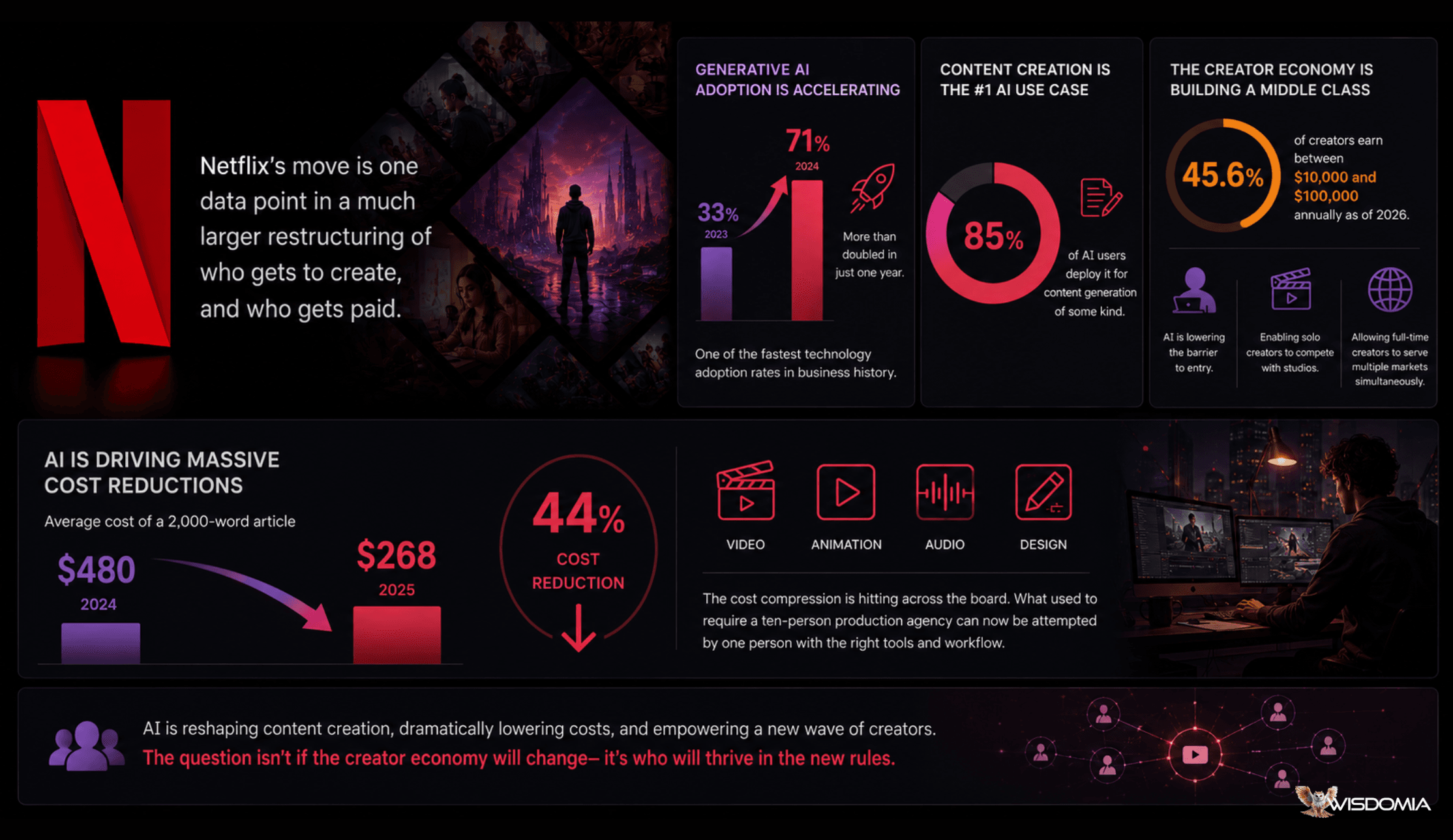
Netflix's move is one data point in a much larger restructuring of who gets to create, and who gets paid.
Consider this: 71% of organizations now use generative AI for content creation, up from 33% in 2023, one of the fastest technology adoption curves in business history, outpacing even cloud computing. Content creation has become the dominant AI use case, with 85% of AI users deploying it for content generation of some kind.
Meanwhile, the creator economy is witnessing the emergence of what researchers at The Influencer Marketing Factory are calling a "creator middle class." As of 2026, 45.6% of creators earn between $10,000 and $100,000 annually — a bracket that barely existed a few years ago. AI is partly responsible: it's lowering the barrier to entry, enabling solo creators to compete with studios on production quality, and allowing full-time creators to serve multiple markets simultaneously.
Generative AI adoption more than doubled in just one year , rising from 33% in 2023 to 71% in 2024, making it one of the fastest technology adoption rates in business history.
The cost reduction is dramatic. According to data from freelance marketplaces, the average cost of producing a 2,000-word article has dropped 44% since 2024 — from $480 to $268. The same compression is hitting animation, video, audio, and design. What used to require a ten-person production agency can now be attempted by one person with the right tools and workflow.
What This Means for Creators, Studios and the Rest of Us
Netflix's INKubator is a signal that the major platforms have made their decision. AI is not a feature, it is infrastructure. The question for every creator, studio, and media company is no longer if to engage with generative AI, but how to do so without losing what makes storytelling matter.
For independent creators, the opportunity is real. AI tools compress production timelines, reduce costs, and expand creative ambition. The creator economy is projected to reach $528 billion by 2030. The ceiling is rising. But so is the noise level.
For artists and animators, the stakes are high. The roles being advertised at INKubator suggest a hybrid model, people who understand both traditional animation and machine learning workflows. That is a new kind of creative professional, and it requires a new kind of preparation.
For audiences, the shift is already underway. The content you scroll past, the shorts that auto-play, the kids' programming filling your living room, more of it will be shaped by generative AI than most people realise.
And for Netflix, INKubator is a bet. A bet that AI-produced animation can be compelling enough to watch, cheap enough to scale, and defensible enough to justify the controversy. Whether it pays off depends on the same thing it always has: whether the stories are worth telling.
Sources & References
- Android Authority — Netflix wants to create AI-made animated shorts for you to ignore (May 14, 2026): androidauthority.com
- No Film School — Netflix is Building an AI Animation Studio... Should We Be Worried? (May 15, 2026): nofilmschool.com
- Digital Trends — Netflix has its own AI studio now (May 2026): digitaltrends.com
- Dataconomy — Netflix Forms AI-powered Studio For Short-form Content (May 15, 2026): dataconomy.com
- CXO Digital Pulse — Netflix Launches In-House AI Animation Studio (May 2026): cxodigitalpulse.com
- TechNave — Netflix reportedly building an AI animation studio called INKubator (May 2026): technave.com
- Digiday — In Graphic Detail: Here's what the creator economy is expected to look like in 2026 (Dec 2025): digiday.com
- SQ Magazine — Creator Economy Statistics 2026: Market Size & Earnings: sqmagazine.co.uk
- inBeat Agency — 75 Creator Economy Statistics Every Marketer Needs in 2026: inbeat.agency
- AutoFaceless Blog — AI Content Creation Statistics 2026: autofaceless.ai
- TechCrunch (Artlist) — 87% of Creators Now Use AI (May 2026): techcrunch.com
- The Influencer Marketing Factory — 2026 Creator Economy Report (Feb 2026): finance.yahoo.com
- Presenc AI — AI Content Creation Statistics 2026: presenc.ai
- Goldman Sachs Research — Creator economy total addressable market projections (via SQ Magazine)
- Adobe — Creators' Toolkit Report 2025 (via SQ Magazine and inBeat)
Share

Sara Srifi
Sara is a Software Engineering and Business student with a passion for astronomy, cultural studies, and human-centered storytelling. She explores the quiet intersections between science, identity, and imagination, reflecting on how space, art, and society shape the way we understand ourselves and the world around us. Her writing draws on curiosity and lived experience to bridge disciplines and spark dialogue across cultures.