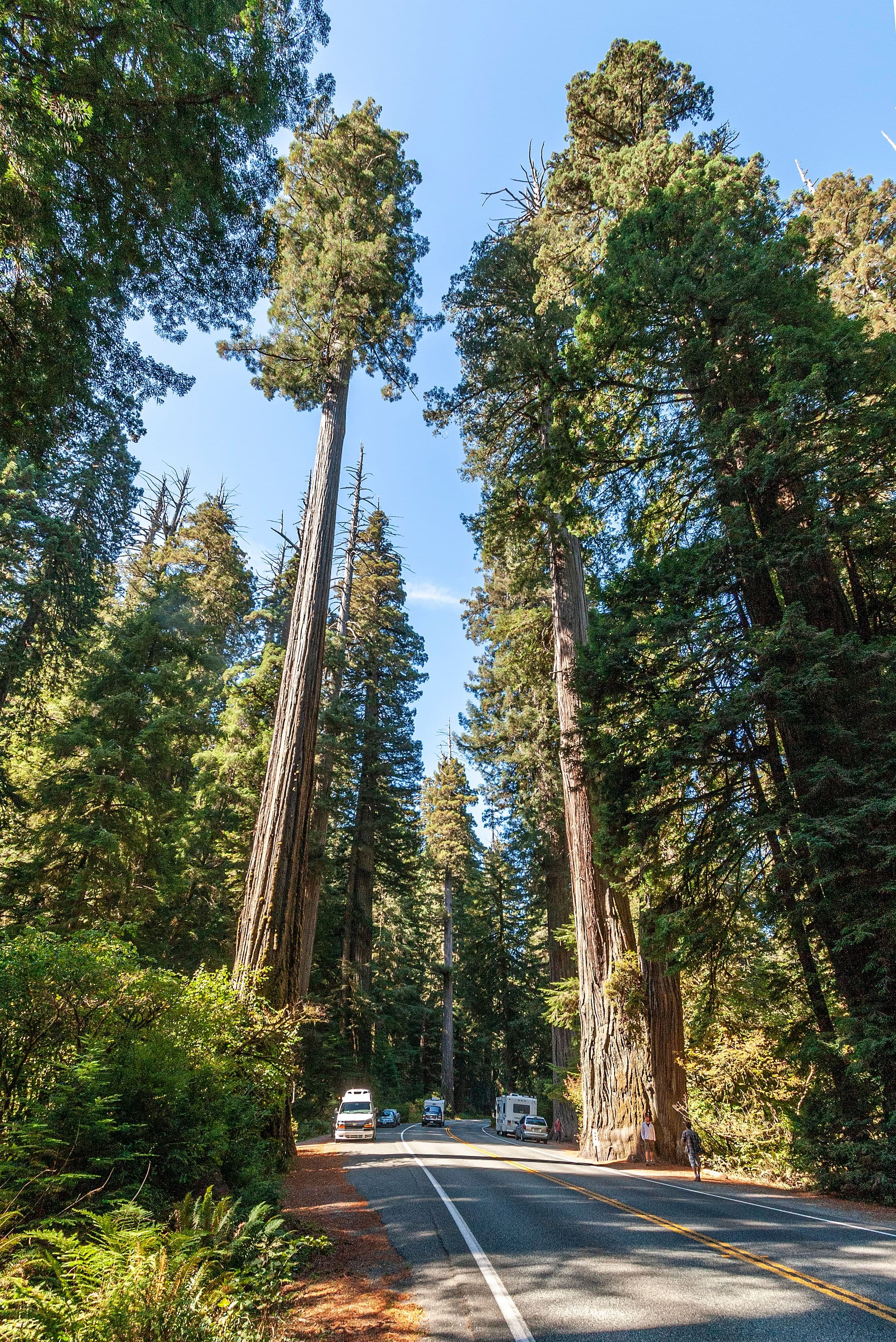

The Coast Redwood, also known as Sequoia sempervirens, is the tallest living tree species on earth. It is native to the Pacific Coast of North America, specifically from southern Oregon to central California. These impressive trees occupy a narrow strip of land approximately 750 km in length and 5-47 miles in width. The name 'sempervirens' means 'always green' or 'ever living' in Latin, referring to the tree's evergreen leaves.
Coast Redwoods are famous for their incredible height. The tallest known living Redwood, named Hyperion, measures over 379.7 feet tall, which is equivalent to a 38-story building. However, because these trees are located in remote, hard-to-reach areas, there might be taller ones that have yet to be discovered. The average height of mature trees is between 200 and 240 feet, but they can reach up to 300 feet under optimal conditions. They also have a long lifespan, reaching over 2,000 years in some cases, with the oldest known living Redwood being estimated to be around 2,200 years old.
The trunk of a Coast Redwood can be quite large, often measuring up to 26 feet in diameter, and has a reddish-brown bark that can be up to 12 inches thick. This bark, combined with the tree's high tannin content, helps protect it from fire damage and insect infestation. The bark is furrowed and has a soft, fibrous texture. The tree's root system is surprisingly shallow for its height, typically only 6-12 feet deep, but it spreads out laterally up to 100 feet from the base of the tree, providing it with stability.
Coast Redwoods are evergreen conifers, meaning they retain their leaves throughout the year. The leaves are arranged in a spiral pattern along the branches and are dark green on the top and lighter on the underside. They are small, flat, and somewhat lance-shaped, measuring about 1 inch long. The tree also produces small, woody cones that are about 1 inch in diameter.
The natural habitat of the Coast Redwood is the fog belt of the Pacific Coast. The trees require a high amount of moisture, which they obtain from the frequent fog that rolls in from the ocean. This fog drip is so critical to their survival that they can suffer from drought in its absence, even in an otherwise rainy climate. The trees also prefer deep, well-drained soils, but they can adapt to a variety of soil types.
Coast Redwoods play a significant role in their ecosystems. They provide habitat for a variety of wildlife, including several bird species, mammals like the northern spotted owl and Roosevelt elk, and various insects. The trees also help regulate the local climate and water cycles and store large amounts of carbon, helping to mitigate climate change.
Coast Redwoods have a long history of human use. The Indigenous peoples of the Pacific Coast used the tree's wood and bark for building materials, tools, and clothing. In the 19th and 20th centuries, the trees were heavily logged for their valuable timber, leading to the loss of over 95% of the original old-growth Redwood forest. Today, the remaining old-growth forests are protected within national and state parks, and the tree is grown in plantations for its timber.
In addition to their ecological and economic importance, Coast Redwoods are also significant for their spiritual and aesthetic value. They inspire a sense of awe and wonder with their grandeur and ancientness, and walking among these giants is often described as a humbling experience. The trees are a popular attraction for nature lovers and tourists, and their preservation is crucial for future generations to enjoy.
Despite the threats they face, including logging, climate change, and urban development, Coast Redwoods are a resilient species. They have the ability to sprout from their base, creating a 'family circle' of trees that share the same root system. They also have a high resistance to disease and damage, and they can recover from fires and other disturbances. With continued conservation efforts and sustainable management, these magnificent trees will continue to thrive and inspire awe for many more millennia.
The Coast Redwood, scientifically known as Sequoia sempervirens, is a species of everlasting coniferous tree that belongs to the cypress family. It is native to the coastal region of western North America, particularly California. The Coast Redwood is renowned for being the tallest living tree species on Earth, reaching heights of up to 379 feet. This remarkable species plays an integral role in human use and interaction, both in historical and modern contexts.
Historically, the indigenous tribes of the Pacific Northwest notably the Yurok, Karuk, Chilula, and others, have utilized the Coast Redwood for various purposes. The tree's sizeable, straight trunk provided an ideal material for the construction of their traditional plank houses and dugout canoes. The bark was used for making baskets and as a source of dye, while the inner bark was sometimes consumed as food. The tribes also harvested the tree's burls, which are large growths on the tree that contain numerous dormant buds. These burls were carved into intricate designs for ceremonial and decorative purposes.
With the arrival of European settlers in the 19th century, the exploitation of the Coast Redwood increased significantly. The tree's timber was highly sought after due to its impressive size, resistance to decay, and straight grain, making it ideal for construction. The gold rush in California during the mid-1800s also spurred the logging of Redwoods to meet the demand for building materials. During this period, many of the ancient Redwood forests were severely depleted.
Today, Coast Redwoods continue to be harvested for their timber. However, modern forestry practices have evolved to become more sustainable, emphasizing selective logging and replanting efforts to ensure the continued survival of this species. The wood of the Coast Redwood is still valued for its strength, durability, and aesthetic appeal, and is commonly used in construction, furniture making, and as a veneer for plywood.
Aside from their economic value, Coast Redwoods also have significant ecological importance. They play a crucial role in carbon sequestration, helping to mitigate the effects of climate change. These trees absorb carbon dioxide from the atmosphere, store the carbon in their massive trunks, and release oxygen back into the environment. A single mature Coast Redwood can sequester up to a ton of carbon over its lifetime.
Furthermore, Coast Redwoods contribute to the biodiversity of their habitats. They provide homes and food sources for a variety of wildlife, including different species of birds, mammals, and insects. The dense canopies of Redwood forests also create unique microclimates that support a diverse array of plant species.
Coast Redwoods also hold cultural and recreational value for humans. Many Redwood forests have been preserved as national and state parks, attracting millions of visitors each year who come to marvel at these magnificent trees. Walking among the towering Redwoods offers a humbling, awe-inspiring experience that connects people with nature. These parks also provide opportunities for hiking, camping, bird-watching, and other outdoor activities.
In recent years, there has been increasing interest in the potential medicinal properties of the Coast Redwood. Some studies suggest that the tree's bark and needles contain compounds with anti-inflammatory, antimicrobial, and antioxidant properties. While further research is needed to confirm these benefits, this highlights another potential avenue for human use of this remarkable species.
In conclusion, the Coast Redwood plays a multifaceted role in human use and interaction. From its historical use by indigenous tribes to its modern economic, ecological, and recreational importance, the Coast Redwood continues to be an invaluable part of human life. As we move forward, it is crucial to ensure the sustainable management and conservation of this majestic species, for the benefit of future generations.
The Coast Redwood, scientifically known as Sequoia sempervirens, is a prominent figure in various cultures and a symbol of longevity, strength, and resilience. Its majestic presence and sheer size have been marveled at by people for centuries and have led to its profound cultural and symbolic significance.
Native American tribes living in the Pacific Northwest have a deep-seated reverence for the Coast Redwood. The tree played an essential role in their daily lives and spiritual practices. Tribes such as the Yurok, Karok, and Chilula used the bark, wood, and roots of the Redwood to build their homes, canoes, and various tools. They also used its bark and needles for medicinal purposes, treating ailments like rheumatism, burns, and fever.
The Redwood tree was also central to their spiritual beliefs. They believed that powerful spirits resided in these trees and revered them as sacred beings. The Redwood was seen as a symbol of endurance and invincibility, mirroring its ability to withstand harsh weather conditions and survive for thousands of years. Some tribes even considered the Redwood as a pathway to the spiritual world and performed religious ceremonies under its towering canopy.
In modern times, the Coast Redwood continues to hold significant cultural and symbolic value. It is often used as a symbol of California, representing the state's natural beauty and rich history. The Redwood also symbolizes the conservation movement in the United States. Its near-extinction due to extensive logging in the 19th and 20th centuries led to a nationwide outcry and the establishment of protected areas such as the Redwood National and State Parks.
For environmentalists and nature enthusiasts, the Redwood is a symbol of nature's grandeur and resilience. Its ability to regenerate from its base, even after being cut down, is a powerful metaphor for the Earth's capacity to heal despite human-induced damage. The Redwood's immense size and age also serve as a reminder of our planet's ancient past and the need to safeguard its future.
Artists and writers have often been inspired by the Coast Redwood as well. Its towering stature and timeless existence have been the subject of numerous poems, songs, and paintings. John Steinbeck, a renowned American author, once wrote about the Redwood, 'The redwoods, once seen, leave a mark or create a vision that stays with you always...no one has ever successfully painted or photographed a redwood tree. The feeling they produce is not transferable.'
The Coast Redwood also holds economic significance. Despite the restrictions on logging, Redwood timber is highly valued for its quality and durability. Its resistance to insects and rot makes it ideal for outdoor construction, including decks, siding, and furniture. However, sustainable harvesting practices are now being promoted to balance economic needs with environmental conservation.
Even in the world of science, the Redwood has made a significant impact. Its remarkable size and longevity have intrigued scientists, leading to extensive research on its genetics and growth mechanisms. The Redwood's ability to absorb and store large amounts of carbon dioxide also makes it a critical player in climate change research.
Overall, the Coast Redwood is more than just a tree. Its cultural, symbolic, and economic significance spans across various aspects of society, from indigenous traditions and modern symbolism to economic interests and scientific research. The Redwood stands as a testament to nature's majesty and resilience, inspiring awe and reverence in all who witness its grandeur.
The Coast Redwood, known scientifically as Sequoia sempervirens, is a marvel of nature, a towering testament to the aesthetic and experiential wonders of the natural world. Standing beneath these colossal trees, one is immediately struck by their sheer magnitude. They stand as the tallest trees on earth, with some reaching heights of over 379 feet. The deep, rich hue of the bark, a russet red-brown, is a sight to behold, contrasting starkly with the vivid green of the surrounding foliage.
Experiencing the Coast Redwoods firsthand is an awe-inspiring encounter, a journey into an ancient world that has remained largely untouched for centuries. The trees create a cathedral-like canopy overhead, filtering sunlight into a soft, ambient glow that illuminates the forest floor. This natural architecture, combined with the hushed silence that pervades the forest, evokes a sense of reverence and tranquility.
The aesthetic beauty of the Coast Redwoods is not limited to their impressive height and girth. The bark of the Redwoods, deeply furrowed and richly textured, is a testament to the resilience and strength of these giants. Each crevice and fissure tells a story of survival, of standing firm against the elements and enduring through centuries of change. The foliage of the Redwoods, too, contributes to the overall aesthetic appeal. The leaves are small and delicate, a surprising contrast to the robust trunks. They form a dense, evergreen canopy, their perpetual verdancy a symbol of the trees' namesake sempervirens, meaning 'always green'.
The Coast Redwoods provide a unique experiential journey for explorers and nature enthusiasts alike. Walking amongst these giants, one is immediately enveloped in an atmosphere of peace and serenity. The forest floor, blanketed in a thick layer of Redwood needles, muffles sound and creates a sense of seclusion, as if one has stepped into a separate realm entirely. The air is rich and earthy, filled with the scent of damp soil and the faint, resinous aroma of the trees themselves. This multisensory experience is a significant part of the allure of the Redwoods, creating an immersive encounter with nature that is hard to replicate.
Aesthetically, the Coast Redwoods also provide a stunning backdrop for photography. Whether bathed in the soft glow of dawn, shrouded in ethereal mist, or standing tall against a clear, azure sky, they present an ever-changing tableau of natural beauty. The thick, gnarled roots, the intricate patterns of the bark, the play of light and shadow amidst the branches - each element contributes to a captivating visual narrative that is a delight for the lenses.
Experientially, the Redwoods offer a wealth of opportunities for outdoor pursuits. Hiking, bird-watching, and nature study are popular activities, as is simply taking the time to sit and soak in the atmosphere. The Redwoods are home to a variety of wildlife, from the tiny banana slug to the elusive Roosevelt elk, adding another dimension to the experience. And for those with a more adventurous spirit, there is the exhilarating prospect of a canopy tour, a chance to view the forest from the unique perspective of the treetops.
From an aesthetic standpoint, the Coast Redwoods are a testament to the grandeur and magnificence of nature. Their towering trunks, rugged bark, and verdant foliage create a visual spectacle that is both breathtaking and humbling. From an experiential perspective, they offer a journey into a world of tranquility and serenity, a chance to connect with nature on a profound level. Whether viewed from afar or experienced up close, the Coast Redwoods are a remarkable tribute to the beauty and resilience of the natural world.
Coast Redwoods - Save The Redwoods
About The Trees - National Park Service
Sequoia sempervirens (D. Don) Endl. - The Gymnosperm Database
The tallest, oldest and biggest Coast Redwoods - Monumental Trees
Genetic Structure and Diversity Among Historic and Modern Populations of the Coast Redwood - MDPI
California coastal redwood forests - World Wildlife Fund
Ecoregion Download Files by State - Region 9 - EPA
Redwood National and State Parks (U.S. National Park Service)
Coast Redwood - Arbor Day Foundation
Examining the viability of planting trees to help mitigate climate change - NASA Climate