AI Creator Economy (Part 2): How Creators Build Sustainable Businesses
05 Mar 2026

From Attention to Ownership: How Creators Build Sustainable Businesses
Most creators fail to build sustainable businesses not because they lack talent or audience, but because they lack a strategy. They accumulate followers without converting them into revenue. They depend on platforms they do not control. They monetise through advertising when they could be building direct relationships with paying communities. They stay at stage one when there are four stages to the journey.
The creator economy has evolved through four distinct generations, each one expanding what was possible, each one raising the ceiling on what a creator business could look like. Understanding that evolution is not just historical context. It is the strategic foundation for understanding where the real opportunity lies today and where it is heading next.
This article, the second in a two-part series based on Dinis Guarda's AI GIG Creator Economy Framework, covers the strategy: the four-stage creator journey, the monetisation realities that define who thrives, the community funnel that converts audiences into businesses, and the broader vision for where the creator economy is going.
Read Part 1: https://wisdomia.ai/ai-creator-economy-part-1-mapping-the-new-digital-ecosystem
Four Generations, How We Got Here
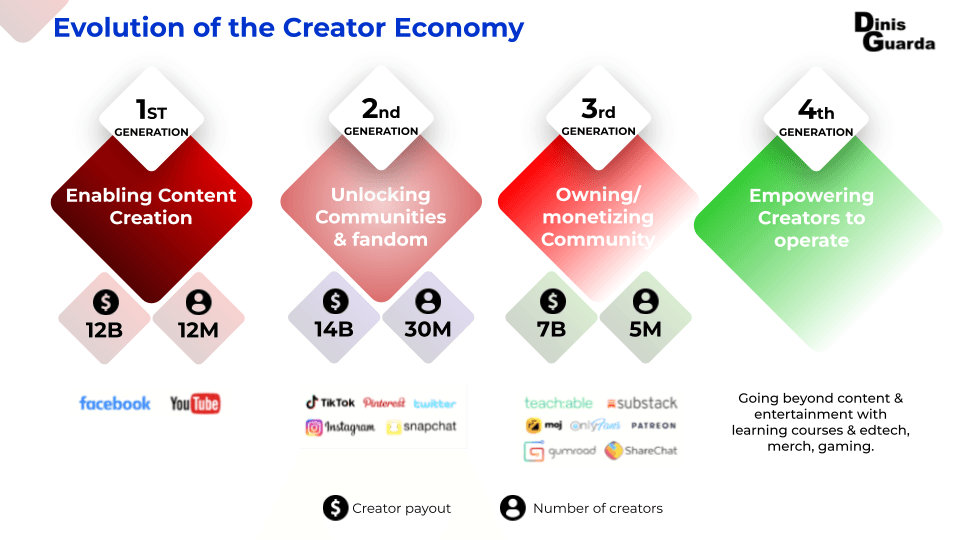
The creator economy did not arrive fully formed. It evolved through four generations, each representing a fundamental shift in what creators could do and what they could earn.
The first generation was about enabling content creation at all. Platforms like Facebook and YouTube democratised publishing, for the first time, anyone could reach a global audience without a record label, a publisher, or a broadcasting licence. The market at this stage was worth $12 billion, supporting around 12 million creators. Monetisation was almost entirely advertising-dependent, and creators had little ownership over their audiences or their revenue streams.
The second generation unlocked communities and fandom. TikTok, Instagram, Snapchat, and Twitter gave creators tools to build dedicated followings, not just passive viewership but genuine fan relationships. The market grew to $14 billion across 30 million creators. But the fundamental dynamic remained the same: platforms owned the audience, platforms owned the data, and creators were tenants rather than owners.
The third generation changed the equation. Platforms like Teachable, Substack, Patreon, and Gumroad enabled direct creator-to-audience monetisation for the first time at scale. Creators could charge for access, sell courses, build paid communities, and receive direct financial support from fans, without relying on advertising as the primary revenue mechanism. The market contracted to $7 billion across 5 million creators, but the quality of those creator-audience relationships and the sustainability of the revenue models improved dramatically.
The fourth generation, the current one, goes further still. It is about empowering creators to operate as full businesses: integrating learning and edtech, merchandise, gaming, Web3 tools, blockchain-based IP protection, and AI-powered production into comprehensive creator business models. The ceiling on what a single creator can build has never been higher.
Understanding this generational arc matters because it clarifies the direction of travel. Each generation has moved toward greater creator ownership, deeper audience relationships, and more diversified revenue. The strategic question for any creator today is not which platform to be on, it is which generation of thinking they are operating with.
The Four-Stage Creator Journey
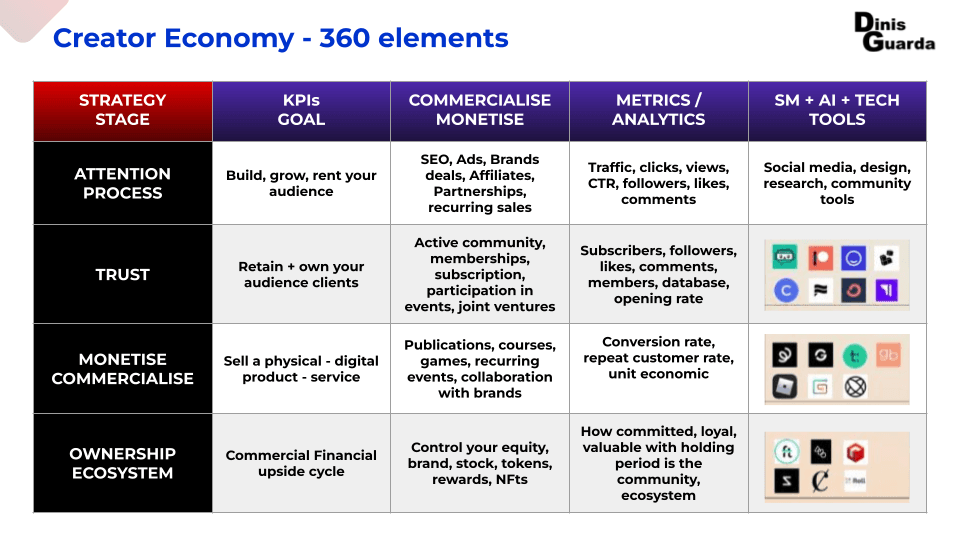
The 360 Elements Framework maps the creator-business journey across four strategic stages. Each stage has a distinct goal, a set of tools, specific metrics to track, and commercial approaches that are appropriate to that level of development. Moving through these stages is not automatic, it requires deliberate strategy at each step.
Stage 1 — Attention: Build, Grow, Rent Your Audience
The first stage is about existence. Before a creator can monetise, they need to be found. This means building a presence across social media platforms, producing content consistently, and optimising for discoverability through SEO, hashtags, and platform-specific algorithms.
The tools at this stage are the standard toolkit of social media management, basic design software, and research tools. The metrics that matter are traffic, clicks, views, click-through rates, followers, likes, and comments. The commercial approaches available are advertising revenue sharing, brand deals, affiliate partnerships, and basic recurring sales.
The critical insight about Stage 1 is in the word "rent." A creator at this stage does not own their audience, the platform does. Followers on Instagram, subscribers on YouTube, fans on TikTok, these relationships are mediated by platforms that can change their algorithms, alter their monetisation policies, or simply decline in relevance. Building attention is necessary, but it is not sufficient. It is the foundation, not the destination.
Stage 2 — Trust: Retain and Own Your Audience
The second stage is about converting platform-dependent attention into owned relationships. This means moving audiences from platforms into channels the creator controls, email lists, private communities, membership platforms, and direct communication channels.
The tools shift accordingly: email marketing platforms, community management tools, engagement analytics, and subscription management systems. The metrics change too, the focus moves from raw reach to depth of engagement: subscribers, members, database size, email open rates, and comment quality. The commercial approaches expand to include active community building, paid memberships, subscriptions, event participation, and joint ventures.
The distinction between Stage 1 and Stage 2 is the difference between borrowing an audience and owning one. A creator with 50,000 email subscribers has a fundamentally more valuable and more durable asset than a creator with 500,000 Instagram followers, because the email list cannot be algorithmically suppressed, and the relationship is direct.
Stage 3 — Monetise: Sell Physical and Digital Products and Services
Stage 3 is where the creator business becomes a real business. Having built an owned audience with genuine trust, the creator can now sell directly: courses, books, digital products, physical merchandise, events, and brand collaborations.
The tools expand significantly: e-commerce platforms, course creation tools, event management systems, and payment infrastructure. The metrics shift to commercial outcomes, conversion rates, repeat customer rates, unit economics, and customer lifetime value. The commercial approaches include publications, online courses, games, recurring events, and structured brand collaborations.
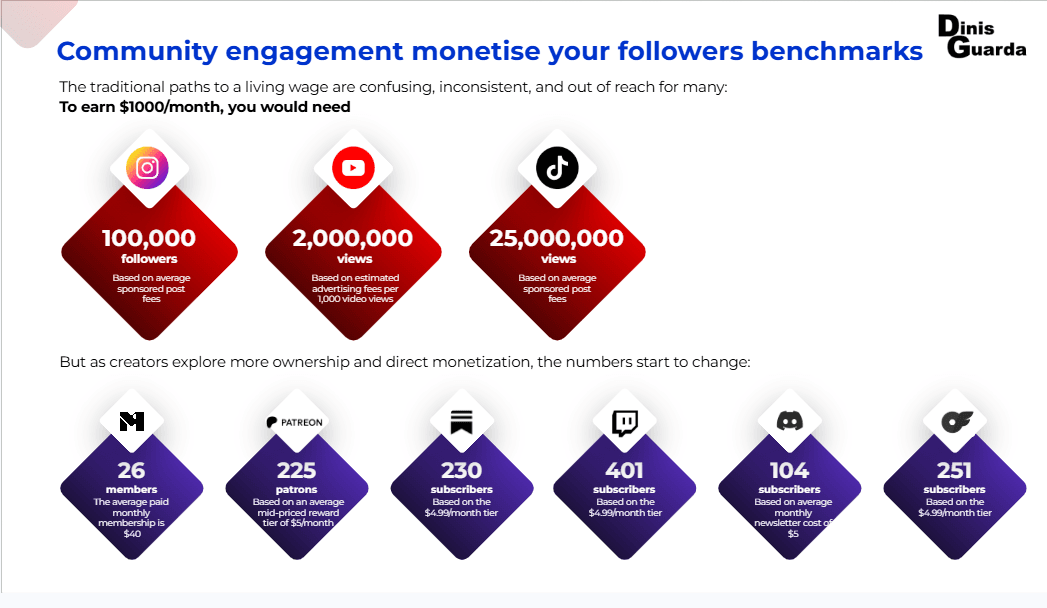
The monetisation benchmarks here are instructive. To earn $1,000 per month through traditional platform advertising, a creator typically needs 100,000 Instagram followers, 2,000,000 YouTube views, or 25,000,000 TikTok views. These are enormous thresholds that the vast majority of creators will never reach.
Direct monetisation changes the arithmetic entirely. On Mighty Networks, just 26 members paying a $40 monthly membership generates $1,000 per month. On Patreon, 225 patrons at a $5 monthly tier achieves the same. A newsletter with 230 subscribers at $5 per month, a Twitch channel with 401 subscribers at the $4.99 tier, a Discord server with 104 subscribers at $9.99 per month, all of these reach $1,000 monthly with audiences that are a fraction of what traditional advertising-dependent models require.
This is not a minor difference. It is a fundamental restructuring of the relationship between audience size and economic viability. Ownership-based monetisation requires a smaller, more engaged, more trusting audience: which is precisely what Stages 1 and 2 are designed to build.
Stage 4 — Ownership Ecosystem: Commercial Financial Upside
The fourth stage is where a creator business becomes a creator economy in miniature. Having built an owned audience, established trust, and proven direct monetisation, the creator can now build the financial and structural upside that comes with true ownership: equity in their brand, stock options, token systems, NFT-based IP frameworks, and community reward models.
The metrics at this stage are less about conventional analytics and more about community commitment: how loyal is the community, how long do members stay, and how valuable is that relationship over time. The commercial approaches include equity control, brand ownership, digital asset creation, token reward systems, and community-driven financial models.
This is the fourth generation of the creator economy made concrete at the individual level. A creator at Stage 4 is not dependent on any single platform, any single revenue stream, or any single format. They have built a system and that system generates value across multiple channels simultaneously.
The Community Funnel, From Stranger to Ecosystem Participant

Underpinning all four stages is a community funnel that maps how audiences move from initial awareness to deep ecosystem participation. Understanding this funnel is essential because it makes explicit the conversion journey that most creators manage intuitively but rarely systematically.
- Awareness is the top of the funnel, traffic, platform discovery, brand visibility, SEO, and the first moment someone encounters a creator's work. At this stage the goal is simple: be found.
- Consideration is where relevant content converts casual discovery into genuine interest. This is where a creator's newsletter, course landing page, membership community, or product offering needs to communicate enough value that a stranger considers becoming a follower or subscriber.
- Conversion is the moment a follower becomes a paying community member, subscriber, or customer. This is the most critical transition in the creator business — the point at which attention becomes revenue and the relationship deepens from passive consumption to active participation.
- Community Ecosystem is the final stage of the funnel and the most valuable. This is where converted members become advocates, collaborators, and long-term participants in the creator's broader ecosystem — referring others, contributing to the community, and becoming the foundation of a sustainable, relationship-based business model.
The funnel is not a linear sequence that audiences move through once. It is an ongoing cycle, new audiences enter at awareness, established community members deepen their participation, and the creator's job is to manage all four stages simultaneously.
The Tools Evolution, Three Phases of Creator Infrastructure
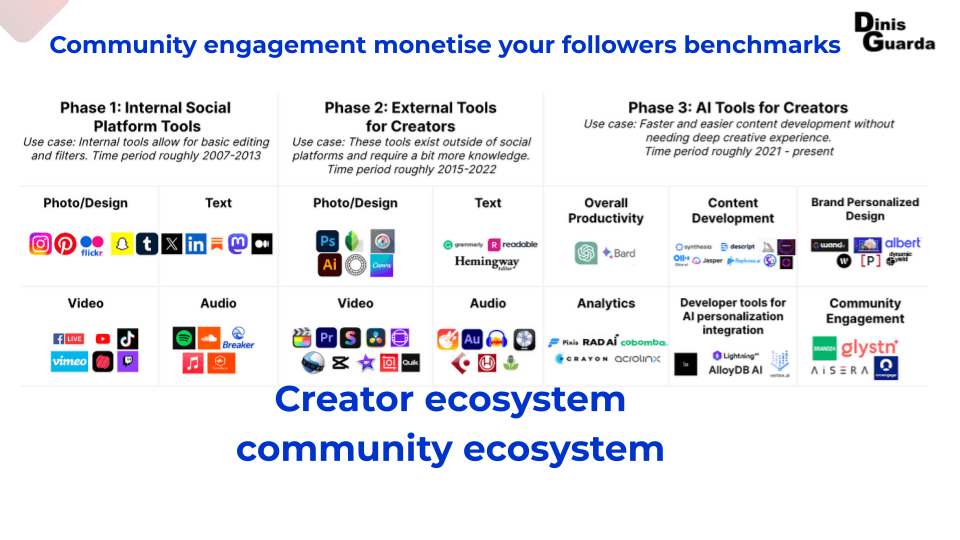
The strategic journey from attention to ownership is only possible because the tools available to creators have evolved dramatically. The 360 Elements Framework maps this evolution across three phases.
The first phase (roughly 2007 to 2013) was the era of internal social platform tools, basic editing, filters, and publishing capabilities built directly into platforms. Creators were entirely dependent on the tools platforms chose to provide.
The second phase (2015 to 2022) saw the emergence of a professional external tool ecosystem, Adobe Creative Suite, Canva, Final Cut Pro, and hundreds of specialised creator tools that existed outside platforms and gave creators genuine production capability. For the first time, a solo creator could produce content that rivalled professional studio output.
The third phase (2021 to present) is the AI era. Tools for text generation, image creation, video production, audio processing, analytics, and community engagement are now AI-powered, enabling faster, cheaper content development without requiring deep creative expertise. The democratisation of production that began with smartphones and Canva is now accelerating rapidly with generative AI.
The practical implication for creators is significant: the technical barriers to producing high-quality content across every format have effectively collapsed. What differentiates successful creators in the AI era is not production capability, it is strategy, community, and ownership.
The Bigger Vision — Utopian, Dystopian, and Somewhere in Between

The creator economy exists within a paradox that the 360 Elements Framework calls the utopian-dystopian tension and any honest assessment of its future has to hold both sides of that tension simultaneously.
The utopian case is real. The tools exist to build sustainable creative livelihoods without gatekeepers. The direct monetisation models work. The community-based business models are proven. The convergence of AI, Web3, blockchain, and immersive technologies is creating possibilities for creator ownership and revenue that did not exist five years ago. A creator today can build a global audience, own their IP, monetise directly, and operate a genuinely independent business from anywhere in the world.
The dystopian reality is equally real. The digital divide means that access to these tools and opportunities is not evenly distributed. The concentration of revenue, with 61% of creators still dependent on advertising, means most creators remain tenants of platforms rather than owners of businesses. The complexity of the technology landscape creates barriers for the majority while amplifying advantages for those already ahead. And the 90/10 rule means that for every creator who builds a sustainable business, there are hundreds who consume content without ever making the leap to creation.
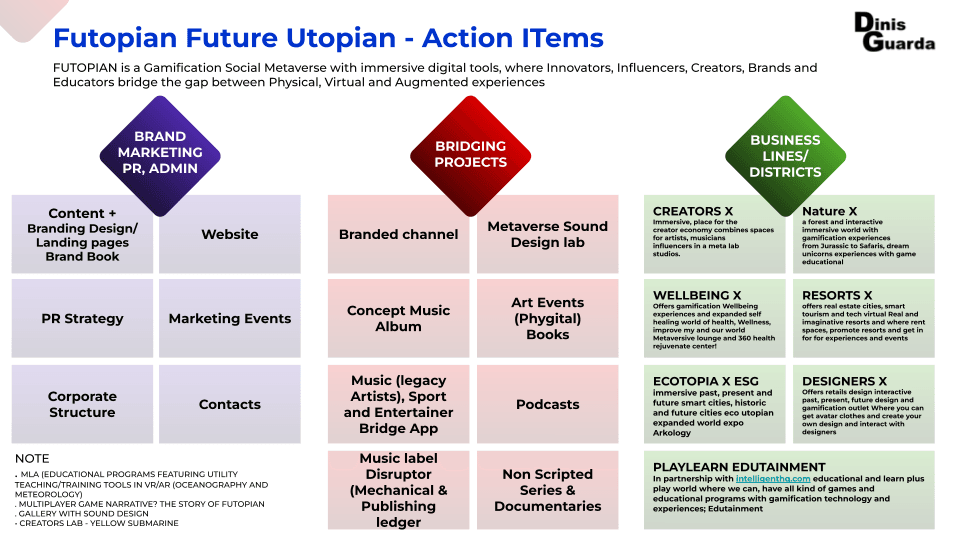
The framework's response to this tension is what I call the Futopian vision, a deliberately constructed middle path between utopia and dystopia. It is built on four pillars: narrative (clear rules of engagement and a compelling reason to participate), challenge (achievement-oriented systems and gamification that reward progress), tribe (a genuine sense of belonging and collective building), and community (a stakeholder ecosystem bound by shared purpose, data independence, and integrity).
Practically, this vision includes the development of gamified universal income models, baseline financial support of $1 to $3 per month for creators, combined with Web3 identity profiles, decentralised marketplaces, metaverse gamification, and blockchain-based IP and reward systems. The go-to-market ambition is to reach one million creators, with each creator activating 10,000 community members, an exponential growth model built on genuine value creation rather than platform dependency.
This is where the creator economy is heading. Not just bigger, but structurally different, more owned, more direct, more equitable, and more technologically sophisticated. The creators who thrive in this next phase will be those who understood early that the journey from attention to ownership was not just a monetisation strategy. It was a fundamental reorientation of what it means to build a creative business in the digital age.
Looking forward
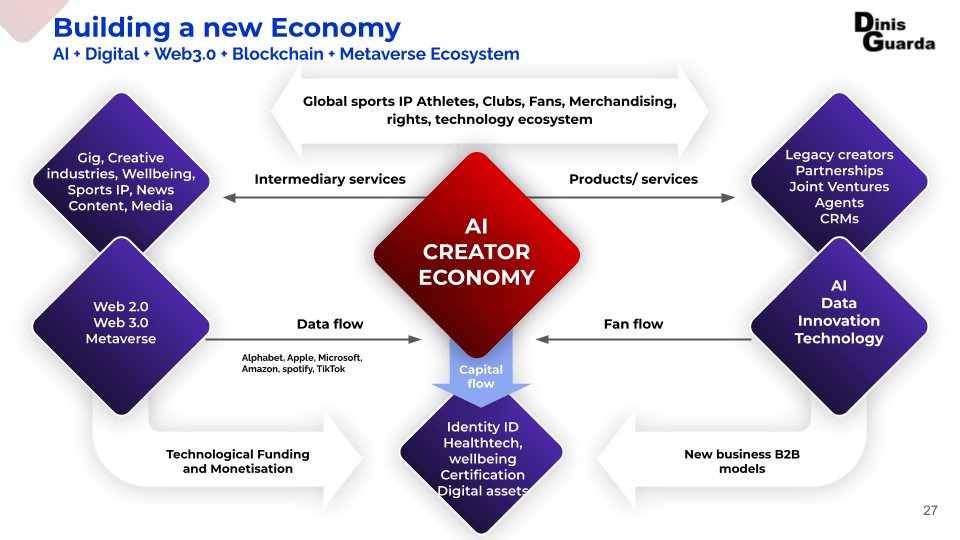
The four-stage creator journey : from building attention to achieving ecosystem ownership, is not a guaranteed path. It requires deliberate strategy, the right tools at each stage, and a genuine commitment to building owned relationships rather than borrowed audiences.
The monetisation data makes the opportunity clear: direct community-based models require dramatically smaller audiences than advertising-dependent platforms, and they generate far more durable revenue. The community funnel makes the mechanics explicit. The tools evolution makes it more accessible than ever. And the generational arc of the creator economy makes the direction of travel unmistakable — toward ownership, toward directness, toward the creator as a genuine business operator rather than a platform tenant.
The utopian vision of the creator economy — sustainable, inclusive, and human-centred — is achievable. But it requires creators, platforms, and businesses to move beyond the first generation thinking that still dominates most of the conversation, and to build with the full four-stage framework in mind from the start.
This article is part of a two-part series based on Dinis Guarda's AI GIG Creator Economy Book (2025).
Share

Dinis Guarda
Dinis Guarda is an author, entrepreneur, founder CEO of ztudium, Businessabc, citiesabc.com and Wisdomia.ai. Dinis is an AI leader, researcher and creator who has been building proprietary solutions based on technologies like digital twins, 3D, spatial computing, AR/VR/MR. Dinis is also an author of multiple books, including "4IR AI Blockchain Fintech IoT Reinventing a Nation" and others. Dinis has been collaborating with the likes of UN / UNITAR, UNESCO, European Space Agency, IBM, Siemens, Mastercard, and governments like USAID, and Malaysia Government to mention a few. He has been a guest lecturer at business schools such as Copenhagen Business School. Dinis is ranked as one of the most influential people and thought leaders in Thinkers360 / Rise Global’s The Artificial Intelligence Power 100, Top 10 Thought leaders in AI, smart cities, metaverse, blockchain, fintech.