Are the Laws of the Universe Discovered or Imposed?
18 Feb 2026

Preamble — About This Series
This article is part of a series that explores foundational questions at the boundary of science, philosophy, and human experience.
The series emerged from an extended dialogue between a human author and an artificial intelligence system. That dialogue served as a space for careful questioning, conceptual testing, and intellectual refinement. The texts presented here are not raw AI outputs, but curated essays shaped through human editorial judgment.
The aim is not to offer final answers, but to clarify what we can reasonably claim, what remains unresolved, and where intellectual honesty requires restraint rather than speculation.
Part 2 of 8
Are the Laws of the Universe Discovered or Imposed?
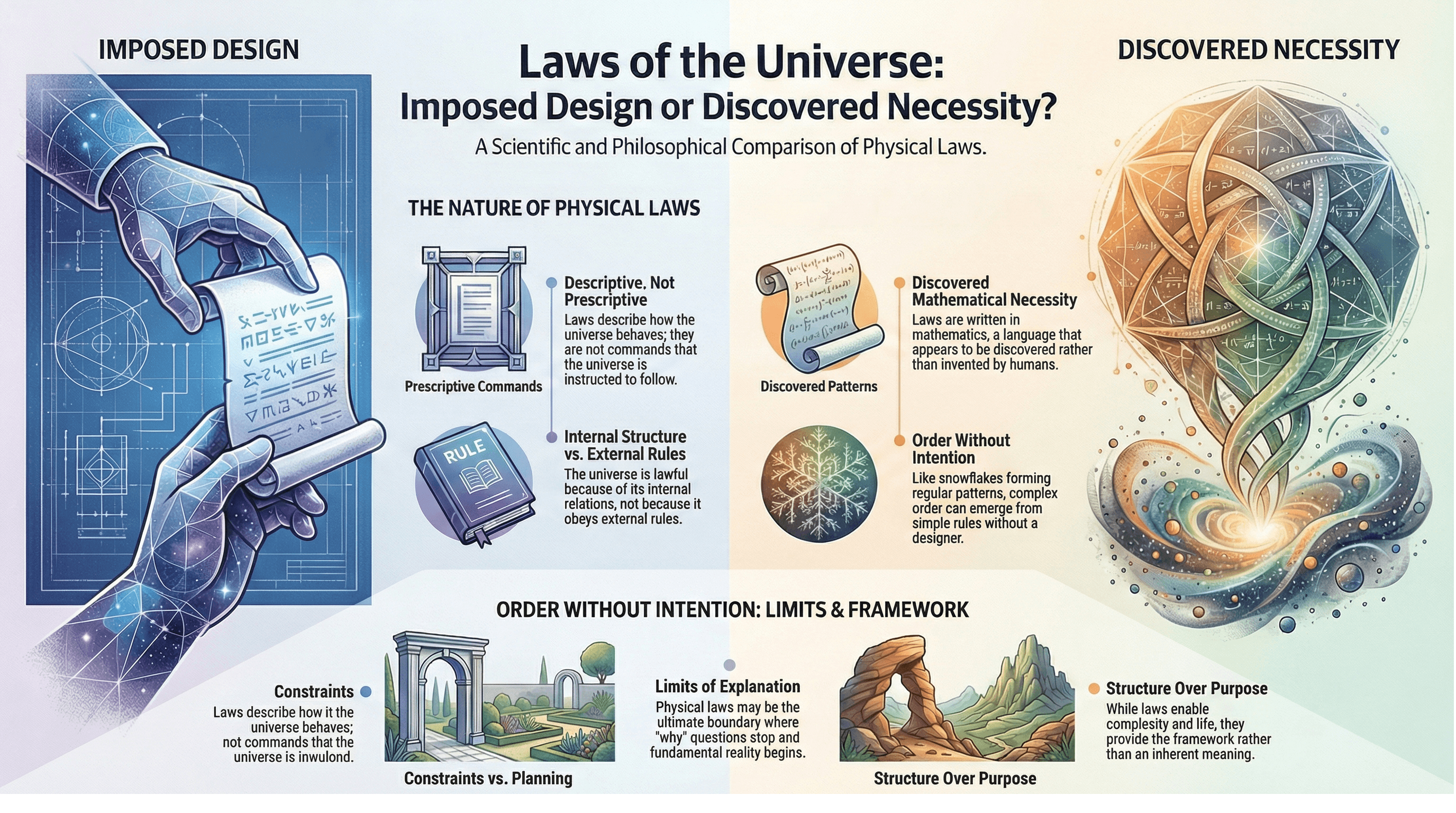
The Strange Authority of Physical Laws
The universe behaves with remarkable regularity.
Stars form and burn according to precise rules.
Atoms combine in consistent ways.
Light bends, time dilates, and gravity curves space exactly as predicted.
We call these regularities laws of nature.
But this word already smuggles in a dangerous assumption.
Laws, in human societies, are imposed. They are written, enforced, and backed by authority. When we speak of the “laws of physics,” it is tempting—almost unavoidable—to imagine something similar: rules that were set, chosen, or decided.
This raises a deceptively simple question:
| Are the laws of the universe imposed, or are they discovered?
What Science Actually Means by “Laws”
In physics, a law is not a command.
It is a description of regularity.
When we say that gravity follows an inverse-square law, we are not claiming that gravity must behave this way because it was instructed to. We are saying that, as far as observation goes, this is how gravity behaves.
The laws of physics are:
descriptive, not prescriptive
inferred, not dictated
provisional, not final
They summarize patterns. They do not explain why those patterns exist.
This distinction matters.
If laws are descriptions, then they are not evidence of intention.
They are evidence of consistency.
Mathematics: Invented or Discovered?
The question becomes sharper when mathematics enters the picture.
Physical laws are written in mathematical language. Often, the mathematics seems to come first, and reality follows. Equations developed abstractly later turn out to describe the universe with uncanny precision.
This raises a parallel question:
Is mathematics invented by humans, or discovered?
Human beings clearly invent:
symbols
notation
formal systems
But they do not invent the fact that:
π relates a circle’s circumference to its diameter
prime numbers behave the way they do
certain structures are unavoidable once assumptions are fixed
Mathematics appears less like a human creation and more like a space of necessary relations that we gradually uncover.
If that is true, then physical laws may not be imposed at all — they may be expressions of mathematical necessity instantiated in the universe.
Could the Laws Have Been Different?
This is where the question becomes unsettling.
Many constants of nature appear finely constrained. Slight variations in values such as:
the strength of gravity
the electromagnetic coupling
the masses of fundamental particles
would result in a universe where:
stars could not form
chemistry would collapse
life as we know it would be impossible
This is often called the fine-tuning problem.
There are three broad ways to interpret it:
Contingency — the laws could have been different, and we simply find ourselves in a rare configuration compatible with observers.
Necessity — the laws could not have been different; they are the only self-consistent possibility.
Selection — many universes exist with different laws, and we observe this one because it allows observation.
At present, science cannot distinguish decisively between these options.
What matters is this: none of them require the laws to have been imposed by intention.
Laws Without a Lawgiver
The idea that laws require a lawgiver is deeply rooted in human psychology.
We associate order with design because, in human affairs, order is usually intentional. But this intuition does not scale automatically to the universe.
Snowflakes exhibit intricate structure without planning.
Crystals form regular lattices without instruction.
Complex patterns emerge from simple rules through iteration and interaction.
Order does not require intention.
It requires constraints.
The laws of physics may simply be the minimal constraints necessary for any coherent reality to exist at all.
A Universe That Obeys Itself

If the laws are not imposed, then what are they?
One increasingly compelling view is this:
The laws of nature are not external to the universe.
They are internal relations the universe has with itself.
In this sense:
the universe does not “follow” laws
the universe is lawful
The laws are not rules written into reality.
They are the structure of reality itself.
The Limit of Explanation
At this point, explanation reaches its natural boundary.
We can explain:
how laws interact
how they unify
how they give rise to complexity
But the question:
Why these laws rather than others?
may not admit a deeper answer.
Not because of ignorance, but because there may be nothing deeper to appeal to.
Explanation must end somewhere.
The laws may be where it ends.
What This Does — and Does Not — Mean
This view does not imply:
that the universe is meaningless
that inquiry is pointless
that mystery defeats reason
It implies something more demanding:
Meaning is not written into the laws of nature.
Meaning is something conscious beings must negotiate within them.
The laws provide structure, not purpose.
They enable complexity, not destiny.
The Question That Carries Forward
If the laws of the universe are discovered rather than imposed,
and if they are expressions of deeper necessity or constraint,
then a new question becomes unavoidable:
How do such impersonal laws give rise to subjective experience at all?
How does a lawful universe produce consciousness?
That question takes us to the next stage of the series.
AI Dialogue Podcast
To explore these ideas further, we generated an experimental podcast conversation between two AI systems discussing the themes of this article.
The dialogue is not presented as an authoritative conclusion, but as an illustration of how artificial systems can already engage with philosophical questions.
| The debate |
Next in the Series
What Is Reality, Really?
Quantum mechanics, observation, and the relational nature of the world.
Share

Gonçalo Pereira
Gonçalo Pratas Pereira is an IT and technology leader with deep expertise in system integration, cloud computing, data infrastructure, and artificial intelligence. With a background in electronics and telecommunications engineering, his work focuses on connecting AI-driven systems, immersive technologies, and digital infrastructure with business strategy and real-world impact. He is particularly interested in how AI and emerging technologies can enhance education, cities, and large-scale digital transformation.