What Is Reality, Really?
24 Feb 2026

Preamble — About This Series
This article is part of a series that explores foundational questions at the boundary of science, philosophy, and human experience.
The series emerged from an extended dialogue between a human author and an artificial intelligence system. That dialogue served as a space for careful questioning, conceptual testing, and intellectual refinement. The texts presented here are not raw AI outputs, but curated essays shaped through human editorial judgment.
The aim is not to offer final answers, but to clarify what we can reasonably claim, what remains unresolved, and where intellectual honesty requires restraint rather than speculation.
Part 3 of 8
What Is Reality, Really?
The Intuition We Rarely Question
In everyday life, reality feels obvious.
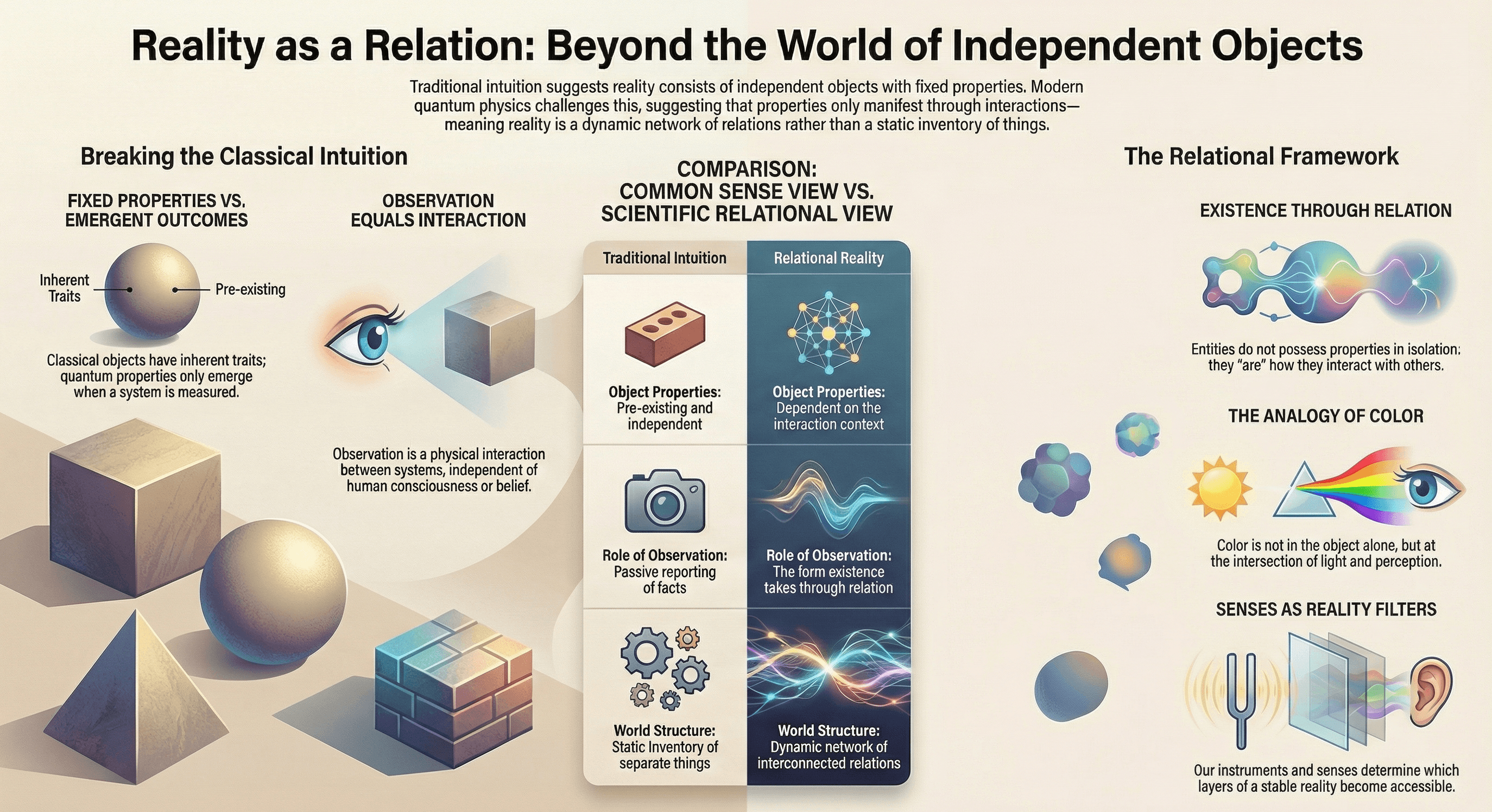
There is a world “out there,” made of objects with properties that exist independently of us. We observe that world, measure it, and describe it — but we do not fundamentally affect it.
This intuition is so deeply ingrained that we rarely notice it. It underlies common sense, classical physics, and much of our language.
But it turns out to be incomplete.
Modern physics, especially quantum mechanics, has forced us to reconsider what we mean by “reality” in ways that are not merely technical, but deeply philosophical.
The Shock Introduced by Quantum Physics

Quantum physics did not challenge reality because it was strange. It challenged reality because it worked.
Experiments repeatedly showed that microscopic systems do not behave as classical objects with well-defined properties at all times. Instead, they behave as if:
- certain properties do not exist prior to measurement,
- outcomes depend on how a system is probed,
- and reality at small scales is fundamentally probabilistic.
The famous double-slit experiment is not important because it is mysterious, but because it is precise. It demonstrates that the same entity can exhibit radically different behavior depending on the experimental context.
This does not mean particles are “aware” of being observed.
It means that properties are not independent of interaction.
Observation Is Not What We Think It Is

A common misunderstanding is to equate “observation” with human consciousness.
In physics, observation simply means interaction.
A measuring device, a detector, a wall, or an environmental interaction all count as observations. Consciousness plays no privileged role in determining outcomes.
What changes in a quantum experiment is not reality itself, but the relational context in which reality manifests.
This leads to a crucial distinction:
Existence is not created by observation.
The form in which existence appears is.
Reality as a Set of Relations, Not Objects
If properties depend on interactions, then reality cannot be fully described as a collection of self-contained objects.
Instead, it begins to resemble a network of relations.
In this view:
- entities do not possess properties in isolation,
- properties emerge in relation to other systems,
- and “what something is” depends on “how it interacts.”
Reality becomes less like a static inventory and more like a dynamic structure.
This does not make reality subjective.
It makes it relational.
Is There a Reality “In Itself”?

This naturally raises a deeper question:
Is there a reality that exists entirely independently of any relation or interaction?
Physics cannot answer this definitively.
All physical descriptions involve measurements, interactions, and reference frames. A completely relation-free reality , if it exists , would be inaccessible by definition.
This does not mean such a reality does not exist.
It means that science cannot describe it.
What science describes is reality as it appears through relations.
The Role of Perspective Without Subjectivism
Relational reality is often confused with relativism or subjectivism.
This is a mistake.
Different observers may have different perspectives, but those perspectives are constrained by the same underlying structure. The universe does not become arbitrary just because it is relational.
A mountain does not vanish when unobserved.
A star does not depend on belief to burn.
What changes is not whether things exist, but how their properties are defined within specific contexts.
Reality, Perception and the Example of Color

Color provides a useful analogy.
Light has objective physical properties , wavelengths and frequencies. But color, as experienced, depends on:
- the structure of the eye,
- the neural processing of the brain,
- and the context of perception.
Color is not an illusion.
But it is not a property of objects alone.
It exists at the intersection of world and observer.
Much of reality may be like this:
not imaginary, but not fully independent either.
Filtering Reality Without Inventing It

Our senses, instruments, and theories act as filters.
They do not create reality, but they determine which aspects of reality become accessible.
As technology advances, new layers of reality become visible:
- radio waves,
- gravitational waves,
- quantum effects,
- cosmic background radiation.
Reality does not change.
Our access to it does.
This suggests that what we call “the real world” is always a partial view, shaped by the interactions available to us.
What This Means — and What It Does Not
This view does not imply that reality is an illusion or hallucination.
There is a stable external world with constraints that resist our wishes and beliefs. But our experience of that world is mediated, structured, and incomplete.
Reality is neither purely objective nor purely subjective.
It is shared, constrained, and relational.
The Question That Remains
If reality is fundamentally relational, then one final question becomes unavoidable:
What kind of relation allows reality to be experienced at all?
In other words:
How does a relational universe give rise to consciousness — a point of view from within reality itself?
That question takes us to the next stage of the series.
AI Dialogue Podcast
To explore these ideas further, we generated an experimental podcast conversation between two AI systems discussing the themes of this article.
The dialogue is not presented as an authoritative conclusion, but as an illustration of how artificial systems can already engage with philosophical questions.
| The debate |
Next in the Series
Is Consciousness an Accident or an Inevitable Outcome?
Emergence, complexity, and the possibility of mind in the universe.
Share

Gonçalo Pereira
Gonçalo Pratas Pereira is an IT and technology leader with deep expertise in system integration, cloud computing, data infrastructure, and artificial intelligence. With a background in electronics and telecommunications engineering, his work focuses on connecting AI-driven systems, immersive technologies, and digital infrastructure with business strategy and real-world impact. He is particularly interested in how AI and emerging technologies can enhance education, cities, and large-scale digital transformation.