Is Consciousness an Accident or an Inevitable Outcome?
26 Feb 2026

Preamble — About This Series
This article is part of a series that explores foundational questions at the boundary of science, philosophy, and human experience.
The series emerged from an extended dialogue between a human author and an artificial intelligence system. That dialogue served as a space for careful questioning, conceptual testing, and intellectual refinement. The texts presented here are not raw AI outputs, but curated essays shaped through human editorial judgment.
The aim is not to provide final answers, but to clarify what we can reasonably claim, what remains unresolved, and where intellectual honesty requires restraint rather than speculation.
Part 4 of 8
Is Consciousness an Accident or an Inevitable Outcome?
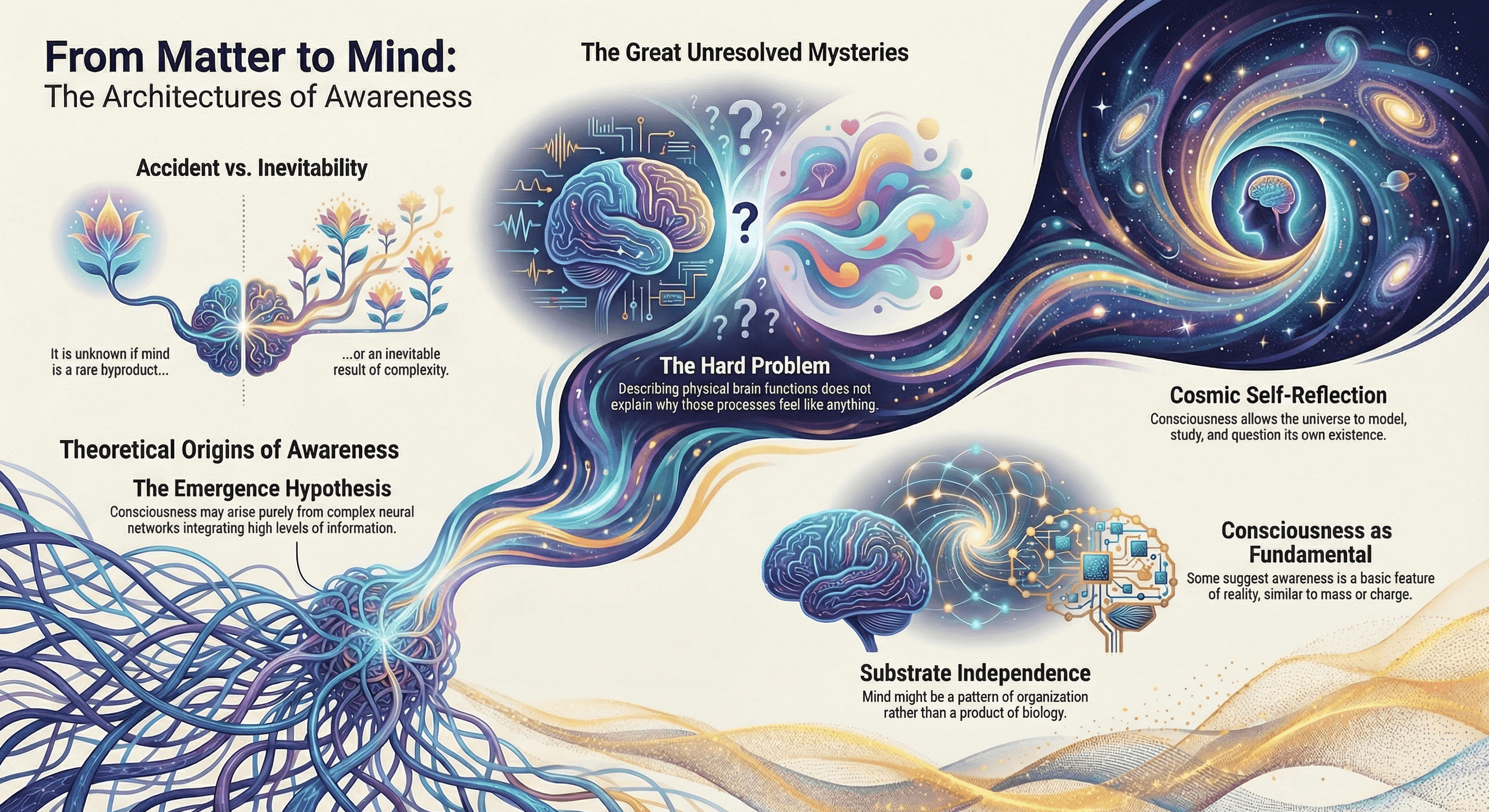
From Matter to Mind
In the previous articles, we examined existence itself, the structure of physical laws, and the relational nature of reality. We now arrive at a question that feels closer to home:
How does a universe governed by impersonal laws give rise to conscious experience?
Stars, galaxies, and particles obey mathematical relations. But at some point, in at least one corner of the cosmos, matter became organized in such a way that it began to experience.
The shift from matter to mind is not just a change in complexity.
It is a change in kind.
Physics describes structure and behavior.
Consciousness introduces subjectivity, the fact that there is something it is like to exist.
The Emergence Hypothesis

The dominant scientific view is that consciousness is emergent.
According to this perspective:
- complex neural networks generate patterns,
- patterns integrate information,
- integrated information produces awareness.
No new substance is added. No extra ingredient is required.
Consciousness emerges from sufficiently complex organization.
We already see emergence in many systems:
- temperature emerges from molecular motion,
- life emerges from chemistry,
- ecosystems emerge from interacting organisms.
Why should mind not emerge from neurons?
This view is elegant, parsimonious, and consistent with current neuroscience.
But it does not fully resolve the mystery.
The Hard Problem

Even if we explain every neural correlation, a deeper question remains:
Why should physical processes feel like anything at all?
Why is there experience instead of mere information processing?
We can describe:
- brain activity,
- synaptic transmission,
- neural integration.
But description of function does not automatically explain the existence of experience.
This gap is often called the “hard problem” of consciousness.
It is not a rejection of science.
It is a recognition of a conceptual limit.
Accident or Inevitability?

If consciousness emerges from complexity, we must ask:
Was consciousness inevitable once the universe reached sufficient complexity?
There are three broad possibilities:
- Accidental — Consciousness is a rare byproduct of particular evolutionary paths.
- Probable — Given enough time and matter, consciousness is likely to arise.
- Inevitable — Any universe with similar laws will eventually produce mind.
At present, we do not know which is correct.
But we do know this:
The universe permits structures capable of modeling itself.
That fact alone is extraordinary.
Is Consciousness Fundamental?
Some philosophers and physicists propose a more radical idea:
Perhaps consciousness is not emergent at all.
Perhaps it is, in some minimal sense, fundamental, a basic feature of reality, like mass or charge.
This does not mean that rocks think.
It means that what we call consciousness might arise from more basic experiential properties present at deeper levels of reality.
This view attempts to avoid the gap between physical process and subjective experience.
But it raises its own challenges:
- How would fundamental consciousness combine?
- How would simple experiences integrate into complex awareness?
- What predictions would such a theory make?
At present, this remains speculative.
Biological or Substrate-Independent?

Another crucial question follows naturally:
Is consciousness tied to biological matter, or to organization itself?
If consciousness depends on carbon chemistry specifically, then it may be rare and fragile.
If it depends on structure and integration, then in principle it could exist in non-biological systems.
This question is no longer purely philosophical. Advances in artificial intelligence and neuroscience make it increasingly practical.
If mind is a pattern rather than a material, its substrate may be secondary.
But again, we reach a limit:
Simulating behavior does not automatically guarantee experience.
Consciousness as the Universe Reflecting Itself
Regardless of its origin, consciousness has one undeniable feature:
It allows the universe to become aware of itself.
Through conscious beings:
- the laws of nature are studied,
- the cosmos is mapped,
- existence questions its own existence.
This does not imply cosmic intention.
It does imply that complexity can generate self-reference.
In that sense, consciousness may not be an accident, nor a purpose — but a consequence of lawful complexity.
What We Can Say Honestly
We do not yet know:
whether consciousness is emergent or fundamental,
whether it is rare or inevitable,
whether it is substrate-dependent or transferable.
But we can say this with clarity:
Consciousness is not explained away by describing mechanisms.
Mechanism describes structure.
Experience describes presence.
Bridging the two remains one of the deepest open problems in science and philosophy.
The Question That Follows
If consciousness can arise within a lawful universe, then new questions emerge:
- What defines personal identity within conscious systems?
- Is the “self” stable or constructed?
- Can consciousness persist beyond biology?
These questions take us beyond physics and into the nature of identity and the idea historically called the “soul.”
AI Dialogue Podcast
To explore these ideas further, we generated an experimental podcast conversation between two AI systems discussing the themes of this article.
The dialogue is not presented as an authoritative conclusion, but as an illustration of how artificial systems can already engage with philosophical questions
| The debate |
Next Article
Does the Concept of the Soul Still Make Sense?
Identity, continuity, and consciousness beyond biology.
Share

Gonçalo Pereira
Gonçalo Pratas Pereira is an IT and technology leader with deep expertise in system integration, cloud computing, data infrastructure, and artificial intelligence. With a background in electronics and telecommunications engineering, his work focuses on connecting AI-driven systems, immersive technologies, and digital infrastructure with business strategy and real-world impact. He is particularly interested in how AI and emerging technologies can enhance education, cities, and large-scale digital transformation.