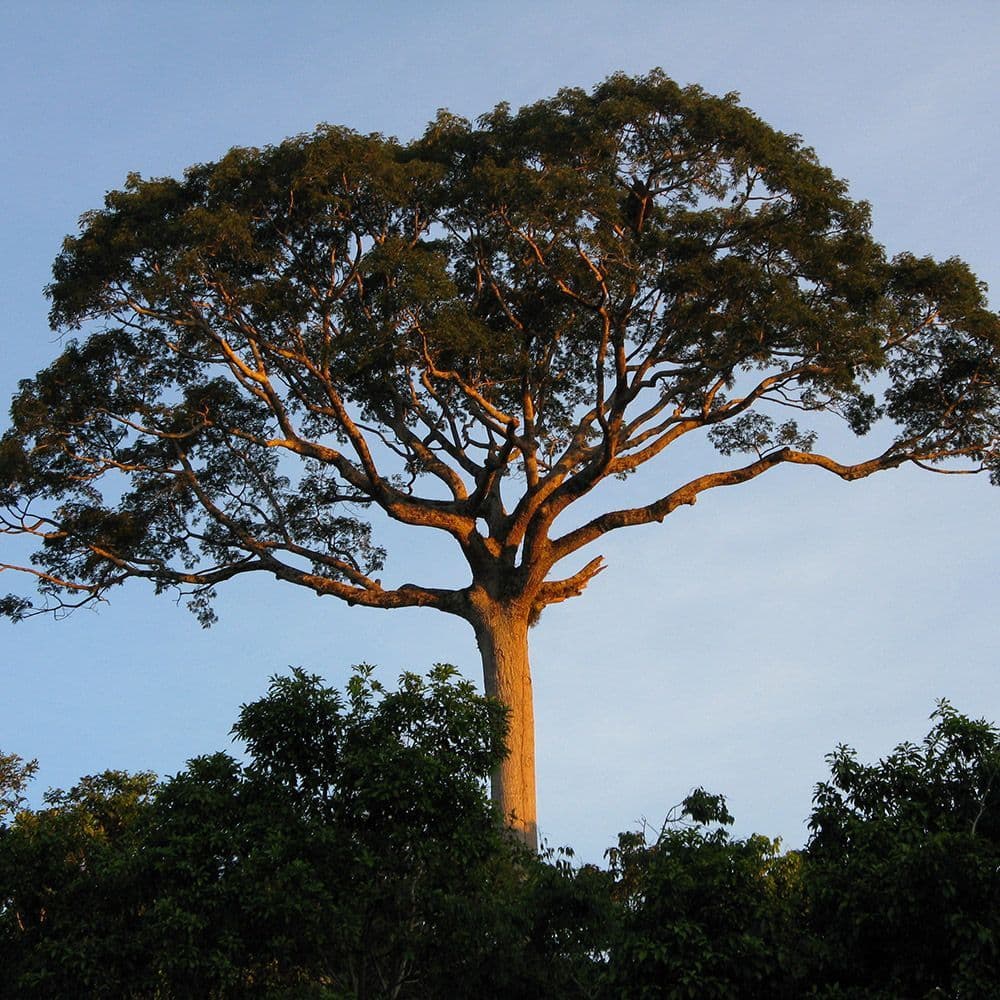

The Ceiba Tree, also known as the silk cotton tree, is a genus of around 20 species of trees that are native to tropical and subtropical regions around the world. This tree is a member of the Malvaceae family, which also includes plants like hibiscus and okra. The name 'Ceiba' is derived from a Taino word, which was the language of the indigenous peoples of the Caribbean, where some species of the tree are native.
Ceiba trees are often characterized by their large size, with some species growing up to 70 meters tall. They have a thick, often spiny trunk and a wide, spreading canopy. The branches usually start high up on the trunk, giving the tree a distinctive, umbrella-like shape. The bark of the Ceiba tree is smooth and gray, and the wood is light and soft, making it useful for things like paper production and light construction.
The leaves of the Ceiba tree are compound, with multiple leaflets arranged in a palmate pattern. The flowers are usually large and showy, with five petals and a complex structure that includes a column of fused stamens. The flowers are often pollinated by bats, which are attracted to their strong, sweet scent. After pollination, the tree produces a large, oval fruit that contains seeds embedded in a fluffy, cotton-like substance.
This 'silk cotton' is actually a type of kapok, a light, buoyant material that has been used for centuries for things like stuffing pillows and life jackets. The seeds themselves are also edible, and in some cultures, they are roasted and eaten like nuts. The young leaves and flowers of the Ceiba tree can also be cooked and eaten, and the sap of the tree has been used in traditional medicine for a variety of purposes.
In addition to their practical uses, Ceiba trees also have a great deal of cultural and spiritual significance in many of the regions where they grow. In Mayan mythology, for example, the Ceiba tree is considered the tree of life, connecting the heavens, the earth, and the underworld. In West African traditions, too, the Ceiba tree is often considered sacred, and in some cultures, it is believed to be the home of spirits or deities.
Despite their many benefits, Ceiba trees are threatened in some areas by deforestation and habitat loss. Because they are often the largest trees in their ecosystems, they are particularly vulnerable to logging. However, they are also being planted and protected in many areas, both for their ecological significance and for their cultural and spiritual importance. Conservation efforts are ongoing to ensure the survival of these magnificent trees for future generations.
Some species of Ceiba trees are also grown as ornamental plants in gardens and parks due to their impressive size and beautiful flowers. They are often used as shade trees in tropical regions, and their resistance to pests and diseases makes them a low-maintenance choice for landscaping. However, their large size means they are not suitable for small gardens, and they need plenty of space to grow.
Ceiba trees have a fascinating biology and a rich history of use by humans. From their use as a source of food and medicine, to their role in mythology and spirituality, these trees are a testament to the complex relationships between plants and people. Their continued survival is not only important for the ecosystems they inhabit, but also for the cultural traditions they support.
Overall, the Ceiba tree is a remarkable species that embodies the diversity and richness of tropical ecosystems. It is a symbol of life and resilience, a provider of resources, and a beacon of cultural and spiritual significance. As we continue to learn more about these trees and work towards their conservation, we are reminded of the intricate and invaluable connections between the natural world and our own human cultures.
The Ceiba Tree, also known as the silk-cotton tree, is a sacred symbol in many different cultures and has provided many resources for humans over the centuries. These majestic trees, which can grow up to 200 feet tall, are native to tropical and subtropical areas around the world, including Central and South America, Africa, and Southeast Asia. They have been used for their wood, fiber, and spiritual significance, among other things.
The Ceiba tree has a large and thick trunk, which is often used for timber. The wood is lightweight and easy to work with, making it a popular choice for making canoes, especially by the indigenous people of the Americas. In fact, large Ceiba trees are still used today in parts of Central America to craft canoes. The wood is also used to make furniture, boxes, and crates. Because the tree grows quickly and to a large size, it is considered a sustainable source of timber.
Aside from its timber, the Ceiba tree is also known for its fiber, also referred to as Kapok. This natural, fluffy material is found in the trees seed pods and has been used for centuries to stuff pillows, mattresses, and life jackets. Kapok is buoyant and water-resistant, which makes it ideal for flotation devices. It is also hypoallergenic, making it a good choice for bedding materials. However, with the advent of synthetic materials, the use of Kapok has decreased.
The bark of the Ceiba tree has been used in traditional medicine for centuries. In various cultures, it has been used to treat conditions like asthma, cough, and constipation. The bark is often boiled to make a medicinal tea. However, the effectiveness of these treatments has not been scientifically proven, and caution should be exercised when using any kind of traditional medicine.
In addition to its practical uses, the Ceiba tree also holds a great deal of spiritual significance for many cultures. For the Mayans, the tree was believed to connect the heavens, earth, and underworld. It was often planted in the center of ceremonial places, and its image was incorporated into many Mayan artifacts. In West African spirituality, the Ceiba tree is considered the home of spirits and is often the site of offerings and ceremonies. In the Caribbean, the tree is associated with the Orisha spirits, particularly Shango, the god of thunder and lightning.
The Ceiba tree is a significant part of the ecosystem in which it grows. Its large size and extensive root system help prevent soil erosion. The tree also provides habitat for many different species of birds, insects, and mammals. Its flowers produce a large amount of nectar, which attracts pollinators. The tree also produces fruit, which is eaten by various animals. In turn, these animals help disperse the trees seeds, contributing to the regeneration of the forest.
Despite their importance, Ceiba trees are threatened by deforestation and climate change. Many of the areas where these trees grow are being cleared for agriculture or urban development. Climate change is also affecting the trees ability to grow and reproduce. Efforts are being made to protect these trees, both because of their cultural significance and their ecological importance. In some areas, they are being replanted to help restore deforested land.
Overall, the Ceiba tree is an impressive and important species. Its uses by humans are extensive, from practical applications like timber and fiber, to medicinal uses, to spiritual significance. The tree is also a critical part of the ecosystem, providing habitat and food for various species. As such, efforts to protect and conserve the Ceiba tree are crucial for both human and ecological health.
The Ceiba tree, scientifically known as Ceiba pentandra, is a majestic tropical tree that has significant cultural and symbolic importance in many societies across the world. It is a giant among trees, reaching heights of up to 70 meters, and its crown can span 30 meters in diameter. The tree is characterized by its thick, cylindrical trunk covered with large conical thorns, and its distinctive umbrella-shaped crown. The Ceiba tree produces large, pear-shaped fruits that yield cotton-like fibers, known as kapok, which have a multitude of uses.
In many cultures, the Ceiba tree is considered sacred and carries profound symbolic significance. This is particularly evident in Mayan culture, where the Ceiba tree, known as Yaaxche, is viewed as a symbol of the universe and a link between the heavens, earth, and the underworld. The tree's towering height and expansive crown were believed to touch the sky, symbolizing the celestial realm. The trunk represented the terrestrial world, and the roots reaching down into the ground were seen as a connection to the underworld. This cosmological concept was deeply ingrained in Mayan society, influencing their architecture, rituals, and worldview.
The Ceiba tree's importance extends beyond Mayan culture. In many West African societies, the tree is revered for its size and longevity, symbolizing strength, resilience, and continuity. The tree is often a focal point in villages, providing shade and a meeting place for community gatherings. Its kapok fibers are used for making pillows, mattresses, and insulation materials, while its seeds are used for oil extraction. The tree's bark and leaves also have medicinal uses, treating conditions such as asthma, fever, and kidney disease.
In the Caribbean, particularly in Puerto Rico, the Ceiba tree, known as Ceiba, is a symbol of history and heritage. The famous Ceiba de Ponce, a centuries-old Ceiba tree located in Ponce, is a national treasure and a living testament to the island's Taino Indian heritage. The tree is believed to possess healing properties and is often visited by locals and tourists seeking its blessings.
In the Amazon rainforest, indigenous tribes also hold the Ceiba tree in high regard. The Shipibo-Conibo people of Peru, for example, believe the tree is home to spiritual beings and use its bark in their traditional medicine. The tree's towering height and unique appearance have earned it the title 'Mother of the Forest' among many Amazonian tribes.
The Ceiba tree's cultural and symbolic significance extends to various religions as well. In Buddhism, the tree is associated with the enlightened Buddha, and it is believed that Buddha achieved enlightenment while sitting under a Ceiba tree. In Hinduism, the tree is linked to the Lord Shiva, one of the principal deities of the religion, and is considered a symbol of fertility and life.
Moreover, the Ceiba tree is also celebrated for its ecological importance. It plays a crucial role in tropical ecosystems, providing food and habitat for numerous species. Its flowers attract pollinators like bats and bees, while its fruits and leaves provide nourishment for various birds and mammals. The tree's massive roots not only stabilize the soil but also create microhabitats for many small organisms. By sequestering significant amounts of carbon, the Ceiba tree also contributes to mitigating climate change.
In conclusion, the Ceiba tree is a remarkable entity that carries immense cultural, symbolic, and ecological significance. Its towering presence, unique features, and multifaceted benefits have earned it reverence and respect in many cultures and societies across the globe. The tree is a living testament to our interconnectedness with nature and a symbol of the enduring power of life.
The Ceiba tree, also known as the silk cotton tree, is a unique aesthetic experience in itself. Its grandeur, its majestic presence, its historical and cultural significance, all contribute to its aesthetic appeal. The Ceiba tree is a visual spectacle, a sight to behold. Its trunk, covered with sharp conical thorns, is broad and sturdy, exuding a sense of strength and resilience. The branches spread out wide and high, reaching out to the sky in a poetic expression of ambition and aspiration. The leaves are bright green, radiating life and vitality. The flowers, though not very frequent, are large and beautiful when they bloom, adding to the aesthetic charm of the tree.
The tree’s aesthetic appeal is not limited to its physical attributes. The Ceiba tree is a symbol of life, continuity, and spirituality in many cultures around the world. In Mayan culture, it is considered the tree of life, a sacred symbol that connects the heavens, the earth, and the underworld. It is depicted in many Mayan artifacts and is an integral part of Mayan mythology. In the African Yoruba tradition, the Ceiba tree is revered as a sacred tree, a meeting point for the divine and the earthly. The tree’s aesthetic appeal is, therefore, intertwined with its cultural, historical, and spiritual significance.
Experiencing the Ceiba tree is an encounter with nature in its most spectacular form. Standing under the tree, one can’t help but feel a sense of awe and reverence. The tree’s massive size, its age-old presence, and its deep-rooted connection with the earth inspire a feeling of humility and gratitude. The rustling of the leaves in the wind, the rhythmic pattern of the thorns on the trunk, the occasional bloom of a flower, all invite the observer to engage in a dialogue with nature, to reflect upon life’s mysteries, and to appreciate the beauty of existence. The tree embodies the inherent wisdom of nature, reminding us of our place in the larger scheme of things, urging us to respect and protect our natural environment.
Touching the thorny trunk of the Ceiba tree can be an unforgettable tactile experience. The rough texture of the trunk, contrasted with the softness of the leaves and the silky feel of the flowers, offers a sensory exploration that is both intriguing and enlightening. Listening to the tree, one can hear the whispers of the wind as it blows through the branches, the rustle of the leaves, the creaking of the branches, the songs of the birds that have made the tree their home. These sounds create a symphony of nature, a harmonious blend of different notes that echo the rhythms of life.
The scent of the Ceiba tree adds another dimension to the experiential encounter. The fresh, earthy smell of the leaves, the sweet fragrance of the flowers, the unique aroma of the tree, all contribute to a sensory experience that is rich and immersive. Tasting the fruit of the Ceiba tree, though not common, can be an interesting experience. The seeds are surrounded by a soft, cotton-like substance that is sweet and edible.
Seeing a Ceiba tree in full bloom, under the open sky, can be an exhilarating visual experience. The bright green leaves against the clear blue sky, the flowers in their full glory, the birds and insects that are attracted to the tree, all create a vibrant, colorful spectacle that can be mesmerizing. The sight of a Ceiba tree at sunset, with the golden light casting dramatic shadows on the tree, can be a soul-stirring sight, an aesthetic experience that is deeply moving and inspiring.
In conclusion, the Ceiba tree offers a multi-dimensional aesthetic and experiential encounter. Its visual charm, its historical and cultural significance, its connection with nature, and its sensory offerings make it a unique and fascinating experience. Whether it is seen, touched, heard, smelled, or tasted, the Ceiba tree engages all our senses, inviting us to immerse ourselves in its beauty, to reflect upon its wisdom, and to appreciate its presence. It is a reminder of the wonders of nature, the richness of our cultural heritage, and the importance of preserving our natural environment for future generations.
NCBI - Traditional Uses, Phytochemistry, and Bioactivities of Cananga odorata (Ylang-Ylang)
World Agroforestry - Ceiba Pentandra
Tropical Plants Database - Ceiba Pentandra
JSTOR - The Sacred Ceiba Tree in Maya Mythology and Iconography
USDA Plants Database - Ceiba Pentandra
Biodiversity Heritage Library - Ceiba Pentandra
Plants For A Future - Ceiba Pentandra
Flowers of India - Kapok Tree (Ceiba Pentandra)