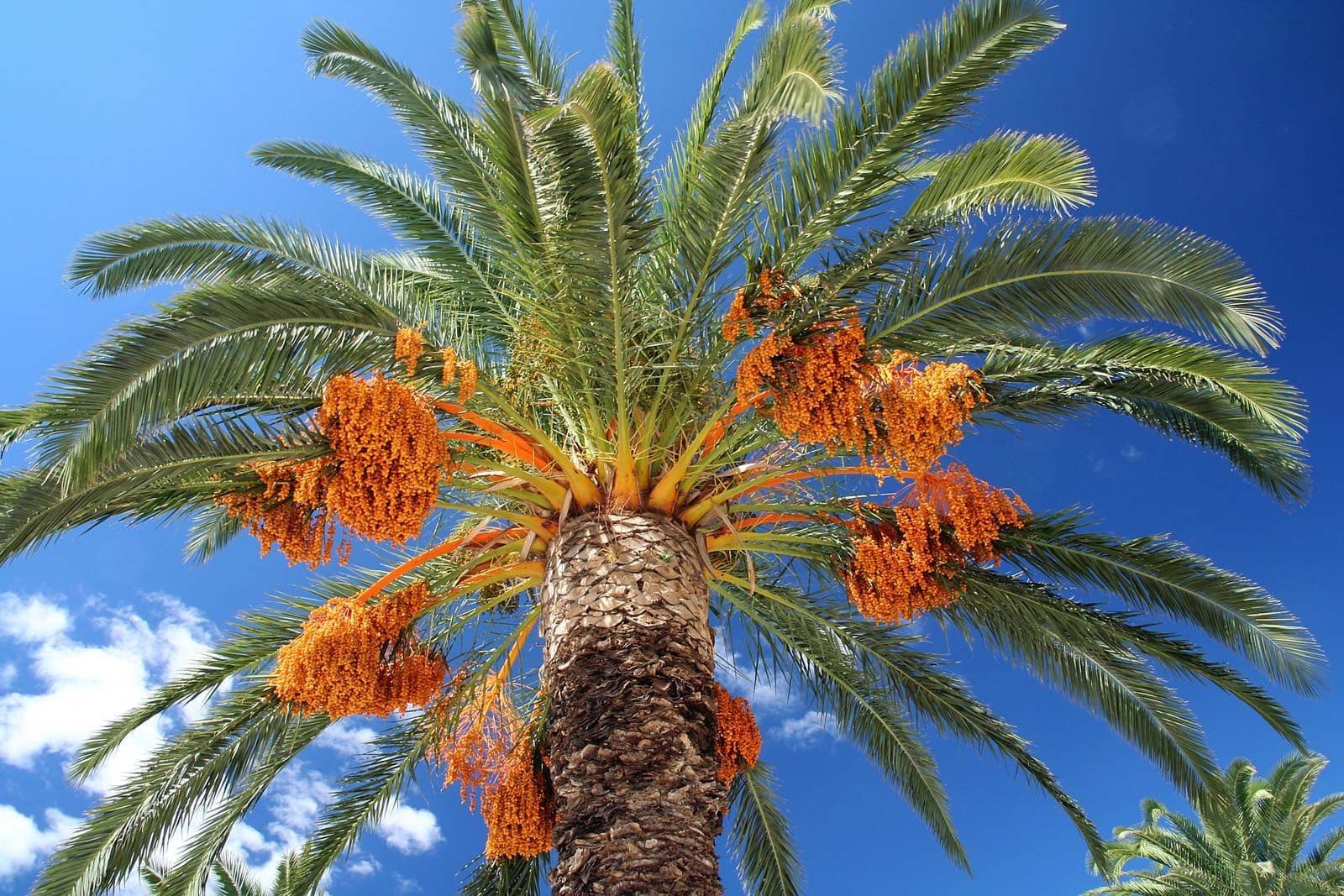

Date Palm, scientifically known as Phoenix dactylifera, is a fruit-bearing tree species cultivated for its sweet edible fruits. The tree is a member of the palm family Arecaceae and is native to the Middle East and North Africa. However, its cultivation has spread to other parts of the world, including North America, South Asia, and Australia.
The date palm is a tall tree, typically reaching a height of 15-25 meters, and has a lifespan of over 100 years. It has a solitary trunk covered with diamond-shaped leaf scars and topped with a crown of pinnate leaves. The leaves are 3-5 meters long, with numerous leaflets. The tree is dioecious, meaning male and female flowers are borne on separate trees. The flowers are small and yellow, and the fruit, known as a date, is an oval drupe, containing a single seed.
Dates are a significant traditional crop in Iraq, Arabia, and North Africa, where they are a staple food and an important part of the diet. The fruit is sweet, with a rich, deep flavor and a slightly wrinkled skin when dried. Dates are consumed in several ways, including fresh and dried. They are also used in cooking, baking, and in making beverages. Furthermore, they are a source of various essential nutrients, including dietary fiber, potassium, magnesium, and B-vitamins.
The date palm not only provides food but also materials for construction and craftwork. The trunk is used for construction, particularly in the making of roofs, doors, and windows. The leaves are used for making baskets, mats, brooms, and other household items. Moreover, the tree's sap can be tapped and made into palm wine or fermented to produce vinegar.
Cultivation of date palms is an ancient practice, dating back thousands of years. They are thought to have been cultivated as early as 4000 BC in ancient Mesopotamia. The trees are well-adapted to arid environments, with a deep root system that allows them to access groundwater and withstand periods of drought. They also tolerate high temperatures and are relatively resistant to pests and diseases.
Propagation of date palms is usually by seeds or by offshoots. The offshoots are small trees that grow at the base of the mother tree. They are separated from the mother tree when they are a few years old and then transplanted. Seed propagation is not commonly used in commercial plantations as it does not guarantee the quality of the fruit or the sex of the tree. However, it is used for establishing new plantations or for ornamental purposes.
Mature date palms start bearing fruit at around 4-8 years, and full production is achieved at around 10-15 years. They can continue to produce fruit for more than 100 years. The trees require regular watering and fertilization to achieve optimal growth and fruit production. They are also pruned regularly to maintain their shape and to improve fruit quality.
Despite their hardiness, date palms can be affected by a number of pests and diseases. These include the date palm weevil, the date moth, and various fungal and bacterial diseases. Integrated pest management strategies, including the use of natural predators, pesticides, and cultural practices, are used to control these threats.
Over the years, the date palm has acquired significant cultural and symbolic importance. It is often associated with life, fertility, and abundance in many cultures, particularly in the Middle East. It is also a symbol of hospitality and is often offered to guests as a sign of welcome. In addition, it has religious significance in several religions, including Islam, where it is mentioned several times in the Quran.
In conclusion, the date palm is a remarkable tree with a long history of cultivation. It is a source of food, materials, and has cultural and symbolic significance. Its resilience to harsh climatic conditions and its ability to provide sustenance in arid regions make it an invaluable resource, particularly in regions where food security is a challenge. The date palm is truly a tree of life in the desert.
Date palms, scientifically named Phoenix dactylifera, have been a staple crop in the Middle East for thousands of years. Their sweet fruit, the date, is a nutrient-rich food that has been a key source of sustenance for people in arid regions. Over time, humans have found a multitude of uses for the date palm, ranging from food to construction materials, and have developed ways to cultivate and harvest this versatile plant.
The fruit of the date palm, the date, is consumed fresh or dried and is a primary food source in many parts of the world. In addition to being rich in fiber, dates are packed with essential nutrients like potassium, magnesium, and vitamins. They are often used in baking and cooking as a natural sweetener or as a standalone snack. Date syrup, also known as date honey, is a common sweetener in Middle Eastern cuisine.
But the fruit is not the only part of the date palm utilized by humans. The leaves and trunk of the date palm have been used as building materials for centuries. The strong, flexible fronds were traditionally used to weave baskets, mats, and other items, while the trunk was used to construct houses and furniture. Even today, date palm wood is a common material in some types of traditional Middle Eastern architecture.
Beyond food and construction, date palms have cultural and religious significance in many societies. In Islamic culture, dates are traditionally eaten to break the fast during Ramadan. In the Bible, date palms are mentioned as symbols of prosperity and peace. In many Middle Eastern and North African cultures, the date palm is a symbol of hospitality and welcome.
Modern science has also found uses for the date palm. The plant is currently being studied for its potential in carbon sequestration, a process to capture and store atmospheric carbon dioxide to mitigate global warming. Moreover, date palm extracts have been studied for their potential medicinal properties, including antioxidant, anti-inflammatory, and antimicrobial activities.
Over the centuries, humans have also developed methods to cultivate and harvest date palms. Traditional methods include planting the offshoots that grow at the base of the mother palm. More recent techniques involve tissue culture, a process where small pieces of the date palm are taken and grown in a controlled environment to produce new plants. This allows for faster propagation and the potential to select for desirable traits.
Harvesting dates is a labor-intensive process that requires skilled laborers. The fruit is often hand-picked from the tall trees using long poles or by climbers. After harvest, the dates are typically sun-dried and then stored for later use. Some date varieties are also processed into products like date sugar, date vinegar, and date liquor.
In conclusion, human interaction with date palms is extensive and multifaceted. From a primary food source to a potential tool against climate change, the date palm continues to be an important part of human culture and economy. Its versatility and adaptability to harsh conditions have made it a staple in arid regions and a symbol of life and prosperity. As we continue to explore and understand the potentials of this remarkable plant, it is clear that the date palm will continue to serve humanity for years to come.
The date palm, scientifically known as Phoenix dactylifera, has a profound cultural and symbolic significance in many societies across the world, particularly in the Middle East and North Africa. It is not just a tree that bears delicious fruits, but a symbol of life, prosperity, and endurance that holds a deep-rooted place in various cultures and traditions. The date palm is one of the oldest trees on earth, with a history dating back over 5000 years, and its cultural significance has been equally long-lasting.
In many Middle Eastern and North African cultures, the date palm is seen as a symbol of hospitality, rest, and peace. It is often depicted in ancient art and architecture, and its branches were used in religious ceremonies. The date palm is mentioned numerous times in the Quran, the holy book of Islam, where it is described as a heavenly tree and used as a metaphor for the righteous. In Christianity, the date palm is associated with Palm Sunday, a significant religious event that commemorates Jesus' triumphant entry into Jerusalem, where people laid down palm branches in his path.
In ancient Mesopotamia, the date palm was a sacred tree and a symbol of the god Ishtar, the goddess of love, fertility, and war. The date palm was also revered in ancient Egypt, where it was associated with the sun god Ra and the sky goddess Nut. The Egyptians used date palm leaves in their art and decoration, and the tree was often depicted in their murals and carvings.
The cultural significance of the date palm extends to its practical uses as well. For centuries, people have used all parts of the date palm, from its fruits to its leaves, for sustenance, shelter, and other practical purposes. The fruits, known as dates, are a staple food in many cultures, particularly in the Middle East and North Africa. They are high in fiber, vitamins, and minerals and are often used in traditional recipes and desserts. The leaves of the date palm are used for weaving mats, baskets, and other items, while the wood of the tree is used for building and fuel.
The date palm is also a symbol of resilience and survival. It is a tree that can withstand harsh desert conditions, including extreme heat and drought, and still produce nourishing fruit. This ability to thrive in challenging environments has made the date palm a symbol of endurance and perseverance in many cultures. It serves as a reminder that life can flourish even in the harshest of conditions.
In recent years, the date palm has also become a symbol of cultural heritage and identity. In 2009, the United Nations Educational, Scientific, and Cultural Organization (UNESCO) added the date palm to its Representative List of the Intangible Cultural Heritage of Humanity. This recognition underscores the cultural significance of the date palm and its vital role in human societies throughout history.
In conclusion, the date palm holds a profound cultural and symbolic significance that transcends its practical uses. It is a tree that has been revered and respected for millennia, and its influence can be seen in art, religion, and everyday life. The date palm is more than just a tree; it is a symbol of life, prosperity, endurance, and cultural heritage that continues to inspire and sustain people around the world.
The aesthetic appeal of the date palm is undeniable. Its slender, towering trunk, crowned with a burst of feathery fronds, commands attention in any landscape. These trees are a symbol of the tropics and subtropics, where they have thrived for thousands of years. The date palm is not just about looks; there is a rich sensory experience involved in its cultivation and consumption.
The trunk of the date palm is a study in symmetry, with its uniform, diamond-shaped pattern that is the result of leaf scars. This texture adds visual interest and a touch of exoticism. The fronds, radiating out from the top of the trunk, add movement and dynamism to the tree. Each frond is a complex structure of leaflets, arranged like feathers, that sway gently in the breeze. The color palette of the date palm is muted yet warm, with shades of brown, green, and gold interplaying beautifully. The aesthetic value of the date palm makes it a popular choice for landscaping in warm climates.
As the date palm matures, it produces clusters of fruits. The sight of these pendulous clusters, heavy with dates, is visually arresting. The fruits themselves are a rich, glossy brown when ripe, their sweetness hinted at by their luscious appearance. The process of harvesting dates adds another layer of visual interest, as workers must ascend the tall trunks to reach the fruit.
The date palm is not just pleasing to the eyes; it offers a unique tactile experience as well. The surface of the trunk, with its pattern of leaf scars, is fascinating to touch. The fronds, with their feathery leaflets, are smooth and cool. The dates themselves have a distinctive texture, a combination of the smooth, shiny skin and the soft, chewy flesh within.
The taste of a ripe date is an experience in itself. There is an initial burst of sweetness, followed by a hint of caramel and a complex array of flavors that can include notes of honey, cinnamon, and vanilla. The experience of eating a date is not just about the taste; there is also the unique sensation of biting into the soft, yielding flesh, and the slight resistance of the skin. The aftertaste is pleasantly sweet and lingers on the palate.
The cultivation of the date palm is a time-honored tradition that involves skill, patience, and an intimate knowledge of the tree. The process of pollination, for example, is usually done by hand. This involves transferring pollen from the male trees to the female trees, a delicate task that requires precision and care. The harvest, too, is a labor-intensive process that requires skill and experience. Observing these processes is a fascinating experience that offers insight into the dedication and effort that goes into each cluster of dates.
The date palm is more than just a tree; it is a symbol of life and fertility. Its aesthetic and experiential appeal lies not just in its physical beauty, but also in the rich cultural and historical significance that it holds. For thousands of years, the date palm has been revered and respected, its fruits enjoyed for their rich flavor and nutritional value. The date palm is a testament to the beauty and resilience of nature, and a symbol of the enduring appeal of the tropics.
The date palm is an integral part of the cultural, economic, and social life of many regions. In these areas, the date palm is not just a tree, but a source of life and sustenance. The tree provides shade and shelter, and its dates provide food. The date palm is deeply ingrained in the culture and traditions of these regions, adding another layer to its experiential appeal. The tree is celebrated in festivals, its dates are offered as gifts, and its leaves are used in traditional crafts. The date palm is not just a part of the landscape, but a part of life itself.
In conclusion, the aesthetic and experiential appeal of the date palm is multi-faceted. It is a visual delight, a tactile experience, a gustatory pleasure, and a cultural treasure. The date palm is a testament to the beauty, versatility, and resilience of nature. Its appeal transcends borders and cultures, making it a truly global icon.