Introduction

Ram, sometimes spelled Rama, is a highly revered figure in Hindu mythology and is a central character in the Ramayana, one of Hinduism's two great epics. Known as the ideal hero, he embodies virtues such as righteousness (dharma), loyalty, bravery, and compassion. Ram is regarded as the seventh incarnation (avatar) of the god Vishnu, who takes various forms to maintain cosmic order and combat evil forces. His narrative focuses on his exile from his kingdom, the kidnapping of his wife Sita, and his ultimate triumph over the demon king Ravana.

Widely respected, particularly within Vaishnavism, Ram is portrayed as an exemplar of virtue and moral integrity. His character reflects courage and an unwavering commitment to ethical principles, even amidst significant challenges. The story of Ram, primarily delivered through the Ramayana, showcases his heroic journey and the lessons of loyalty and righteousness that resonate deeply within Hindu culture.
 

Significance

The name "Ram" embodies profound meanings, often interpreted as "one who is divine bliss," "one who delights," or "the source of joy," derived from the root "ram," which signifies "to please" or "to delight." Chanting this name is considered highly auspicious in the Hindu faith, reflecting its profound significance in devotion. Ram is deeply revered in Hinduism, and his name symbolises purity, familial respect, and a strong sense of duty. He is known as Maryada Purushottama, or "the supreme being who respects the boundaries of dharma." He is celebrated as a model of ideal kingship, representing wisdom and fairness in governance.

Appearance and Iconography

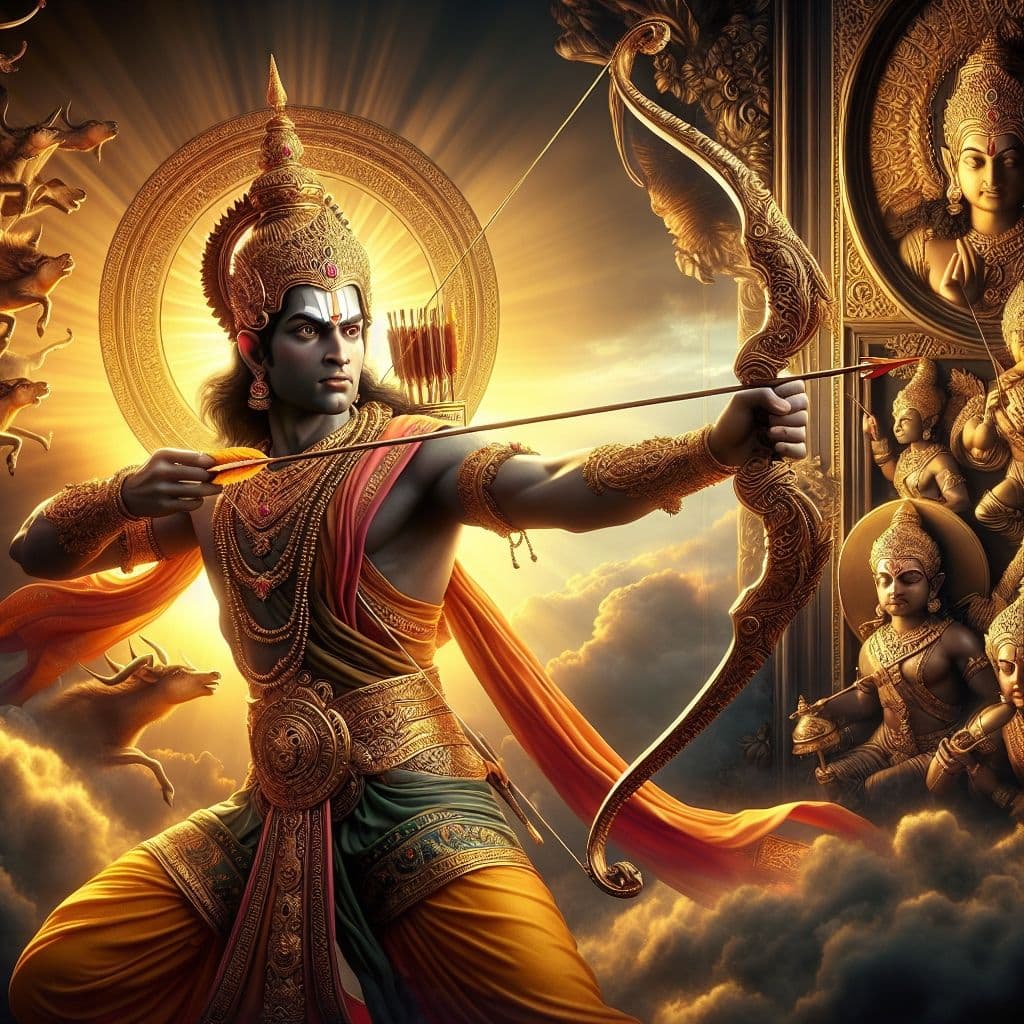
Ram is often portrayed as a handsome and youthful prince, embodying a serene and compassionate demeanour. His iconography frequently includes a bow and arrows, reflecting his indomitable warrior spirit. Additionally, he is depicted wearing a crown, symbolising his noble lineage. In many representations, he is accompanied by his loyal brother, Lakshman, Hanuman, and his beloved wife, Sita, highlighting the strength of his character and the profound bonds he shares with others.

  • Ram's portrayal of a blue or dark complexion embodies a divine essence, often linked with Vishnu, though he may also shine with a fair complexion. This divine essence invokes a sense of reverence and awe in those who contemplate his form. 
  • Adorned in royal attire, he reflects a princely status that inspires nobility. 
  • Holding the bow known as Kodanda, along with his arrows, Ram stands as a symbol of strength and unwavering commitment to conquering evil. Revered as "Kodandapani," he embodies a readiness to defend righteousness, instilling a sense of security in those who look up to him. 
  • With a quiver of arrows by his side, Ram is depicted upright, often with Sita and Lakshmana, forming the Ram Parivar, a vision of unity and strength. This unity and strength of the Ram Parivar inspire those who seek to build strong and harmonious relationships. 
  • In moments of exile, his matted hair represents an ascetic life in the forest, a testament to resilience. 
  • Crowned with a Vaishnava tilak on his forehead, he inspires devotion and purpose.
Historical Narratives and Roles

The epic of Ramayan, penned by sage Valmiki, unfolds Ram's extraordinary life and accomplishments, born to King Dasharatha and Queen Kausalya in Ayodhya. His birth, a divine purpose, sets the stage for a journey of duty and righteousness. As the narrative progresses, Ram's exile to the forest becomes a pivotal moment leading to the demon king Ravana's abduction of his beloved wife, Sita. In the face of adversity, Ram exemplifies the ideals of a devoted son and a loyal husband, fiercely upholding the principles of Dharma. Joined by his brother Lakshman and the monkey god Hanuman, he courageously battles the forces of evil, ultimately restoring justice and rescuing Sita. Ram's journey is a powerful testament to an unwavering commitment to righteousness and duty, inspiring us all to persevere in our struggles.

  • Birth and Childhood: The epic begins with Ram, the eldest son of King Dasharatha of Ayodhya. Ram displayed virtues and skills that marked him for greatness from his early years, setting the stage for his future exploits.  
  • Marriage to Sita: He demonstrated his strength and determination by winning Sita's hand in a swayamvara, triumphantly stringing and breaking Shiva's unbreakable bow.  
  • Exile: In a poignant act of honour, Ram accepted the fourteen-year exile decreed by his father's promise to Kaikeyi. This journey was made bearable by the unwavering support of Sita, his beloved wife, and his loyal brother, Lakshmana, who stood by him through thick and thin.  
  • Life in the Forest: The exile was not a period of waiting but growth and learning. Rama, Sita, and Lakshmana faced numerous challenges in the forest, forging deep connections with sages and forest dwellers, enriching their journey and teaching them valuable lessons.  
  • Abduction of Sita: Driven by lust and revenge, the demon king Ravana abducted Sita and took her to his kingdom of Lanka, igniting a valour quest.  
  • Alliance with Hanuman and the Monkey Army: Ram forged a robust partnership with the Vanara army, led by the devoted Hanuman and Sugreev, uniting forces to rescue Sita.  
  • Battle against Ravana: The epic climaxes with the battle between Ram's righteous army and Ravana's dark forces. This epic battle culminates in Ram's triumph, marking the victory of good over evil.  
  • Return to Ayodhya: Following his victory, Rama, Sita, and Lakshmana returned to Ayodhya, where Rama was crowned king, embodying the ideals of justice and duty.  
  • Just and Righteous Rule: Ram's reign, known as Ram Rajya, is a beacon of perfect justice, prosperity, and harmony, inspiring future generations.  
  • Later Life and Departure: The latter parts of the Ramayan portray Ram's continued resilience through trials, leading to his eventual noble departure from the mortal realm.  
Regional Variance

Ram is revered throughout India, with portrayals and emphasis on his life varying from region to region. While his fundamental story remains consistent across India and Southeast Asia, diverse interpretations illuminate unique facets of his character. These interpretations create a rich tapestry of traditions and practices that not only inspire but also serve as a unifying force, connecting communities at a local level.

  • North India: The Ramayan tradition embodies profound significance in India with its vibrant and energetic celebrations. It is celebrated through countless temples and vibrant festivals honouring Lord Ram. Among the most cherished customs is the Ramlila, a dramatic re-enactment of the Ramayan that captivates hearts. In Ayodhya, Ram's birthplace, the celebrations resonate deeply, marking his return from exile and his triumph over the demon king Ravana during the joyous festival of Diwali. In Madhya Pradesh, Chhattisgarh, and Uttar Pradesh, the Ram Leela emerges as a vital cultural treasure, weaving narratives of courage and virtue. 
  • In South India, the Ramayan shines through distinctive regional adaptations, particularly Kamban's Ramavataram in Tamil, offering fresh perspectives and rich details of the epic. Here, Lord Ram is revered across the land, with a unique emphasis on his bond with Hanuman and his steadfast devotion to Sita, showcasing a beautiful cultural interpretation of these beloved figures. 
  • East India presents a tapestry of diverse versions and interpretations, where local deities intertwine with the Ram narrative, enriching the tradition further. 
  • Southeast Asia feels the powerful influence of the Ramayan, as it permeates the cultures of Thailand (Ramakien), Indonesia (Kakawin Ramayan, Wayang Kulit), Malaysia (Hikayat Seri Rama), and Cambodia (Reamker). The local adaptations of the Ramayan in these regions reflect moral lessons and timeless themes, underscoring the enduring relevance of this epic. 
  • In Sri Lanka, Ram is highly esteemed, especially in regions linked to the epic, like Ravana's kingdom, where the Ramayan continues to inspire and connect hearts across generations.
Incarnations

Ram is the revered seventh avatar of Vishnu in Hindu tradition, a powerful embodiment of the divine purpose to uphold Dharma and restore cosmic balance. His inspiring narrative unfolds in the Ramayan, where he bravely confronts the demon king Ravana, whose overwhelming power threatens this harmony. Ram exemplifies righteousness and justice through his noble actions, fulfilling Vishnu’s mission to vanquish evil and establish a harmonious reign on Earth. Uniquely, no further recognized forms of Ram make his story a profound representation of Vishnu’s divine intervention.

Text or epic-associated

Ram's life and teachings resonate deeply through the timeless texts and epic tales that inspire generations.

  • The Ramayan, attributed to the sage Valmiki, stands as a foundational epic of Indian literature and culture. It intricately weaves the inspiring story of Lord Ram. It delves deep into his life, adventures, and unwavering commitment to Dharma, embodying India's moral and cultural values. Ram's influence extends beyond this narrative, enriching various texts that explore his character and teachings.
  • The 'Ramcharitmanas,' penned by Tulsidas in the 16th century, is a celebrated rendition of the Ramayan in the Awadhi dialect of Hindi. This work, focusing on Lord Ram's divinity and the profound importance of devotion, resonates powerfully in North India. Its use of vernacular language makes it accessible to a broader audience, ensuring that the narrative of Ram's life and teachings is inclusive and far-reaching.
  • The Ramayan has inspired numerous regional adaptations in various Indian languages, offering unique perspectives and literary styles. Works such as Kamban's 'Ramavataram' and Krittibas Ojha's Bengali Ramayan enrich the narrative of Ram's life, each with its distinct interpretation. The Puranas, ancient Hindu scriptures, further emphasize his significance as an avatar of Vishnu, depicting him as an incarnation of Vishnu and a moral example for humanity. Through these diverse accounts, Ram emerges as a divine figure and a beacon of virtuous living, enriching the narrative with various interpretations.
  • While not solely focused on Ram's story, the Upanishads contain philosophical concepts that resonate deeply with the ideals he embodies. The Bhagavad Purana, although primarily centered on Krishna, underscores the significance of Dharma and righteous action—central themes in Ram's life. Though the Ramayan remains the primary narrative of Ram's story, the Bhagavata Purana acknowledges his incarnation and vital role in the cosmic order

With its profound narrative and accompanying tales, Ram's story has significantly influenced literature, culture, and religious practices across India and beyond. It showcases the triumph of good over evil, the importance of duty, and the principles of righteous living. This wide-ranging influence underscores that Ram has become a symbol of virtue, integrity, and justice, permeating every aspect of life.


References

Encyclopedic and General Knowledge Sources

Wikipedia – Rama
https://en.wikipedia.org/wiki/Rama

Britannica – Rama: Hindu Deity
https://www.britannica.com/topic/Rama-Hindu-deity

Institutional & Museum Sources

Indian Culture and Heritage Portal – Ministry of Culture, Govt. of India
https://www.indianculture.gov.in/

British Library – Stories of Rama in Manuscripts
https://www.bl.uk/learning/cult/sacredbooks/hindu/ramayana/ramayanastories.html

British Museum – Images and Sculptures of Rama
https://www.britishmuseum.org/collection/term/BIOG60091

Metropolitan Museum of Art – The Ramayana in Indian Art
https://www.metmuseum.org/art/collection/search#!?q=Rama

Art UK – Rama Depictions
https://artuk.org/discover/artworks/search/keyword:rama

Scriptural and Devotional Texts

Valmiki Ramayana – Full Text and Commentary
https://www.valmikiramayan.net/

Tulsidas’ Ramcharitmanas (translated)
https://www.hindupedia.com/en/Ramcharitmanas

Adhyatma Ramayana (Spiritual Ramayana)
https://www.wisdomlib.org/hinduism/book/adhyatma-ramayana

Bhagavata Purana – Accounts of Rama as Vishnu's Avatar
https://www.wisdomlib.org/hinduism/book/srimad-bhagavatam

The Mahabharata – Mentions and Teachings of Rama
https://www.sacred-texts.com/hin/maha/

Festivals and Worship

Rama Navami – Birth of Lord Rama
https://www.drikpanchang.com/festivals/ram-navami/ram-navami-date-time.html

Times of India – Celebrations of Rama Navami
https://timesofindia.indiatimes.com/life-style/ram-navami

ISKCON – Worship of Rama and the Ramayana Tradition
https://iskconnews.org/tag/ramayana/

Share with friends

Ram, also known as Rama, is the seventh avatar of Lord Vishnu, widely worshipped in Hinduism. He is the main character in the epic Ramayana. He is considered to be the perfect man or the supreme being in various cultures. His weapon of choice is a bow and arrow.
BackgroundImage
Weapon
Bow and Arrow
Symbol
Dharma, Virtue, Royalty
Mount
Horse or Chariot
Consort
Sita
Festivals
Rama Navami, Diwali