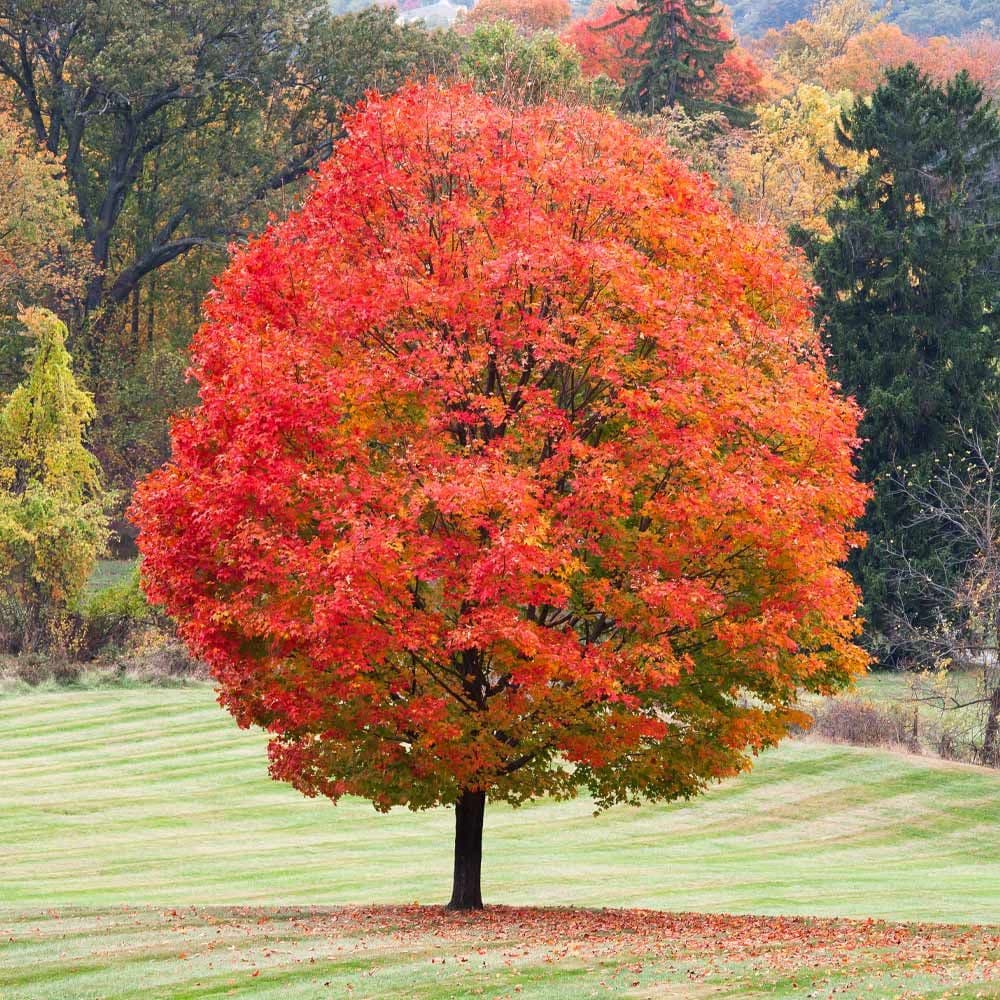

The Sugar Maple, scientifically known as Acer saccharum, is a species of maple native to the hardwood forests of eastern Canada, from Nova Scotia west through southern Quebec, central and southern Ontario to southeastern Manitoba around Lake of the Woods, and the northern parts of the Central and Eastern United States, from Minnesota eastward to the highlands of the eastern states.
It is recognized by its distinctive leaf shape, which is represented on the Canadian flag. The leaves of the sugar maple are deciduous, meaning they fall off in the autumn. They are 3 to 5 lobed with irregular serrated edges, and they turn a brilliant red or orange color in the fall, making sugar maple one of the trees that contribute to New Englands famed fall foliage.
The sugar maple is known for its quality hardwood and the production of maple syrup, which is a significant economic contribution. The tree's sap is gathered in the late winter and early spring, and it is then boiled down to produce maple syrup. It takes about 40 gallons of sap to make one gallon of syrup. The syrup is not only used as a natural sweetener but also in baking and cooking.
The wood of sugar maple is one of the hardest and densest of the hardwoods, making it a popular choice for furniture, flooring, and cabinetry. It is also used to make musical instruments like violins and guitars because of its excellent resonance qualities. The tree can grow up to 35 meters (115 feet) tall and can live for up to 400 years.
Sugar maples are also important ecologically. They are a food source for various wildlife species. Squirrels feed on the seeds, buds, twigs, and leaves, while cavity-nesting birds and squirrels also use the trees for nesting. In addition, the tree provides habitat for various insects and caterpillars, which are in turn a food source for birds.
Despite its many benefits, the sugar maple faces several threats. The tree is sensitive to air pollution, salt, and compacted soil. Acid rain, in particular, can leach away necessary nutrients in the soil and make the tree more susceptible to stress and disease. In recent years, the Asian longhorned beetle has also become a significant pest, boring into the trunks of sugar maples and other trees, often causing significant damage and tree death.
Efforts are ongoing to protect and preserve sugar maple populations. These include monitoring for disease and pests, protecting trees from damage during construction, and planting trees in suitable locations where they can thrive. Research is also being conducted to develop more disease-resistant varieties.
In terms of cultural significance, the sugar maple has long been a symbol of strength and endurance. Its leaf is featured on the Canadian flag, and it is the state tree of New York, West Virginia, Wisconsin, and Vermont. The tree is also celebrated in festivals and events throughout its range, particularly in connection with the maple syrup industry.
In conclusion, the sugar maple is a vital component of North Americas forests. Its economic contributions through the maple syrup industry and hardwood production, as well as its ecological importance, make it a truly valuable species. Its vibrant autumn colors also add to the aesthetic beauty of the landscapes it inhabits. Despite facing a number of threats, efforts are ongoing to ensure the survival of this remarkable tree for future generations to enjoy.
Sugar Maple, scientifically known as Acer saccharum, is a species of maple native to the hardwood forests of northeastern North America, from Nova Scotia west through Quebec and Ontario to southeastern Manitoba around Lake of the Woods, and south to northern Florida and Texas. It is recognized by its distinctively sharp, brown buds and its five-lobed leaves. The sugar maple is one of Americas most-loved trees, with its fiery fall color and the sweet sap that is the primary ingredient for maple syrup.
One of the most significant human uses of sugar maple is for the production of maple syrup. The sap of the sugar maple is preferred for syrup production because it has an average sugar content of 2.2 percent, while other maple species have sap with a sugar content of 1.7 percent. This sugar content allows producers to make more syrup per gallon of sap. Furthermore, the sugar maple sap has a unique, delicate flavor that is prized in maple syrup. The process of making maple syrup involves tapping the trees in late winter or early spring, collecting the sap, and then boiling it down to remove the water and concentrate the sugars. This syrup is then filtered and bottled. It is a significant industry in regions where sugar maples are common, such as New England and the Great Lakes regions.
Sugar maple wood is also highly valued. It is dense, hard, and has a fine grain, which makes it excellent for a variety of uses. It is used in furniture making, flooring, cabinetry, and millwork. Sugar maple wood is also used in the production of musical instruments such as violins, guitars and piano frames. The wood is also favored for making bowling pins, bowling alley lanes, pool cue shafts, and butcher's blocks because of its resistance to wear and splintering. Moreover, sugar maple charcoal is an important component in the production of Tennessee whiskey.
Additionally, sugar maples are often planted as ornamental trees because of their impressive fall foliage. The leaves turn a variety of brilliant colors, including bright yellow, orange, and fiery red. This makes them a popular choice for landscape design in parks, campuses, and residential areas. They also provide excellent shade due to their dense canopy.
Despite their benefits, human interaction with sugar maples is not always positive. They are sensitive to air pollution, soil compaction, and road salt, all of which are common in urban and suburban environments. This vulnerability has led to a decline in sugar maples in some areas. Efforts are being made to plant sugar maples in more suitable environments and to closely monitor their health.
Furthermore, climate change is also impacting sugar maples. Rising temperatures can affect the timing and volume of sap flow, which in turn impacts syrup production. Warmer winters can also lead to increased pest and disease problems. Research is being done to understand these impacts and develop strategies to help sugar maples adapt.
Historically, sugar maple has had cultural significance for Native American tribes, who were the first to discover the sap's sweet properties. They also used the tree's wood for various purposes, including tool making and construction. Today, the sugar maple continues to hold cultural importance. It is the state tree of several US states, including New York, Vermont, West Virginia, and Wisconsin. It is also featured on the Canadian flag, symbolizing strength and endurance.
In conclusion, the sugar maple tree has a long history of human use and interaction. Its sap and wood have been valuable resources, and its beauty has been appreciated in natural and landscaped settings. However, human activities are also posing challenges to this beloved tree, and efforts are needed to ensure its continued health and survival.
The sugar maple, scientifically known as Acer saccharum, holds significant cultural and symbolic meanings across various regions and communities. This tree is renowned not only for its majestic beauty but also for the numerous benefits it offers, including providing the sap for making the world-famous maple syrup. In terms of cultural significance, the sugar maple tree is deeply rooted in the lives and traditions of the indigenous peoples of North America, particularly those living in the Northeastern regions where the tree is native. For these communities, the tree has been a vital resource for centuries.
The Native American tribes, such as the Iroquois and the Ojibwa, have a special place for the sugar maple in their culture, folklore, and traditional practices. They were the first to discover the sweet sap of the tree and developed the method of turning it into syrup and sugar. The process of tapping the trees and making the syrup was an important annual tradition, marking the end of winter and the arrival of spring. The maple sugar was used not only as a sweetener but also as a key ingredient in various traditional dishes. The wood of the tree was also used for making a variety of tools and items.
Symbolically, the sugar maple tree represents strength and endurance, owing to its ability to withstand harsh climates and its long lifespan. The tree is also seen as a symbol of love and longevity in various cultures. In Native American symbolism, the sugar maple tree is associated with the Moose, one of their many animal totems, representing gentleness and strength. In the Celtic tree alphabet, known as Ogham, the maple tree symbolizes balance and promise, and is associated with the moon and the energy of the Goddess.
In addition to its cultural and symbolic significance, the sugar maple tree also holds a special place in the history and identity of Canada. The maple leaf, which is a distinctive feature of the tree, is a national symbol of Canada and features prominently on the countrys flag and coat of arms. The maple leaf is also used as a symbol by various Canadian organizations and entities, including the Canadian Armed Forces and the Royal Canadian Mint. The tree itself, along with its syrup, is considered an integral part of Canadian culture and heritage.
Furthermore, the sugar maple tree is also significant in the United States, particularly in the Northeastern states where it is native. In these regions, the tree is celebrated for its vibrant fall colors and its contribution to the local economy through the production of maple syrup. The state of Vermont, for instance, has adopted the sugar maple as its state tree and the maple tree is also the state tree of Wisconsin, New York, and West Virginia. The annual maple syrup festivals in these regions are a testament to the trees cultural importance.
Moreover, the sugar maple tree has been featured in various forms of art and literature, further highlighting its cultural and symbolic significance. From paintings and photographs showcasing the trees stunning fall colors to poems and songs inspired by its beauty and offerings, the sugar maple has been a source of inspiration for artists and writers for centuries. In literature, the tree is often used as a symbol of home, stability, and natural beauty.
Finally, in the realm of environmental symbolism, the sugar maple serves as a potent symbol of the effects of climate change. The tree, which thrives in cooler climates, has been struggling to adapt to the rising temperatures and changing weather patterns brought about by global warming. The decline of sugar maple populations in certain areas serves as a stark reminder of the urgent need to address climate change.
In conclusion, the sugar maple tree is deeply woven into the cultural and symbolic fabric of North America. From its role in indigenous traditions to its status as a national symbol of Canada and its significance in the environmental dialogue, the tree stands as a testament to the enduring bond between humans and nature.
The Sugar Maple, known scientifically as Acer saccharum, is a tree that embodies beauty and utility, contributing to its high aesthetic and experiential value. The sugar maple is native to the hardwood forests of eastern North America, from Nova Scotia, west to southern Ontario, and south to Georgia and Texas. This tree is best known for its vibrant autumn foliage and the production of maple syrup, a sweet treat that has graced breakfast tables for centuries.
From an aesthetic point of view, the sugar maple offers stunning visual appeal. In the spring and summer, its leaves are a lush, vibrant green, providing a cooling canopy of shade. Then, as the year progresses into autumn, the leaves transform into a dazzling array of colors. Brilliant hues of yellow, orange, and fiery red adorn the tree, creating a spectacular display that has become synonymous with fall in many parts of the United States and Canada.
The aesthetic appeal of the sugar maple isn’t limited to its leaves. The tree itself, with its tall, robust trunk and spreading branches, presents an impressive, stately figure. The bark, a grayish-brown with deep furrows and ridges, adds texture and interest. The sugar maple's flowers, though perhaps less noticeable than its leaves, are also quite beautiful. They appear in early spring, even before the leaves, and are small, pale yellow, and arranged in drooping clusters that flutter in the breeze.
Experientially, the sugar maple also has much to offer. It’s a tree that connects us to the natural world and to history. Many Native American tribes revered the sugar maple for its sweet sap, using it as a source of sugar and syrup. The process of tapping these trees for their sap and boiling it down to make syrup is an experience that many people associate with the late winter and early spring. It is a tradition that continues today, providing a unique sensory experience - the sight of the dripping sap, the sound of the boiling process, the smell of the steam, and of course, the taste of the sweet syrup.
The sugar maple is also a tree that invites exploration and interaction. Its sturdy branches are perfect for climbing and its broad, flat leaves are ideal for pressing and preserving. In the fall, the dropped leaves create a crunchy carpet that children love to play in, and that adults can’t resist kicking through. There’s something deeply satisfying about the sound of those crisp leaves underfoot, a sound that speaks to the changing seasons and the passage of time.
Additionally, the sugar maple has a significant role in woodworking. Its wood is dense, hard, and has a fine, uniform texture, making it highly desirable for furniture, flooring, and even musical instruments. The grain of the wood is typically straight, but can also be wavy or curly, resulting in interesting and beautiful patterns. This characteristic, along with the wood’s natural light color, lends an elegant aesthetic to any piece made from it.
In conclusion, the sugar maple is a tree that offers a wealth of aesthetic and experiential value. Its striking visual appeal, historical significance, and practical uses make it a truly remarkable species. Whether you are admiring its vivid autumn colors, tasting its sweet syrup, climbing its sturdy branches, or appreciating a piece of furniture made from its wood, the sugar maple is a tree that invites engagement and appreciation on many levels.