Why Is There Something Rather Than Nothing?
05 Feb 2026

This series originated from an extended, in-depth conversation between a human author and an artificial intelligence system.
Rather than hiding this fact, we chose to make it explicit.
The dialogue explored foundational questions about existence, reality, consciousness, science, faith, and the limits of human knowledge. As the conversation unfolded, it became clear that it formed a coherent philosophical trajectory, one worth consolidating, refining, and presenting as a structured series of essays.
The articles published here are not raw AI outputs. They are the result of:
- sustained human questioning,
- critical reflection,
- iterative clarification,
- and editorial curation.
The AI’s role was not to provide authority or hidden knowledge, but to act as a cognitive partner: organizing arguments, exposing assumptions, and helping articulate ideas already latent in human inquiry.
No claim is made that these texts deliver final answers. On the contrary, their purpose is to model intellectual honesty at the edge of explanation, where science, philosophy, and existential reflection meet, and where certainty is neither possible nor required.
Part 1 of 8
Why Is There Something Rather Than Nothing?
Every question we ask about the universe already assumes something fundamental: that there is a universe at all.
Before physics, before cosmology, before consciousness or meaning, there is a prior and unavoidable mystery:
Why does anything exist rather than nothing?
This is not a poetic question, nor a religious one by default. It is an ontological question — a question about being itself. And it is unsettling precisely because it resists the kinds of answers we are used to giving.
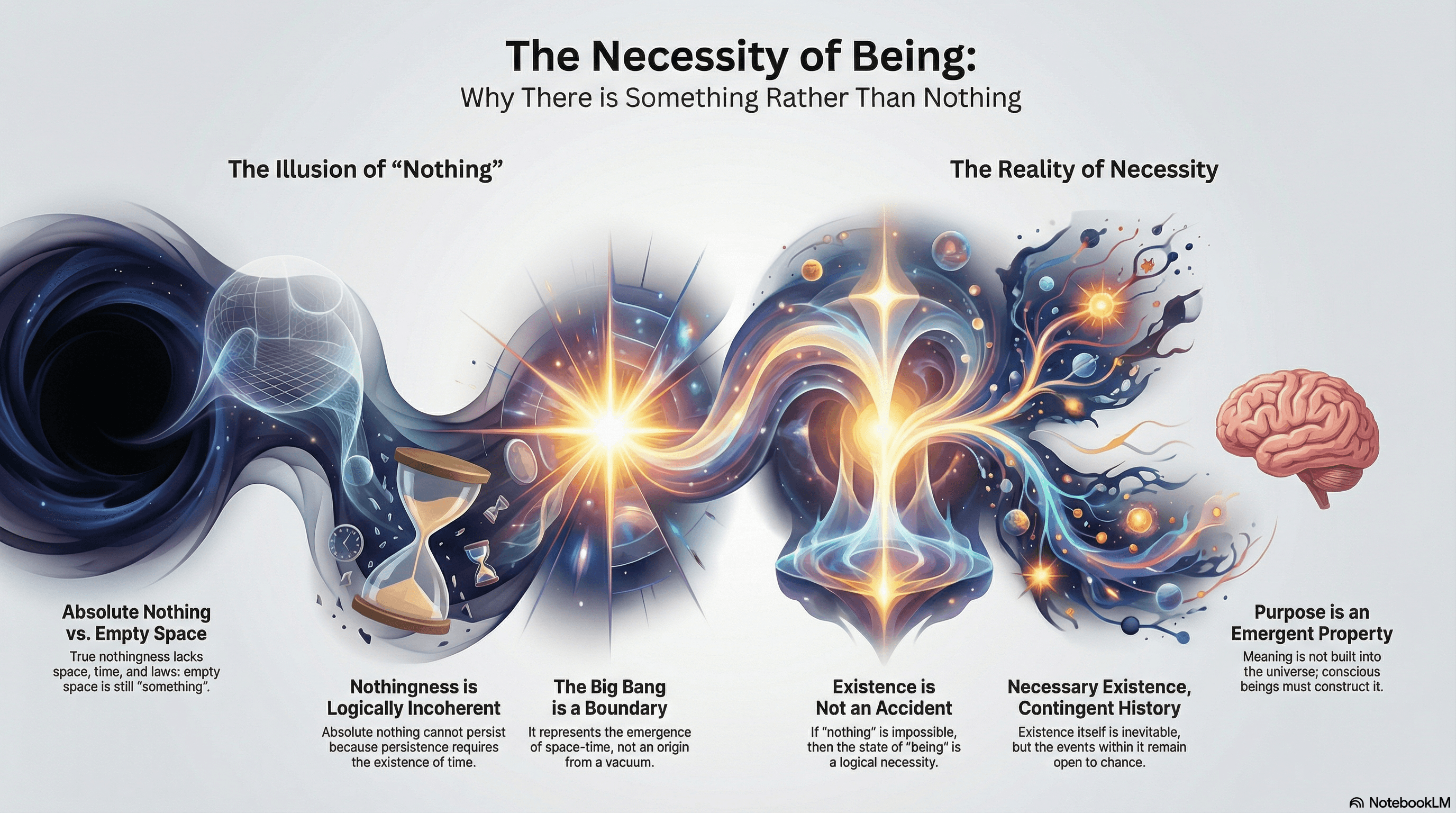
The Illusion of “Nothing”
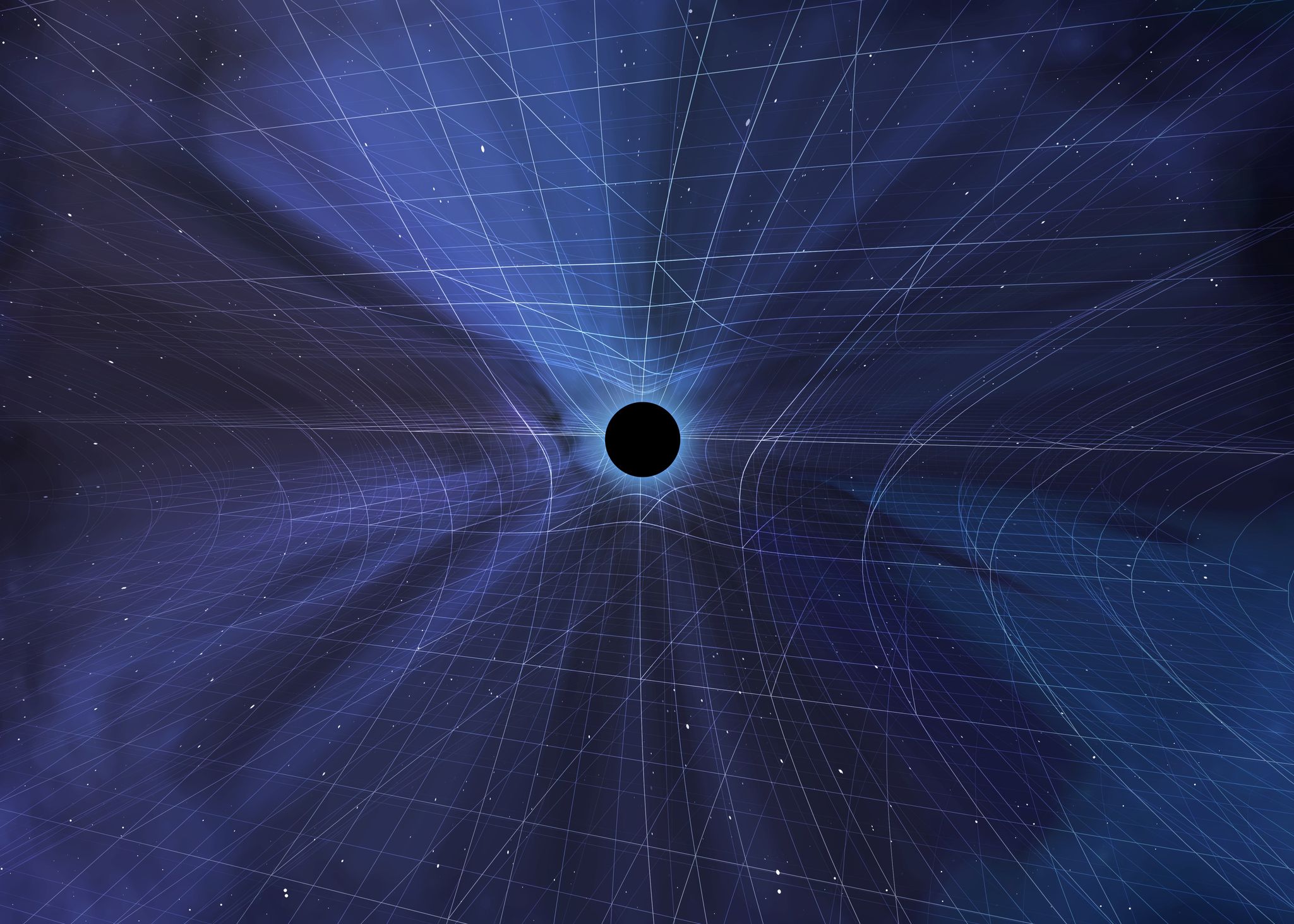
Most discussions stumble at the very beginning, because we misunderstand what “nothing” means.
When we imagine nothing, we often picture:
- empty space
- darkness
- a vacuum
- the absence of matter
But all of these are still something. Empty space has structure. A vacuum has laws. Darkness presupposes light.
A true absolute nothing would have:
- no space
- no time
- no laws
- no properties
- no stability
And here lies the first deep crack in our intuition:
Absolute nothing cannot even persist as nothing.
Persistence already assumes time. Stability assumes rules. “Nothing” has neither.
This leads to a disturbing but serious possibility:
absolute nothingness may be logically incoherent.
If Nothing Is Impossible, Is Existence Necessary?
Once this is taken seriously, the original question changes shape.
Instead of asking why something appeared, we are forced to ask:
Could there ever have been nothing at all?
If the answer is no, then existence is not:
a choice…
an accident…
a creation event…
It is necessary.
Not necessary because it was planned, but because non-existence may not be a coherent state.
This is not a scientific claim.
It is a philosophical one — and science is honest enough to admit its limits here.
Science explains how things behave once they exist.
It does not explain why existence itself exists.
The Big Bang Is Not an Ultimate Origin
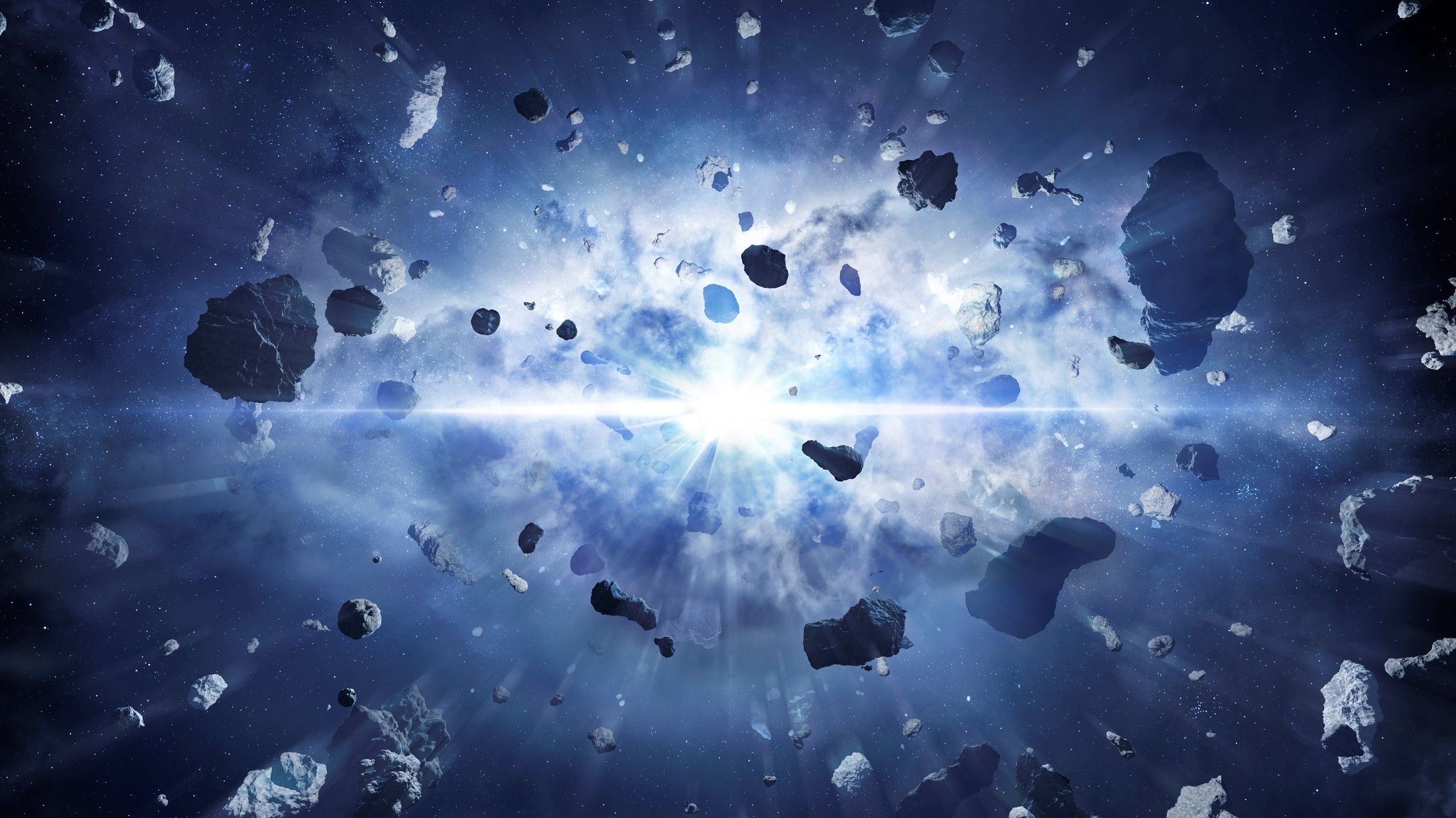
The Big Bang is often invoked as an answer, but it does not solve the problem.
The Big Bang was not:
an explosion in space
the creation of matter inside time
It was, according to our best models, the emergence of space and time themselves.
Asking what happened before the Big Bang is like asking what lies north of the North Pole. The question may simply not apply.
The Big Bang is therefore not a metaphysical beginning —
it is a boundary of our current understanding.
Was the Universe Created for a Purpose?
Modern science finds no evidence of intention encoded in the laws of nature.
There is no sign that:
the universe was designed for life
consciousness was a goal
meaning was built into the fabric of reality
But this does not imply nihilism.
It implies something more subtle and more demanding:
Purpose does not precede existence.
Purpose emerges within existence.
Meaning is not handed to us by the universe.
It is something that conscious beings must construct from within it.
Necessity Without Destiny
If existence is necessary, does that mean everything is predetermined?
No.
There is a crucial distinction between:
the necessity of there being something
and the contingency of what that something becomes
Existence may be inevitable, while everything inside it remains open:
evolution
chance
creativity
catastrophe
In this sense:
Existence may be necessary,
but history is not.
Where Knowledge Reaches Its Edge
Neither science nor philosophy provides a final answer here.
And that is not a failure.
Both converge on a sober conclusion:
The fact that anything exists at all cannot be explained by any existing thing.
Existence is not an event within reality.
It is the condition that makes events possible.
What This Question Ultimately Reveals
Perhaps the deepest insight is not an answer, but a shift in perspective.
The mystery is no longer:
Why does the universe exist?
But rather:
How did existence become complex enough to reflect on itself?
From matter to life.
From life to consciousness.
From consciousness to inquiry.
The fact that this question can be asked at all may be the most extraordinary consequence of existence — even if existence itself remains unexplained.
AI Dialogue Podcast
To explore these ideas further, we generated an experimental podcast conversation between two AI systems discussing the themes of this article.
The dialogue is not presented as an authoritative conclusion, but as an illustration of how artificial systems can already engage with philosophical questions
| The debate |
Next in the Series
Are the Laws of the Universe Discovered or Imposed?
Mathematics, constants, and whether reality could have been otherwise.
Share

Gonçalo Pereira
Gonçalo Pratas Pereira is an IT and technology leader with deep expertise in system integration, cloud computing, data infrastructure, and artificial intelligence. With a background in electronics and telecommunications engineering, his work focuses on connecting AI-driven systems, immersive technologies, and digital infrastructure with business strategy and real-world impact. He is particularly interested in how AI and emerging technologies can enhance education, cities, and large-scale digital transformation.